The Road to a Winning Project
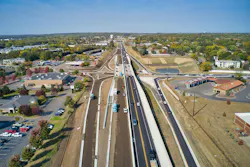
Roads & Bridges Top 10 Roads Awards has returned for the 2026 season. Construction crews, engineers and transportation agencies can enter for a chance to be named the #1 road project in the country until September 4.
Whether your team built a new roadway, rehabilitated a street or enhanced an existing corridor, we want to hear from you. Our trio of judges evaluate awards based on design, the use of technology, uniqueness, level of improvement over existing infrastructure, overcoming obstacles and collaboration with the community and stakeholders.
These are the top five roads our team selected last year after reviewing submissions from across the country.
No. 5: I-40 Widening Project (I-440 to Cornwallis Road) — Raleigh, N.C.
The I-40 Widening Project transformed one of North Carolina's busiest corridors to better serve the rapidly growing Raleigh region. The $440 million effort widened nearly 13 miles of interstate, upgraded and replaced 15 bridges and added two diverging diamond interchanges to improve traffic flow and safety. Despite complex construction constraints and work that spanned the COVID-19 pandemic, the project team kept traffic moving while delivering major capacity improvements. Innovative construction methods, including private access roads and material conveyor systems, helped reduce disruptions and improve safety throughout the project. The completed corridor has cut average commute times by 18 minutes each way and is positioned to accommodate future growth in one of the nation's fastest-growing metropolitan areas.
No. 4: 169 Redefine — Elk River, Minn.
The 169 Redefine project transformed a congested stretch of U.S. Highway 169 into a modern freeway designed to improve mobility, safety and freight movement through Elk River. The $123 million effort reconstructed 3.6 miles of roadway, replaced signalized intersections with grade-separated interchanges and added five new bridges. Using an innovative "roller coaster" design, the project reduced material hauling and construction costs while streamlining delivery. A highly collaborative CMGC approach between the Minnesota Department of Transportation, the city of Elk River, WSB and Ames Construction helped save nearly $6 million and accelerated completion by six months. The result is a safer, more efficient corridor that supports continued growth while serving as a showcase for innovative design and teamwork.
No. 3: I-69 Finish Line (Contract 5) — Indianapolis, Ind.
The I-69 Finish Line Contract 5 project marked the completion of a decades-long effort to create a continuous interstate connection between Evansville and Indianapolis. The $728 million project upgraded State Route 37 to interstate standards, added capacity along Interstate 465 and eliminated six at-grade intersections to improve safety and mobility. Through a highly collaborative design-build approach, the project team leveraged advanced technologies and innovative design solutions to keep the complex effort on schedule and on budget. The completed corridor has reduced travel times between Martinsville and Indianapolis while enhancing freight movement through one of the state's busiest transportation hubs. Beyond its transportation benefits, the project is expected to support billions in economic activity, making it a landmark investment in Indiana's future.
No. 2: METRO Gold Line Bus Rapid Transit — Minnesota
The METRO Gold Line Bus Rapid Transit project introduced Minnesota's first BRT line operating primarily in dedicated bus lanes, creating a faster and more reliable transit option across the Twin Cities east metro. The $247 million project includes 10 miles of dedicated guideway, 16 stations, multiple bridges, retaining walls and other supporting infrastructure connecting St. Paul to Woodbury. Extensive coordination among agencies, municipalities and utility owners helped keep the complex project on schedule and on budget. Designed to provide frequent all-day service, the Gold Line improves access to jobs, housing and key destinations while supporting future transit-oriented development. The completed corridor serves as a model for modern transit investment, enhancing regional connectivity and expanding transportation options for Minnesota residents.
No. 1: Hurricane Ian Sanibel Island Access — Lee County, Fla.
The Hurricane Ian Sanibel Island Access project transformed a devastating disaster into a model for resilient infrastructure. After Hurricane Ian destroyed the Sanibel Causeway in September 2022, the project team restored emergency access within days and ultimately delivered a permanent solution designed to withstand future major storms. The $328 million effort rebuilt and fortified the three-mile corridor using advanced coastal modeling, elevated roadways, strengthened seawalls and durable materials engineered for long-term performance. Innovative technology and an unprecedented level of collaboration helped accelerate construction, allowing the project to be completed ahead of schedule and under budget. Today, the causeway once again serves as the critical link between Sanibel Island and the mainland while standing as a national example of infrastructure resilience, emergency response, and community recovery.
This year’s winning projects could be just as transformative. If your team delivered a roadway project that improved mobility, strengthened safety, solved a complex challenge or made a lasting impact on the community it serves, now is the time to submit it for consideration. Roads & Bridges is looking for the projects that show what is possible when strong planning, innovation and collaboration come together on the road.
About the Author
 Jessica Parks, Staff Writer
Jessica Parks, Staff Writer
Staff Writer
Jessica Parks is a staff writer at Roads & Bridges with newsroom experience in Brooklyn, Long Island and the U.S. Virgin Islands, and several years spent living in Puerto Rico. She is currently based in Tulsa, Oklahoma.