Road No. 5: Building for Raleigh’s Future
In the heart of North Carolina, where Raleigh’s skyline rises and commuters weave between the state capital and its booming suburbs, a stretch of road has long been a lifeline and a headache. Interstate 40—one of the state’s busiest and most vital arteries—serves as the gateway from Johnston County to downtown Raleigh and beyond.
Over 110,000 vehicles travel this corridor each day. For years, congestion along the 12.8-mile span between Interstate-440 in Wake County and Cornwallis Road in Johnston County was a frustrating fixture. That changed with the completion of the I-40 Widening Project—a $420 million design-build effort by S.T. Wooten Corporation for the North Carolina Department of Transportation (NCDOT).
Ambitious in scale and innovative in execution, the project didn’t just expand a road—it reshaped the region’s mobility and set new benchmarks for efficiency, safety and environmental stewardship. For these reasons, the project placed fifth on our list of Top 10 Roads of 2025.
Home to 1.5 million people, the Raleigh region is the second-fastest growing metro area in the country. Wake County alone has surged past 1.2 million residents, making it North Carolina’s most populous county. Johnston County, immediately to the east, has seen a 36% population increase in the past decade. That explosive growth has turned what was once a suburban corridor into a regional lifeline for workers, industry and commerce.
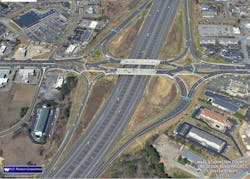
Because of that growth, the I-40 corridor became a bottleneck. The NCDOT’s solution—a six-year, multi-phase expansion—was as complex as it was critical: widening nearly 13 miles of interstate, upgrading or replacing 15 bridges, constructing two diverging diamond interchanges (DDIs), adding 10 noise walls and modernizing utilities and culverts throughout.
The challenge was immense: crews were never allowed to reduce lanes during the day, and daytime hauling was limited to the narrow window between 9 a.m. and 3 p.m. To keep traffic moving, the team executed dozens of meticulously timed traffic shifts.
S.T. Wooten leveraged adjacent property ownership to create private access roads and ramps, keeping construction vehicles out of live traffic. Conveyor systems moved materials across the site without clogging public lanes, improving safety and cutting emissions. These strategies were as innovative as they were effective.
When complete, the widened I-40 delivered immediate relief: average commute times dropped by 18 minutes each way. The highway now boasts shoulders ready for future expansion and includes one of the widest pavement sections in North Carolina—ten lanes across its broadest stretch.
Two new DDIs at North Carolina Highway-42 and Jones Sausage Road brought cutting-edge safety and efficiency to key interchanges. The latter interchange, added mid-project to accommodate rapid industrial growth (including a massive Amazon distribution center), required retrofitting an existing bridge—an uncommon and technically demanding feat completed just in time for Thanksgiving traffic in 2024.
Beyond the engineering, the I-40 project became a story of resilience. Construction spanned the COVID-19 pandemic, forcing crews to adapt to new safety protocols while maintaining progress.
The I-40 Widening Project represents as a forward-looking model for how infrastructure can evolve alongside population growth and economic expansion. By blending innovation with practicality—leveraging access efficiencies, pioneering construction methods and maintaining unwavering commitment under extraordinary circumstances—S.T. Wooten and NCDOT delivered a project that now serves as the gateway to one of America’s most dynamic metro areas.
Project: I-40 Widening: I-440 to Cornwallis Road
Location: Raleigh, N.C. (Wake and Johnston Counties)
Owner: North Carolina Department of Transportation
Designer: Rummel, Klepper & Kahl, LLP (RK&K)
Contractor: S.T. Wooten Corporation
Cost: $440 million
Length: 12.8 miles