Road No. 2: Minnesota’s Gold Line Redefines Transit Infrastructure
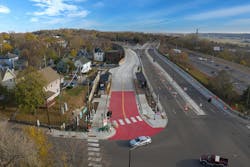
When the METRO Gold Line Bus Rapid Transit (BRT) Project opened to riders in March, it marked a first for Minnesota—a 10-mile bus rapid transit system operating primarily within its own dedicated lanes.
The project, delivered by Ames Construction for the Metropolitan Council and METRO Transit, represents a transformative leap forward for public transit in the Twin Cities’ east metro. With its blend of innovation, collaboration and community benefit, the Gold Line embodies the kind of excellence that defines the Roads & Bridges Top 10 awards. And for these reasons, the project has earned second place on our list of the year’s best road projects.
Stretching from downtown St. Paul through Maplewood, Landfall, Oakdale and into Woodbury, the Gold Line establishes a fast, reliable and connected transportation option for tens of thousands of residents. The project’s scope was formidable: 10 miles of new bus-only lanes, 16 modern stations, eight new road bridges, two pedestrian bridges, two rehabilitated bridges, 43 retaining walls, and eight noise walls—all completed on time and on budget.
“As the first BRT route to operate primarily on bus-only lanes in Minnesota, this project strengthens the region’s transportation system and economy by creating new connections between people, jobs, housing, and other destinations,” said Josh Brudelie, senior project manager at Ames Construction.
But the project’s significance extends well beyond its infrastructure. The Gold Line offers a new model for how transit can shape urban growth, improve livability and foster regional connectivity. It provides all-day service every 10 to 15 minutes in both directions, unlike traditional express routes limited to rush hour. Heated shelters, real-time arrival displays and pre-boarding fare payment will ensure that riders experience comfort and efficiency. The line also integrates Park & Ride lots, improved lighting, and enhanced security features—key elements designed to attract new riders and retain long-term users.
The design phase, led by Kimley Horn, reflected deep coordination among multiple jurisdictions and disciplines. Designers analyzed route alignments, vehicle technologies, station amenities and bridge structures to balance cost, performance and community priorities.
Early planning also gave five participating cities an opportunity to align economic development goals and pursue transit-oriented development near station areas. One milestone achievement, the Bielenberg Bridge over Interstate-94—opened in late 2023—now provides a vital connection between Woodbury and Oakdale, benefiting motorists, cyclists and pedestrians alike.
The project’s diversity of structures demanded a wide array of techniques, including cast-in-place, MSE, lagging, block and soil nail retaining walls, along with complex utility and drainage systems. Ames Construction submitted four value engineering proposals that improved constructability and reduced community impacts.
For example, the team replaced sheet pile walls with block walls to minimize vibration and noise near residential neighborhoods—a decision that made construction safer and less disruptive.
The project’s urban setting presented daily challenges. The 10-mile corridor passed through five cities and required coordination with numerous stakeholders and more than a dozen utility owners. Ames assigned a full-time utility coordinator to manage over 500 utility conflicts, working closely with the owner’s counterpart to resolve issues quickly. A full-time quality manager ensured that every element met rigorous performance standards, while proactive scheduling and winter work kept the project on track.
The success of the Gold Line also stems from the people who built it. Collaboration among Ames Construction, METRO Transit, Kimley Horn, and key subcontractors—Egan Company, Sheehy Construction, North Country Concrete, Bituminous Roadways, and Doyle Conner—set a high standard for teamwork. Among the many standout contributors was foreman Mitch Koebnick, who managed the most utility-dense section of the corridor. His leadership, daily coordination and meticulous utility tracking kept construction safe, efficient and on schedule.
In every respect, the METRO Gold Line stands as a model of modern infrastructure delivery: complex, collaborative, and community focused. It is not just a new transit line—it is a foundation for future growth, cleaner mobility and better connections across Minnesota’s east metro.
Project: METRO Transit Gold Line Bus Rapid Transit
Location: St. Paul, Maplewood, Landfall, Oakdale and Woodbury, Minn.
Owner: Metro Transit
Designer: Kimley-Horn
Contractor: Ames Construction
Cost: $247 million
Length: 10 miles