Road No. 4: Redefining Collaboration in Minnesota
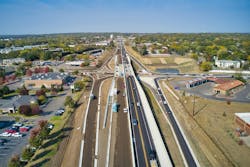
For years, U.S. Highway 169 in Elk River, Minn., has served as a vital corridor connecting the central lakes region to the Minneapolis–St. Paul metropolitan area. By 2025, the corridor’s growth had outpaced its capacity, leading to congestion and safety concerns.
Enter the 169 Redefine — Elk River project: A comprehensive reconstruction and redesign of 3.6 miles of highway that has reimagined mobility in this growing community. Through design ingenuity, planning and teamwork, the project not only converted Highway 169 into a freeway but also enhanced pedestrian safety, freight movement and traffic flow. For these reasons, the project placed fourth on our list of Top 10 Roads of 2025.
The project’s centerpiece was the replacement of four intersections with grade-separated, diverging single-point interchanges. This “roller coaster” layout alternates overpasses and underpasses—Highway 169 travels over Main Street, under School Street, over 193rd Avenue, and under 197th Avenue—allowing the contractor to repurpose excavated materials from underpasses as fill for overpasses.
This strategic approach reduced material costs, minimized hauling and streamlined construction while maintaining aesthetic and functional integrity. Five new bridges, 19 retaining walls, additional freeway lanes and improved adjacent road and sidewalk connections further elevated the corridor’s safety and accessibility.
What sets the 169 Redefine project apart is the collaborative approach enabled by the Construction Manager/General Contractor (CMGC) delivery method. From design through construction, Ames Construction collaborated with the Minnesota Department of Transportation (MnDOT), the city of Elk River, Elk River Municipal Utilities, and designer WSB.
By treating all stakeholders as partners rather than separate entities, the team built a culture of trust, open communication and creative problem-solving. Innovations developed in this co-managed environment, such as alternating bridge layouts and reimagined earthwork solutions, resulted in nearly $6 million in savings and a six-month reduction in the overall schedule.
Safety remained a paramount concern on this high-volume corridor. More than 100 workers operated in the project’s tight corridor, yet Ames maintained an OSHA Recordable Incident Rate of 0.80 and a Lost Time Incident Rate of 0.00.
Strategies included weekly project-wide safety meetings, the SAFEStart program for new employees, MnOSHA workplace consultations and a strong culture in which every team member—from interns to seasoned foremen—was empowered to halt unsafe work. Clean, organized work zones and proactive traffic management further safeguarded both the public and the construction team.
The project’s phased construction strategy was equally critical to its success. Completed over three stages with two phases per stage, the team carefully sequenced work on the Highway 169 over TH10 Bridge and 197th Avenue Bridge, followed by the School Street and 193rd Avenue bridges, and concluding with the Main Street Bridge.
Bypasses allowed head-to-head traffic to flow around intersections, facilitating bridge construction without repeated traffic switches. These measures, combined with precise tracking of materials and production rates, enabled Ames to anticipate issues, optimize scheduling and avoid costly rework.
The design phase benefitted from advanced technology and contractor insight. Using 3D/BIM modeling, Ames visualized complex structures and storm sewer layouts while providing real-time feedback to designers to improve constructability.
Relocating 58.7 miles of utilities ahead of construction eliminated schedule conflicts and generated additional savings, while bridge and earthwork innovations reduced retaining wall requirements and optimized material use. Such forward-thinking planning kept change orders to just over 1% of the $123 million contract value and ensured the project remained under budget.
The 169 Redefine — Elk River project succeeded because it addressed a complex challenge with ingenuity, efficiency and teamwork. From a congested arterial with stoplights to a streamlined freeway designed for safety, mobility and economic vitality, the project exemplifies how collaboration, technology and innovative engineering can reshape a community’s transportation landscape.
Project: 169 Redefine — Elk River
Location: Elk River, Minn.
Owner: Elk River/Minnesota Department of Transportation
Designer: WSB
Contractor: Ames Construction
Cost: $123.1 million
Length: 3.6 miles