Catching Concrete Problems Before They Harden
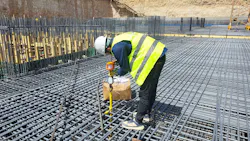
When a mass concrete pier cracks, crews may have to break through hardened concrete and reinforcing steel. They haul it away and pour again, with schedule delays piled on top of the direct cost. On a highway or bridge contract, that can wipe out a project’s margin.
Amir Azhari argues that this risk should be caught while the concrete is curing, not discovered after it has hardened. Azhari is co-founder and chief commercial officer of Brickeye, where he leads product and commercial strategy for LumiCon, an IoT-enabled platform that uses sensors embedded in the concrete to track temperature, temperature differentials and strength development. He holds a Ph.D. from the University of Waterloo and an MBA, and has co-authored more than 20 papers, book chapters and patents.
Real-time data, according to Azhari, changes when decisions get made. Crews can adjust blankets, heaters or cooling while there’s still time to head off thermal cracking. Maturity data from the element itself also gives a clearer read on in-place strength than cylinders cured under different conditions, though required acceptance testing doesn’t go away.
Roads & Bridges spoke with Azhari over email about how the technology works on infrastructure projects, who should pay for it on low-bid work and what happens when a sensor raises an alarm.
R&B: What does Brickeye actually do on a road, bridge or dam project? Most of Brickeye’s track record seems to come from building construction. On a highway, bridge or dam project, what does the platform monitor, and can you walk me through a specific transportation or dam job where it caught a problem and what that saved?
AA: Heavy civil and infrastructure are actually a major use case for the concrete side of Brickeye. Mass concrete is much more common on dams, locks, bridges, foundations and major transportation projects than it is on a typical residential building. On a bridge project, for example, the design engineer may specify that a pier needs to reach a certain strength and meet certain thermal requirements. From there, the contractor and ready-mix supplier select the mix and determine how the pour will be executed. The challenge is that the conditions assumed during design are not necessarily the conditions you get on pour day. Temperature changes, wind changes, the mix can vary, and even the size and geometry of the element affect how that concrete behaves.
We embed sensors in the concrete so the project team can monitor temperature and temperature differentials throughout the element and understand how the concrete is actually behaving as it cures. The objective is to compare what is happening in the field against what the project expected to happen and give the team an opportunity to intervene before a deviation becomes cracking, rework or a larger structural-quality issue. Brickeye has used this approach on infrastructure projects including San Antonio I-35 NEX for Texas DOT, Kentucky Locks for the U.S. Army Corps of Engineers, the Pattullo Bridge replacement in British Columbia and dam projects in North America.
On a bridge project in Missouri, our system flagged early one morning that the temperature differential in a mass concrete element was about to exceed its limit. Overnight cold was pulling the surface temperature down while heat of hydration kept pushing the core temperature up. Because the alert came before the limit was breached, the crew turned on heaters right away, warmed the surface, and brought the differential back within spec. The element was saved from thermal cracking, and the contractor avoided what could have been millions of dollars in removal, replacement, and rework.
R&B: Much transportation work is low bid, with thin margins and specifications set by the DOT. If risk-monitoring technology isn’t a bid item, how does a contractor justify the cost? Should owners be specifying it or paying for it, and does the answer change on design-build or P3 megaprojects?
AA: This is where the economics of construction can work against good risk management. Contractors may be operating on 3% to 5% margins, and on a low-bid job there is tremendous pressure to remove anything that is not explicitly required. If one bidder includes additional risk controls and another does not, the more cautious contractor can actually put itself at a disadvantage before the project even starts.
That is why I think owners, designers and specifiers have an important role. On projects where the consequences of a concrete failure are substantial, the appropriate monitoring and risk-management requirements should be considered during design and procurement, not added after the contract is awarded.
We spend a lot of time educating design engineering firms, owners and developers on this point. If the quality program requires additional tools to demonstrate that concrete is behaving the way the design intended, every contractor can price that requirement from the beginning. It changes monitoring from an optional technology expense into part of the project’s quality and risk strategy.
The business case also needs to compare the right numbers. If monitoring costs a fraction of what it costs to demolish and replace a major concrete element, the comparison should not be monitoring versus zero dollars. It should be the cost of managing the risk versus the financial consequence if you get it wrong.
That becomes even more relevant on large design-build or P3 projects where schedule and performance risk may sit with the delivery team for much longer. The more exposure a contractor or consortium retains, the stronger the incentive to know about a concrete problem before it becomes a delay, a claim or a lifecycle issue.
R&B: Brickeye pitches a Certificate of Protection that can help win better Builder’s Risk terms. On public infrastructure, where owners often control the insurance program, who actually captures those savings? And there’s a flip side: if a sensor flags a problem and nobody acts on it, does having that data increase a contractor’s liability?
AA: I would separate two parts of our business first. The Certificate of Protection is primarily associated with our water-risk work and the Builder’s Risk placement process. On roads, bridges and dams, our concrete work is generally focused on quality, thermal control and reducing the risk of defects and rework.
Who captures an insurance benefit on a public infrastructure project depends on how the project and insurance program are structured. If the owner is purchasing the coverage, the direct premium or deductible benefit may sit with the owner. But the value of preventing the underlying incident extends well beyond the insurance transaction.
A concrete failure can create rework, schedule delays, financing impacts, disputes and claims that affect multiple project participants. Our philosophy is that you want to de-risk the project upfront, monitor the risk during construction and create a record of what actually occurred, rather than simply relying on insurance after something goes wrong.
On the liability question, I would not make a legal determination because contracts and responsibilities vary significantly by project. But from an engineering and operational perspective, having data does create accountability, and that is a good reason to define the process before monitoring begins.
If an alert is generated, the team should already know what that threshold means, who receives it, who has authority to make a decision and what mitigation options are available. A sensor on its own does not manage risk. The value is connecting the information to a process that allows the team to respond.
I would still much rather know that concrete is moving outside its expected performance range while I have an opportunity to act than discover a crack later and try to reconstruct what happened. The data did not create the risk. It gave the project visibility into a risk that was already there.
About the Author
 Gavin Jenkins, Head of Content
Head of Content
Gavin Jenkins is an award-winning journalist based in Pittsburgh. His work has appeared in The New York Times, The Washington Post, The Atlantic, VICE, Narrative.ly, Prevention, the Pittsburgh Tribune-Review and Beijing Review.
In 2020, two stories he wrote for Pitt Med Magazine earned three Golden Quill Awards from the Press Club of Western Pennsylvania. “Surviving Survival” won Excellence in Corporate, Marketing and Promotional Communications – Written, Medical/Health, while “Oct. 27, 2018: Pittsburgh’s Darkest Day, and the Mass Casualty Response” won Excellence in Written Journalism, Magazines – Medical/Health, as well as the Ray Sprigle Memorial Award: Magazines, a Best in Show award.
After graduating from the University of Pittsburgh at Johnstown in 2003, he covered sports for the Bedford Gazette, in Bedford, Pa., and the Martinsville Bulletin, in Martinsville, Va. In 2006, he returned to Pittsburgh to write for Trib Total Media. Based out of the Kittanning Leader Times, he worked for the Trib for two years, and then he moved to Shenzhen, China, to teach English and freelance. After two years in China, he earned an MFA in nonfiction from the University of Pittsburgh.
When he's not at work, he's usually playing with his border-collie mix, Bob.