Aging Transport Infrastructure: Challenges for Bridges and Tunnels
Key Highlights
- Rising traffic loads accelerate infrastructure deterioration
- Bridges and tunnels are critical safety bottlenecks
- Tunnel wall protection remains a major safety gap
- Compact precast barriers reduce traffic disruption
- Rapid installation supports efficient maintenance projects
- MASH-tested systems provide high-level containment performance
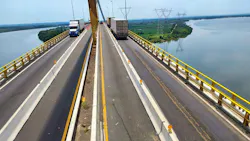

Transport infrastructure worldwide is facing major challenges: a significant number of bridges and road structures across the United States and other countries have deteriorated and are increasingly in need of refurbishment. Many of these structures were built at a time when traffic volumes and vehicle weights were considerably lower. Today, intense traffic and heavier vehicles have an impact on many structures that are reaching or have already exceeded their limits.
Critical Bottlenecks: Bridges and Tunnels
Bridges and tunnels are critically important to modern transport networks. They overcome geographical obstacles, such as water and mountainous regions, and are used wherever conventional roads reach their limits. At the same time, however, they are critical bottlenecks. Limited space, a lack of alternative routes, and often no emergency exits increase their vulnerability to disruption. Accidents in these areas have severe consequences, as emergency response measures are more difficult to handle and potential risks such as fire or smoke may arise.
A frequently underestimated issue is the lack of tunnel wall protection. There are plenty of tunnel sections worldwide, without any longitudinal barrier systems in place. A collision with an unprotected tunnel wall can result in serious consequences for the vehicle occupants.
Increasing Damage to Aging Infrastructure
Traffic volume has risen sharply over recent decades, while vehicles have become larger and heavier, placing additional strain particularly on bridge structures. As a result, infrastructure has deteriorated with a subsequent need for maintenance and repair measures. Therefore, infrastructure operators are under considerable pressure to rehabilitate critical structures in time, before safety-related restrictions occur.
Maintenance and repair work are technically complex and have far-reaching implications. Construction sites on bridges and tunnels frequently lead to significant traffic delays, congestion and the necessity for rerouting traffic.
Focus on Precast Concrete Longitudinal Barrier Systems
For many reasons, maintenance measures are vital to preserve the healthy condition of the structures despite the inconvenience to motorists caused by construction work. Reliable safety solutions are particularly necessary in confined areas such as in tunnels and bridges. Tested precast concrete safety barriers have proven to be especially suitable in these environments.
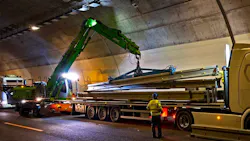
Tested in accordance with MASH-2016, REBLOC’s precast concrete safety barriers are a perfect fit for these applications. With test levels ranging from TL3 to TL5, they cover a wide spectrum of traffic scenarios and vehicle fleets ranging from passenger cars to heavy goods vehicles. Their compact design is key. This advantage offers the barriers an extremely narrow system width, requiring minimal space, yet providing a containment performance that is reliable. This slim design allows at least one traffic lane to remain open during construction phases.
Another advantage is their symmetric design; thanks to the integrated coupling system, REBLOC precast concrete barriers can be offloaded and installed in either orientation. This enables rapid adjustments and reduces downtime significantly.
On bridges, freestanding systems can be installed without extensive structural disruption. As anchoring options are often limited by design, solutions are required that function with minimal or no anchoring. At the same time, these systems require only small working widths, which means a major advantage in confined spaces.
In addition, precast concrete safety barriers can be installed and removed quickly, making them ideal for temporary traffic management. In the event of damage, individual elements can be replaced quickly and swiftly without dismantling larger sections. This reduces repair times and allows for the rapid restoration of traffic safety.
Today for Tomorrow
The refurbishment and maintenance of bridges and tunnels is a key task of modern infrastructure policy. Despite short-term disruptions, these measures are essential to ensure long-term safety, efficiency and sustainability.
Modular longitudinal barrier systems made from precast concrete make an important contribution: they combine reliable, high-level protection with minimal space requirements and rapid installation, thereby enhancing safety without unnecessarily disrupting traffic flow.
REBLOC Inc.
1000 N West Street
Wilmington, DE 19801
www.rebloc.com
[email protected]