In roughly a decade, e-bikes have gone from a niche product to a common sight on American streets, sidewalks and trails. According to the U.S. Department of Energy, annual U.S. sales have climbed from more than 100,000 in the mid-2010s into the millions and, according to JAMA Surgery, emergency room visits involving e-bikes have risen with them. Yet agencies trying to respond are working with incomplete information. National injury estimates are extrapolated from a sample of hospitals, and crash reports often lump e-bikes together with conventional bicycles and mopeds. Raw incident counts can mislead, too, since more riders will naturally produce more crashes. What’s missing is how often incidents occur relative to how much people actually ride.
Joe Caloggero, P.E., PTOE, PTP, vice president of the Traffic Group, says closing that gap should come before major infrastructure spending. Some traffic counting equipment can already tell e-bikes from conventional bikes, and video studies can show how riders interact with pedestrians and vehicles. Caloggero has more than 30 years of experience in traffic engineering and transportation planning. Based in Baltimore County, Md., the Traffic Group runs one of the industry’s largest in-house traffic data collection divisions. Caloggero argues agencies should begin tracking e-bike volumes, speeds, locations and conflicts now.
In this written Q&A, which was conducted over email, Caloggero explains where bicycle design guidance falls short for faster, heavier e-bikes, from shared-use paths to narrow suburban sidewalks. He also says why he’d tell a cash-strapped town to start with education and low-cost markings rather than concrete, and how jurisdictions might decide where Class 1, 2 and 3 e-bikes and higher-powered models belong. Throughout, he stresses that the goal isn’t to discourage e-bike use but to accommodate it safely.
R&B: Most bike facility design guidance assumes conventional bike speeds and weights. Where does it fall short for e-bikes, for example lane width, sight distance, intersection design, or shared-use paths where pedestrians mix with faster riders? What would you change first?
JC: Much of our existing bicycle and pedestrian infrastructure was designed before e-bikes became as popular as they are today. A typical shared-use path may be approximately 10 feet wide, accommodating pedestrians and bicyclists traveling in both directions. That can work well, but when you introduce e-bikes traveling at higher speeds, the dynamics change considerably.
The challenge becomes even greater in suburban communities where sidewalks may be only 4-5 feet wide. I've personally observed sidewalks bordered by guardrails, trees, light poles and other roadside obstacles. Two pedestrians walking side by side can occupy nearly the entire available width. Now introduce an e-bike approaching at 20 mph. E-bikes are relatively quiet, and pedestrians may be wearing headphones or talking on their phones. How does a young, inexperienced rider safely navigate that situation?
We also need to think about what happens at intersections. Does the rider understand the traffic signals? Are they anticipating turning vehicles? Do they understand that motorists may not expect something traveling at bicycle speeds to approach from a sidewalk?
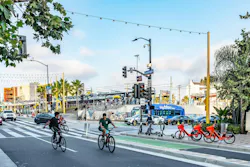
During a recent visit to Charlotte, N.C., I observed bicycle facilities with green pavement markings, directional striping and flexible delineator posts separating bicycle traffic from motor vehicles. Those improvements demonstrate how we can organize roadway space more effectively. However, we can't realistically reconstruct every roadway or sidewalk.
I would start by evaluating locations where different users are experiencing the greatest conflicts. That may mean improving pavement markings, providing clearer directional guidance, widening selected facilities or creating separation where space permits.
We also need to consider sight distance, passing opportunities and the differences in operating speeds between pedestrians, conventional bicycles and e-bikes. The important thing is to evaluate the actual conditions rather than assume that infrastructure designed for conventional bicycles will automatically accommodate e-bikes safely.
R&B: Your list of measures runs from signage and helmet laws to concrete dividers and grade separation. Which do the most for safety per dollar, and which are overrated? What would you tell a small town or county with a limited budget to do first?
JC: If I'm advising a small municipality with a limited transportation budget, my first recommendation would be education. Major infrastructure improvements can be extremely expensive. Reconstructing roads, widening sidewalks or installing physically separated bicycle facilities may not be realistic for every community. But we can do a better job educating young riders and their parents.
Teenagers are operating e-bikes at speeds of 20-28 mph, often before they've taken a driver's education course or learned the rules of the road. Parents need to understand where their children are riding, what types of e-bikes they're operating and whether they're prepared to navigate busy intersections or higher-speed roadways.
Schools can play an important role. I've read about schools requiring students to dismount and walk their bicycles once they enter school property. That simple policy helps reduce conflicts with pedestrians, school buses and other vehicles during arrival and dismissal. Beyond education, I would look at relatively inexpensive engineering improvements. Pavement markings, signage, directional centerlines and flexible delineator posts can help organize traffic and identify designated operating spaces.
In some locations, it may be possible to widen a short sidewalk segment or establish a designated bicycle facility without reconstructing an entire roadway. Where there's sufficient room, communities might consider one-way bicycle facilities on opposite sides of the road rather than trying to accommodate two-way bicycle traffic in a constrained area.
That doesn't mean physical barriers or grade-separated facilities aren't valuable. They can provide important safety benefits in appropriate locations. But those investments need to be justified by traffic volumes, operating speeds, demonstrated safety concerns and anticipated use.
I wouldn't characterize major infrastructure improvements as overrated. I would say they're not necessarily the first or most practical solution everywhere. Small towns can also gather valuable information by talking with schools and observing how residents travel. Are more students riding e-bikes to school? Are children riding to parks or athletic practices? Are there missing connections between neighborhoods and popular destinations? Those observations, combined with targeted traffic counts or video-based studies, can help identify where limited funding will have the greatest impact.
R&B: Class 1, 2 and 3 e-bikes, plus higher-powered models that are effectively electric motorcycles, behave differently. How should jurisdictions decide which belong on sidewalks, trails, bike lanes or the road, and can those rules realistically be enforced?
JC: This is probably one of the most challenging questions because the answer depends heavily on the infrastructure available in each community. Class 1 and Class 2 e-bikes generally provide assistance up to 20 mph, while Class 3 models can provide pedal assistance up to 28 mph. Higher-powered electric vehicles that fall outside those classifications present additional concerns and shouldn't automatically be treated the same as conventional bicycles.
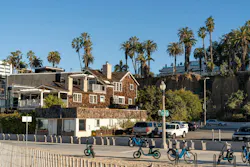
A quiet residential street is very different from a heavily traveled roadway with a 35- or 40-mph speed limit. If a community doesn't have bicycle lanes or suitable shoulders, where should an e-bike rider travel? Riding alongside faster motor vehicles introduces one set of risks, while using a sidewalk introduces another.
Maryland's recent changes to e-bike regulations illustrate this challenge. The state has expanded opportunities for sidewalk use while allowing local jurisdictions to establish restrictions based on local conditions. But just because an e-bike may legally operate on a sidewalk doesn't necessarily mean every sidewalk is appropriate for that use. A 4-foot sidewalk with pedestrians, roadside obstacles and frequent driveway crossings presents very different conditions from a 10-foot shared-use path.
I believe jurisdictions need to consider the speed and classification of the vehicle, the characteristics of the roadway or path, pedestrian activity and the experience of the rider. We also need clear, understandable rules. I'm not necessarily advocating for more government regulation. But whatever rules exist need to be communicated effectively and enforced realistically. Education remains a critical part of that process.
Parents should understand the classifications and capabilities of the e-bikes their children operate. They should also establish expectations about where their children can ride. A teenager may be perfectly comfortable riding through a residential neighborhood but not have the experience to navigate a congested arterial roadway or complicated intersection. Ultimately, I believe the best approach combines clear operating rules, parental responsibility, education and infrastructure improvements based on local conditions.
We should also recognize that e-bikes offer tremendous benefits. They're more affordable than automobiles, provide independence for younger riders and can connect people to schools, parks, employment and other destinations. Our goal shouldn't be to discourage e-bike use. It should be to make sure we're accommodating it responsibly and safely.
About the Author
 Gavin Jenkins, Head of Content
Head of Content
Gavin Jenkins is an award-winning journalist based in Pittsburgh. His work has appeared in The New York Times, The Washington Post, The Atlantic, VICE, Narrative.ly, Prevention, the Pittsburgh Tribune-Review and Beijing Review.
In 2020, two stories he wrote for Pitt Med Magazine earned three Golden Quill Awards from the Press Club of Western Pennsylvania. “Surviving Survival” won Excellence in Corporate, Marketing and Promotional Communications – Written, Medical/Health, while “Oct. 27, 2018: Pittsburgh’s Darkest Day, and the Mass Casualty Response” won Excellence in Written Journalism, Magazines – Medical/Health, as well as the Ray Sprigle Memorial Award: Magazines, a Best in Show award.
After graduating from the University of Pittsburgh at Johnstown in 2003, he covered sports for the Bedford Gazette, in Bedford, Pa., and the Martinsville Bulletin, in Martinsville, Va. In 2006, he returned to Pittsburgh to write for Trib Total Media. Based out of the Kittanning Leader Times, he worked for the Trib for two years, and then he moved to Shenzhen, China, to teach English and freelance. After two years in China, he earned an MFA in nonfiction from the University of Pittsburgh.
When he's not at work, he's usually playing with his border-collie mix, Bob.