Ohio Roundabout Becomes Digital Delivery Test Bed
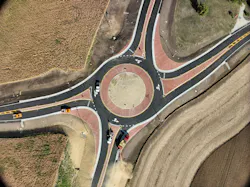
Located in Northwest Ohio, on the border of Wood and Sandusky Counties, the intersection of U.S. Route 23 and State Route 105 serves as a critical connection for local communities like Pemberville. Regional commerce and freight movement depend on it, as well.
However, the skewed intersection geometry, combined with high volumes of commercial truck traffic, created operational challenges and increased the potential for vehicle conflicts. Between 2018 and 2020, the Ohio Department of Transportation (ODOT) recorded 18 crashes at the intersection, highlighting the need for a safer and more efficient solution.
As traffic volumes grew, ODOT sought an approach that could improve safety while maintaining access and mobility for all roadway users. The selected solution, a single-lane roundabout, reflects a broader industry shift toward intersection designs that reduce conflict points, lower vehicle speeds and significantly decrease the severity of crashes.
Innovation on Multiple Fronts
Progressive Design-Build (PDB) was selected for this project to advance ODOT’s broader digital delivery and Building Information Modeling for Infrastructure (BIM4I) objectives. While the project itself involved the design and construction of a roundabout, the primary driver for choosing PDB was the opportunity to leverage its collaborative delivery framework to implement, evaluate and mature BIM-enabled workflows in a real-world project environment.
As ODOT’s first completed PDB project, the initiative brought together ODOT, Michael Baker International (Lead Designer), and Kokosing Construction Company (Lead Contractor) as a single, integrated team from the earliest stages of project development.
This collaborative approach enabled design, construction and owner perspectives to be incorporated simultaneously when evaluating alternatives, managing risks, assessing constructability and refining project scope. In doing so, the project served as a strategic vehicle for advancing ODOT’s BIM4I program by demonstrating how integrated teams, shared digital information and BIM-enabled processes can improve coordination, support data-driven decision-making, enhance construction delivery and provide greater continuity of information throughout the asset lifecycle.
For a typical roundabout project, a traditional delivery method would likely have been sufficient; however, the BIM4I objectives made PDB the preferred approach for achieving ODOT’s broader digital transformation goals.
With the U.S. 23/SR 105 roundabout project, ODOT achieved another milestone by incorporating digital project delivery for the first time as part of its BIM initiative to modernize infrastructure development, drawing on Michael Baker International’s experience helping transportation agencies implement BIM4I and digital delivery practices nationwide.
By integrating BIM technologies throughout planning, design, construction and project handover, the project served as a pilot for transforming how infrastructure projects are delivered. Digital project delivery for this project included comprehensive modeling and coordination of key infrastructure components such as roadway design, drainage systems, culverts, lighting, signing and striping, as well as right-of-way planning.
Utilizing BIM4I Across Project Phases
Michael Baker International’s BIM4I approach extended beyond model development, creating a connected digital delivery framework that supported collaboration, decision-making, construction and long-term asset management throughout the project lifecycle.
At the onset of the project, the team developed an integrated BIM Execution Plan (BEP) that established the project’s digital project delivery strategy, including workflows, roles and responsibilities, data exchange requirements and model management procedures. To support consistent implementation, the team also customized a BEP template specifically for ODOT, creating a framework that guided collaboration and BIM use throughout the project lifecycle.
A key component of the BEP was the development of a Model Element Breakdown (MEB), which defined how individual model elements would be represented and managed throughout the project. The MEB established clear expectations for model content by using customized element attributes and visual examples to identify what information would be included and what the required Level of Development (LOD) for each element would be.
This approach improved transparency and consistency, ensuring that project stakeholders understood what information within the model could be relied upon at each stage of design and delivery.
With the BEP established, the project team transitioned from planning to execution by developing project-specific BIM models and delivering required submissions in accordance with the BEP. The team configured the model with customized model views and data filters that enabled users to quickly interrogate the model and review specific project components, such as guardrail, sub-base and pavement systems.
Version comparison capabilities allowed stakeholders to efficiently identify changes between submissions, improving review accuracy and transparency. The model also supported automated quantity generation for all modeled elements, providing reliable, data-driven results throughout the project. By centralizing design data, quantities and review information within the model, the team established a single source of truth that improved collaboration, decision-making and overall project efficiency.
To support successful adoption, the team prepared ODOT personnel and other stakeholders for model-based reviews through guidance documents, role-specific training and just-in-time learning opportunities delivered when users needed them most.
Training focused on helping reviewers navigate the models, provide direct feedback and participate in collaborative digital reviews using a cloud-based platform hosted by Michael Baker International and accessible through a web browser.
The project team extended BIM beyond design by creating a seamless connection between the digital model and field construction activities. During construction, the 3D model was used to generate Automated Machine Control files, alignments, IFC files and survey control data, providing field crews with accurate digital information for project execution.
The team worked closely with construction managers, project engineers, foremen, inspectors and subcontractors to deliver model views, printouts and project-specific files tailored to each user’s needs. Training on cloud-based tools enabled stakeholders to access measurements, details and model data in the field, improving coordination, accuracy and efficiency while ensuring a consistent flow of information from design through construction.
Beyond Construction
Throughout the project, the team worked closely with ODOT to ensure that digital deliverables aligned with its long-term record-keeping, asset management and operational needs. These deliverables included BIM models and associated digital files, supplemented by traditional documentation, such as streamlined PDF plan sets, when appropriate.
The team also continuously captured lessons learned, documented best practices and developed training and guidance materials throughout each phase of the project. This included iPad upgrades to capture changes in real time, working with utility and ROW stakeholders as both fields were not ready for the digital deliverable, and providing the background, understanding and limitations that legislators need to adopt for accepting Models as a Legal Documents (MALD) moving forward.
These efforts culminated in a framework of standards, specifications and implementation guidance designed to support ODOT’s future BIM initiatives and advance ODOT’s broader digital delivery program.
While the project’s primary objective was to improve safety by replacing a high-risk intersection with a modern roundabout, its impact extends well beyond crash reduction and operational improvements. The project also served as a proving ground for new approaches to project delivery, digital collaboration and lifecycle asset management that will influence how ODOT plans, designs, constructs and manages future transportation investments.
As transportation agencies face increasing demands to improve safety, maximize resources and manage growing volumes of infrastructure data, projects like the U.S. 23/SR 105 roundabout demonstrate the value of thinking beyond traditional project boundaries.
By pairing an innovative delivery method with a comprehensive digital delivery strategy, ODOT, in partnership with Michael Baker International and Kokosing Construction, not only delivered a safer and more efficient intersection for the traveling public, but also advanced the agency’s ability to deliver future projects more effectively.
The result is a project that stands as a transportation improvement and a catalyst for organizational change, proving that infrastructure investments can simultaneously address today’s challenges and build the foundation for tomorrow’s success.
Ultimately, the roundabout’s legacy will not be defined solely by the vehicles that move through it more safely each day. Its lasting impact will be the standards, processes and institutional knowledge it helped create. These resources will continue to support ODOT’s evolution toward a more collaborative, data-driven and digitally enabled future. In that sense, the project marks an important step in the ongoing transformation of transportation project delivery in Ohio.
Sean Milroy, P.E., PMP, DBIA, Project Manager – Transportation at Michael Baker International, Joseph Brenner, P.E., Technical Director - Bridge Technologies at Michael Baker International