What’s Behind Connecticut’s Growing Roundabout Push?
Key Highlights
- Connecticut has about 40 roundabouts on state and local roads
- A CTDOT study found an 81% drop in severe crashes at five converted intersections
- More than a dozen additional roundabouts are planned or under construction
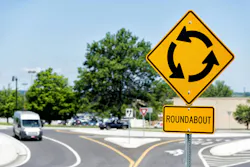
For drivers used to traffic lights and stop signs, a roundabout can take some getting used to. But Connecticut transportation officials say the circular intersections are proving their worth when it comes to safety.
Connecticut has about 40 roundabouts on state and local roads, and that number is growing. More than a dozen additional roundabouts are planned or under construction, according to CTDOT, which is using National Roundabouts Week to point to the safety benefits of the design.
Why Roundabouts Can Reduce Serious Crashes
A modern roundabout sends traffic in one direction around a center island. Drivers approaching the intersection slow down and yield to vehicles already in the circle, as well as pedestrians and bicyclists crossing the roadway.
That setup eliminates many of the crossing movements found at traditional intersections.
Roundabouts are a Proven Safety Countermeasure because they reduce vehicle speeds and the number of potential conflict points, according to the Federal Highway Administration. FHWA says converting certain signalized and two-way stop-controlled intersections to roundabouts can substantially reduce crashes resulting in serious injuries or deaths.
A CTDOT study of five intersections found that severe crashes dropped 81% after the intersections were converted to roundabouts. Total crashes fell 44%.
What Makes the Design Different?
One of the biggest changes is speed.
The curved approach to a roundabout forces drivers to slow down rather than entering a straight intersection at higher speeds. The design also removes many opportunities for head-on and T-bone crashes, which tend to be more severe.
CTDOT says raised splitter islands can also allow pedestrians to cross one direction of traffic at a time. Lower vehicle speeds give pedestrians additional opportunities to cross safely.
Roundabouts can also keep traffic moving. FHWA notes that they can reduce delay and queuing compared with some other intersection designs, while still slowing vehicles enough to improve safety.
One Connecticut Roundabout Saw a Big Change
CTDOT points to the roundabout at Route 10, Route 202 and Notch Road in Granby as one example.
The roundabout opened in 2020 after being designed to improve safety at the intersection. Since construction was completed, crashes have dropped 60% and injuries have fallen 83%, according to CTDOT.
Tim Weber, chief of the Lost Acres Fire Department, said emergency crews previously responded to crashes at the intersection several times a year. Since the roundabout opened, he said, crashes have no longer been an issue there.
Connecticut Has More on the Way
CTDOT says more than a dozen roundabouts are currently planned or under construction throughout the state.
The agency's Roundabouts Committee is made up of engineers who work with Connecticut cities and towns on roundabout planning, design and construction. The committee can help communities evaluate whether a roundabout is appropriate and provide guidance on issues such as size, materials, pavement markings and overall design.
FHWA also identifies roundabouts as a safety treatment that can be used in both urban and rural settings and at a range of intersections, including freeway interchange ramp terminals and rural intersections.
What Drivers Should Know
For drivers, CTDOT's advice is straightforward: slow down, pay attention to signs and pavement markings and be prepared to yield.
Drivers entering a roundabout must yield to traffic in all lanes of the circle, not just the lane closest to them. Bicyclists can enter the roundabout with traffic or dismount and use the sidewalk and crosswalks, according to CTDOT.
As Connecticut continues to add roundabouts, the state's transportation officials are making the case that these intersections can do more than move vehicles through a junction. Their design can also change the types of crashes that occur and reduce the likelihood that a mistake turns into a serious injury.
Source: CTDOT, Federal Highway Administration
About the Author
 Karina Mazhukhina, Digital Content Specialist
Karina Mazhukhina, Digital Content Specialist
Digital Content Specialist
Karina Mazhukhina has extensive experience in journalism, content marketing, SEO, editorial strategy, and multimedia production. She was previously a real-time national reporter for McClatchy News and a digital journalist for KOMO News, and ABC-TV affiliate in Seattle.