AI Won’t Fix Bad Data
Contractors, agencies and fleet operators are being told that artificial intelligence (AI) will change how they manage equipment, maintenance and field crews. Before they integrate AI into their workflows, they need to answer some practical questions: Is your data ready? Which tools are worth paying for? How do you know if any of it is working?
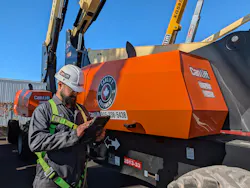
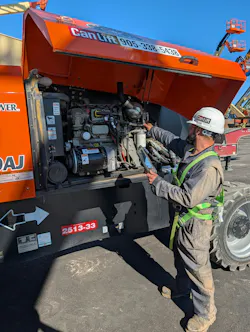
CanLift Equipment Ltd. has spent the past year working through those questions. Founded in 2009 and headquartered in Burlington, Ontario, CanLift is a family-run company that rents, sells and services aerial lifts and material handling equipment. It is one of Ontario’s largest independently owned lift equipment providers. In October, the company announced it was moving its AI efforts from experimentation into daily operations. It rolled out the AI-powered service documentation platform Keycard to all its road service technicians, and it built its own integration layer, using the Model Context Protocol (MCP), to connect approved AI tools to live business data.
Ryan Fitzgibbon, CanLift’s co-founder and director of technology and marketing, leads that work. In this Q&A, which was conducted over email with Roads & Bridges, he talks about the AI tools CanLift tried and then dropped, what field technicians asked to change in Keycard, and why cleaning up data has to be a continuing job rather than a one-time project. He explains why CanLift built its own integration layer instead of waiting for vendors, and how it limits what AI can change in its records.
R&B: Over the past year of testing, which AI tools or uses did you try and then drop, or change significantly? When you rolled Keycard out to road service technicians, what did they push back on, and what did you change because of it?
RF: Over the past year, we've experimented with quite a few AI tools and changed direction several times. We initially used Otter and Read AI for meeting transcription, Julius AI for financial analysis, and started with a ChatGPT Team workspace before eventually migrating to Claude as our primary AI platform. That doesn't mean those were bad products. AI is evolving so quickly that tools which were valuable six months ago can become redundant as larger platforms introduce new features, models and integrations. We've found that consolidating capabilities into one primary AI workspace reduces complexity, simplifies adoption and allows us to build more integrated workflows.
With Keycard, we actually experienced very little resistance. We deliberately kept the interface and workflows familiar to our technicians to minimize the learning curve.
There were some missing features and requests for improvements, particularly around locating and managing work orders. Based on technician feedback, Keycard introduced better filtering and sorting, along with the ability to create work orders directly in the application.
We're still identifying opportunities for improvement, including better cross-referencing between manufacturer and aftermarket parts, easier entry of parts purchased in the field, and improvements to multilingual voice functionality and app updates. Adoption of the more advanced AI capabilities is also still developing.
What's encouraging is the operational feedback. Our service team is seeing more consistent, detailed work orders and fewer calls from technicians asking about equipment history because they can now access AI-generated summaries of previous service calls and work order histories, rather than having to manually search through individual records.
R&B: Before AI could do anything useful with your work orders, asset records and service histories, what condition was that data in? What cleanup or standardization did you have to do, and what did you learn about your data quality along the way?
RF: Data quality is one of the first things I'd encourage any organization to address before connecting AI to its business systems. If your underlying data is inaccurate or inconsistent, AI isn't going to magically fix that. You're just feeding it bad information and potentially making bad decisions faster.
We had a bit of a head start at CanLift. In January 2024, we went live with Point of Rental, replacing our previous ERP system. That migration forced us to review, clean up and standardize a significant amount of our operational data well before we started integrating AI.
That said, data quality isn't something you fix once and forget about. It's a moving target, especially in a business where equipment, work orders, service histories and customer information are constantly changing.
We've implemented standard operating procedures to improve data consistency, and we're now using AI to audit our operational data daily, helping identify errors and inconsistencies so employees can correct them quickly.
One of the biggest lessons we've learned is that maintaining accurate data is an ongoing operational responsibility. AI itself is becoming a valuable tool in helping us improve the quality of the information it relies on.
R&B: Why did you build your own MCP integration layer instead of relying on the integrations vendors offer? Which systems did you connect, which did you deliberately leave out, and how do you handle permissions and an AI giving a wrong answer based on live data?
RF: One of our biggest advantages as an independently owned rental company is our agility. When we see an opportunity to improve our business, we can move quickly. We didn't want to wait for software vendors to develop AI integrations.
Building our own MCP integration layer gives us control over which systems we connect, how information is accessed, and the permissions governing its use across our teams.
Our integrations span Point of Rental, our CRM, reporting and analytics platforms, Google Workspace, and selected accounting and expense management systems. Fortunately, most already offer APIs. Rather than relying on multiple third-party MCP services, we've centralized those connections through infrastructure we control. This also allows us to build workflows specifically around how our business operates.
We deliberately started with read-only access, allowing AI to retrieve and analyze information without modifying records. We've since introduced limited, controlled write capabilities, but consequential actions, such as sending emails or updating ERP and CRM records, still require human review and approval. We haven't connected every possible system or experimental device, and we'll expand those capabilities cautiously as we establish appropriate safeguards.
Accuracy is equally important. Our AI responses provide the original records or information sources so employees can verify answers. The system can also flag apparent inconsistencies, but employees are expected to use their judgment and double-check anything consequential.
Many problems we've encountered have originated from inaccurate or incomplete source data rather than the AI itself. Having employees identify and correct those issues is helping us continuously improve data quality.
R&B: What baseline did you measure before the rollout, such as time spent on paperwork per job, first-time fix rate, or equipment downtime? What have the numbers shown so far? And what result would lead you to scale back or stop?
RF: We didn't establish formal performance baselines before starting our AI journey, and I wouldn't want to suggest we've already demonstrated a measurable return on investment.
Our initial focus was on experimenting, identifying practical applications, getting tools into employees' hands and learning what worked. We established departmental objectives and key results (OKRs) early on, but consistent measurement and analysis are areas we're still developing.
Fortunately, we have historical operational data that should allow us to compare performance before and after AI adoption. Service response times, work order completion times and equipment downtime are all areas we intend to evaluate. The challenge will be isolating AI's impact from other operational changes.
We've already discontinued or scaled back several AI tools because of poor reliability, limited employee adoption or insufficient value relative to their cost. Often, new features and improved models within Claude have also made separate tools unnecessary.
As our investment in AI grows, measuring ROI becomes increasingly important. Employee feedback and adoption are useful early indicators, but ultimately, we need to demonstrate improvements in efficiency, cost and customer service. If a tool consistently fails those tests, we'd reconsider or discontinue it.
My advice to other fleet operators would be to establish their baselines earlier than we did. It's much easier to demonstrate AI's value when you have a clear understanding of where you started.
About the Author
 Gavin Jenkins, Head of Content
Head of Content
Gavin Jenkins is an award-winning journalist based in Pittsburgh. His work has appeared in The New York Times, The Washington Post, The Atlantic, VICE, Narrative.ly, Prevention, the Pittsburgh Tribune-Review and Beijing Review.
In 2020, two stories he wrote for Pitt Med Magazine earned three Golden Quill Awards from the Press Club of Western Pennsylvania. “Surviving Survival” won Excellence in Corporate, Marketing and Promotional Communications – Written, Medical/Health, while “Oct. 27, 2018: Pittsburgh’s Darkest Day, and the Mass Casualty Response” won Excellence in Written Journalism, Magazines – Medical/Health, as well as the Ray Sprigle Memorial Award: Magazines, a Best in Show award.
After graduating from the University of Pittsburgh at Johnstown in 2003, he covered sports for the Bedford Gazette, in Bedford, Pa., and the Martinsville Bulletin, in Martinsville, Va. In 2006, he returned to Pittsburgh to write for Trib Total Media. Based out of the Kittanning Leader Times, he worked for the Trib for two years, and then he moved to Shenzhen, China, to teach English and freelance. After two years in China, he earned an MFA in nonfiction from the University of Pittsburgh.
When he's not at work, he's usually playing with his border-collie mix, Bob.