AI Will Assist Operators, Not Replace Them
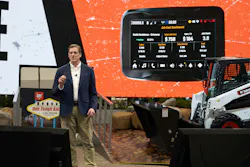
Artificial intelligence (AI) is one of the most discussed technologies in road and bridge construction, but on the equipment itself, it is still in its early stages. Compact loaders are used on jobsites from highways to municipalities and serves as a good example for how AI can improve equipment.
Scott Johnson, senior director of construction products at Bobcat Company, sees the first practical applications of AI focused on a modest goal: making machine information and jobsite insights easier to find and use. Bobcat recently introduced an in-cab assistant that lets operators ask questions and get answers without leaving the machine.
In a Q&A conducted over email with Roads & Bridges, Johnson explains how natural-language tools can cut the time operators spend searching manuals or asking supervisors for help, and how jobsite data can give fleet managers a clearer view of project status and costs while work is underway. He also pushes back on the hype around autonomy, arguing that the complexity of construction sites will keep operators in control. Finally, he outlines what contractors will need to see before AI becomes a productivity tool rather than a buzzword.
R&B: Artificial intelligence has quickly moved from concept to implementation across the construction industry. From your perspective, where is AI already making a measurable difference in construction equipment, and where do you think the industry is still in the early stages of adoption?
Scott Johnson: From a construction equipment standpoint, the initial focus has been on improving access to machine information, generally through online tools that use language models to help users find and apply information more efficiently.
The industry is still in the early stages of adopting AI directly into the machine. Some of the first applications are likely to focus on software that supports planning, job management and other processes around the equipment.
Within the equipment itself, Bobcat has launched its first in-cab AI-based assistant. The focus is on improving operator efficiency and providing access to information directly through the machine. As these technologies continue to develop, the opportunity will be to apply AI in ways that improve operator efficiency while supporting the work they are already performing.
R&B: Many contractors hear the term "AI" but aren't always sure what it looks like on a job site. What are some practical ways AI is being integrated into construction equipment today, and how is it changing the day-to-day work of operators, fleet managers, and project supervisors?
SJ: The most practical AI applications are often the simplest. Instead of searching through manuals, websites or support resources, operators can ask questions in a natural way and get answers quickly. This allows them to spend less time looking for information and more time focused on the work in front of them.
AI is an extremely broad term and can conjure images of robots running machines. In reality, it means making machines more intelligent and empowering operators to get more done in less time. In the past, operators adapted to the machine. Today and in the future, the machine will increasingly adapt to them.
Bobcat Company’s Jobsite Companion enables new operators to learn from the machine rather than stopping supervisors to ask "how-to" questions. We also bring job insights directly into the machine, helping operators work more efficiently.
Those same insights can provide value to fleet managers. By making job information available remotely throughout the day, fleet managers can better understand job status and costs while the work is still underway. This gives them the opportunity to make adjustments during the job rather than waiting until the end, when it may be too late to make changes.
R&B: Looking beyond today's capabilities, how do you expect AI to change the relationship between the operator and the machine over the next five to 10 years? Are we moving toward equipment that can make more decisions autonomously, or will AI primarily serve as a tool to assist human operators?
SJ: Over the next 10 years, there will likely be a lot of hype around AI and autonomy. However, operators should be assured that the complexity of a construction site may make fully autonomous machines a challenge.
AI may result in some actions being automated, particularly in situations where those actions could reduce risk to the operator. But there is an important distinction between automating individual actions and achieving true machine autonomy.
The operator will remain critical to machine operation, even if the nature of that operation changes from what it is today. AI will continue to develop as a tool that supports the operator, while the operator remains responsible for understanding the jobsite, making decisions and directing the work.
R&B: Every major technological shift brings challenges alongside opportunities. What are the biggest barriers to implementing AI in construction equipment—from data quality and workforce training to contractor trust—and what will determine whether AI delivers meaningful productivity gains rather than becoming just another industry buzzword?
SJ: Contractors will adopt AI when it solves real-world challenges without adding complexity. That means the information needs to be accurate and reliable, the tools need to be easy for teams to understand and use, and the technology needs to fit naturally into existing workflows.
For AI to deliver meaningful productivity gains, it needs to help operators and business owners work more efficiently rather than creating another layer of complexity. The value will ultimately be determined by how effectively these tools support the work contractors are already doing.
About the Author
 Gavin Jenkins, Head of Content
Gavin Jenkins, Head of Content
Head of Content
Gavin Jenkins is an award-winning journalist based in Pittsburgh. His work has appeared in The New York Times, The Washington Post, The Atlantic, VICE, Narrative.ly, Prevention, the Pittsburgh Tribune-Review and Beijing Review.
In 2020, two stories he wrote for Pitt Med Magazine earned three Golden Quill Awards from the Press Club of Western Pennsylvania. “Surviving Survival” won Excellence in Corporate, Marketing and Promotional Communications – Written, Medical/Health, while “Oct. 27, 2018: Pittsburgh’s Darkest Day, and the Mass Casualty Response” won Excellence in Written Journalism, Magazines – Medical/Health, as well as the Ray Sprigle Memorial Award: Magazines, a Best in Show award.
After graduating from the University of Pittsburgh at Johnstown in 2003, he covered sports for the Bedford Gazette, in Bedford, Pa., and the Martinsville Bulletin, in Martinsville, Va. In 2006, he returned to Pittsburgh to write for Trib Total Media. Based out of the Kittanning Leader Times, he worked for the Trib for two years, and then he moved to Shenzhen, China, to teach English and freelance. After two years in China, he earned an MFA in nonfiction from the University of Pittsburgh.
When he's not at work, he's usually playing with his border-collie mix, Bob.