
Duluth Upgrades Observational Capabilities
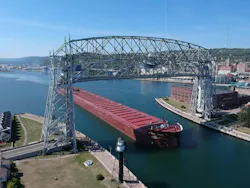
Since 1905, the Duluth Aerial Lift Bridge has been an iconic landmark for the city of Duluth, Minn. Spanning the Duluth Ship Canal, the bridge connects the city center with Minnesota Point — a narrow sand island that is home to a residential community and a recreation district. The bridge’s movements are controlled by an operator who monitors operations from a pilot house in the structure’s center. The operator uses cameras mounted above and below the bridge to check for vehicles and pedestrians, as well as to observe approaching vessels and determine whether their height might pose a problem.
Every 30 minutes, the bridge is raised for sailboats, fishing charters and other passing vessels, but it also needs to accommodate cruise ships, barges, tankers and other vessels frequenting the port city of Duluth. In fact, the city estimates that the bridge might be raised as many as 4,000 times a year between water traffic and maintenance needs, which means situational awareness is critical. To ensure bridge operators have all of the information they need to make safe, accurate and timely decisions, the city of Duluth has invested heavily in modern observation solutions.
The Specific Challenges
For decades, the city relied on a system of analog cameras to observe conditions around the bridge, but these older devices weren’t perfectly suited for a bridge 390 feet long and 138 feet high.
Poor image quality could make it difficult to discern fine details, particularly during inclement weather conditions like heavy rain or snow. As more advanced devices became available, Duluth officials upgraded the cameras and sensors placed throughout the bridge, moving away from traditional analog devices and toward digital devices with higher image quality, better zoom capabilities and the durability to withstand extreme weather and temperatures ranging from -50 degrees Fahrenheit to 120.
Ultimately, the bridge required these devices to provide a clear view of all traffic entry points and high-risk areas, as well as full visibility across the entirety of the bay. According to Duluth, accomplishing this without cameras would require the city to hire at least four new employees per shift to stand outside the structure and manually observe the bridge’s status—an option that would be inefficient and financially unsustainable.
By turning to modern surveillance technology, the city improved the efficiency and accuracy of its observational capabilities, assuring bridge operators that no vehicles or pedestrians were present in dangerous areas.
Bridge Safety
It's important to note that cameras themselves are not enough. Any modern observation system requires a robust video management system (VMS). Duluth elected to hard-wire the bridge’s cameras into its VMS to reduce the potential for latency or outages, which would significantly disrupt bridge operations.
By using a hard-wired system, Duluth minimized potential video loss and ensured that bridge operators maintained a reliable, real-time view of bridge conditions—even in the event of internet outages. Operators can also use the VMS to pan, tilt or zoom each individual camera while also streaming footage directly to the city’s data center servers where it can be recorded and archived for later searchability and review.
Bridge operators are not the only ones making use of these observational capabilities. While the operator has primary control of the cameras, police and fire department personnel can manipulate the cameras during emergency events to improve their understanding of conditions on the ground. Cooperation between these departments has been essential and has led to the institution of a hierarchy of permissions: police and fire staff can temporarily control certain cameras, while Coast Guard personnel have access to livestreams (but cannot control them). This ensures that the appropriate departments can gain access to the information they need, when they need it—without compromising bridge safety or operations.
Before upgrading to more modern devices, bridge operators manually relayed incident information to emergency departments. But older, analog devices often could not discern key details. Today, operators can clearly see details like clothing, distinguishing features and even license plate numbers, allowing them to provide law enforcement with critical information.
Best of all, the new devices capture much of the information automatically, ensuring bridge operators can verify safety conditions swiftly and accurately. In the past, it could be difficult for an operator working alone to establish visual clearance of every key location. Today, the process is straightforward, reliable and safer than ever.
Enhancing Safety Efficiently
Safety is a key priority for Duluth, and city officials have been pleased with the impact the new devices have had.
“We couldn’t operate the Aerial Lift Bridge without these cameras,” said Bridge Supervisor Dave Campbell.
Other officials have noted that the self-contained nature of the camera network ensures continuous operation.
“As long as the bridge has power, those cameras keep on working,” said Duluth Network Administrator Chris Majerle.
By enhancing the bridge’s observational capabilities in a manner that serves the location’s unique and specific needs, Duluth has established an efficient, reliable way to keep everyone safe—whether they are in the water or on the road.
Anthony Incorvati is the transportation segment leader- Americas region, at Axis Communications.