Precision and Connectivity
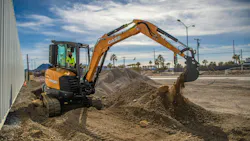
Mini excavators are playing a larger role on road and bridge projects, from trenching for utilities to cutting embankment slopes. Technology once reserved for larger machines and expert operators is now showing up on these smaller machines. Affordable 2D guidance systems help operators hit grade and slope with less corrective work, telematics helps fleet managers keep track of machines spread across multiple jobsites and attachments such as tilt rotators let skilled operators work around structures with fewer moves.
Ryan Anderson, product manager — subcompact equipment at CASE Construction Equipment, discusses those changes in this Q&A with Roads & Bridges, which was conducted over email. He explains how 2D guidance can help less-experienced operators become productive quickly, and why AI in compact equipment is showing up first in manuals, service and diagnostics rather than in machine operation. He also explains why he expects mini excavators to stay relatively simple machines, even as 2D guidance moves toward becoming standard from the factory.
R&B: Mini excavators have evolved from utility machines into sophisticated pieces of construction equipment. What technological advancements have had the biggest impact on their capabilities over the past decade, and how has that changed the way they're used on today's transportation infrastructure projects?
Ryan Anderson: The further adoption and development of 2D precision tools have really driven a lot of the change and evolution. These tools give the operator real-time guidance for bucket position relative to a target depth or slope. On road projects, that can help with excavating roadway bases, cutting embankment slopes and digging utility trenches to the right depth and pitch.
2D tools have become far easier to learn and use and cheaper to implement. The clear added value of doing less corrective work and lowering material costs has driven a shift where less experienced operators are starting to look at these tools. Ten years ago, 2D tools were thought to be for expert operators and larger machines only. Now technology like lasers and depth-check receivers can be seen on 2.5-ton mini excavators and up.
In addition, telematics has helped in the realm of road and bridge construction where machines are deployed in more public environments. This provides a little more peace of mind as theft and vandalism continue. Fleet managers have better visibility into machines that may be spread across multiple road projects. They can monitor machine activity, receive maintenance alerts and use geofencing and curfew settings to help identify unauthorized operation. That’s especially useful when compact machines are out overnight or moved frequently between jobsites.
R&B: Artificial intelligence is becoming a major force across the construction industry. How is AI beginning to influence compact equipment—from machine diagnostics and predictive maintenance to operator assistance—and where do you see the greatest opportunities over the next five years?
RA: In the compact equipment category, AI is still in an exploratory phase from the manufacturer perspective. Sure, there are some machines coming out with AI user operating systems, but they are still not widely available with the acceptance level still to be determined. Going back to the manufacturer perspective, AI is starting to find its way more in the product support realm. AI is starting to really help manufacturers, dealers and customers with more user-friendly operator manuals and better service support and diagnostics. This allows manufacturers and dealers to swiftly resolve customer machine issues, resulting in less downtime.
R&B: Highway contractors are under constant pressure to improve productivity while addressing skilled labor shortages. Which operator-assistance and automation technologies are having the greatest impact on mini excavators? How do they help less-experienced operators work more safely and efficiently?
RA: This goes back to the adoption of 2D solutions. Where the tech is at today, someone with less operational experience can quickly gain a high level of productivity and efficiency. For labor savings, this reduces how frequently the operator must stop, leave the cab or rely on another crew member to check grade.
The use of attachments like tilt rotators is also clearly trending, allowing more experienced operators to separate themselves. This kind of tool is really driving solid efficiency where operators can work around structures and obstacles with fewer moves to position the excavator. A good example is manhole maintenance, when the operator can dig, shape, backfill and finish around the structure with less maneuvering and less manual cleanup. In the hands of a skilled operator, that can produce substantial time and labor savings.
R&B: Looking ahead, what technologies that seem cutting-edge today do you expect will become standard on mini excavators within the next five years? How will those advancements change the way contractors approach road, bridge and utility construction?
RA: Even with added operational enhancements like tandem hydraulic pumps and electro-hydraulic controls, mini excavators are still simple machines. Customers tend to prefer that. That said, eventually, 2D factory solutions will be more readily available and potentially standard on many models.
About the Author
 Gavin Jenkins, Head of Content
Gavin Jenkins, Head of Content
Head of Content
Gavin Jenkins is an award-winning journalist based in Pittsburgh. His work has appeared in The New York Times, The Washington Post, The Atlantic, VICE, Narrative.ly, Prevention, the Pittsburgh Tribune-Review and Beijing Review.
In 2020, two stories he wrote for Pitt Med Magazine earned three Golden Quill Awards from the Press Club of Western Pennsylvania. “Surviving Survival” won Excellence in Corporate, Marketing and Promotional Communications – Written, Medical/Health, while “Oct. 27, 2018: Pittsburgh’s Darkest Day, and the Mass Casualty Response” won Excellence in Written Journalism, Magazines – Medical/Health, as well as the Ray Sprigle Memorial Award: Magazines, a Best in Show award.
After graduating from the University of Pittsburgh at Johnstown in 2003, he covered sports for the Bedford Gazette, in Bedford, Pa., and the Martinsville Bulletin, in Martinsville, Va. In 2006, he returned to Pittsburgh to write for Trib Total Media. Based out of the Kittanning Leader Times, he worked for the Trib for two years, and then he moved to Shenzhen, China, to teach English and freelance. After two years in China, he earned an MFA in nonfiction from the University of Pittsburgh.
When he's not at work, he's usually playing with his border-collie mix, Bob.