When Wildfire Reaches the Highway
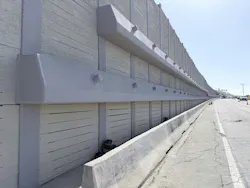
When the Palisades Fire burned to the coast in January 2025, much of the attention focused on lost homes. But the fire also left lasting damage along the Pacific Coast Highway, also known as State Route 1. Caltrans inspectors found burned guardrails, charred retaining walls, unstable slopes and destroyed drainage systems, and mud and debris flows from the fire-stripped bluffs buried parts of the highway. At least one timber retaining wall failed after flames consumed the hillside behind it. Repairs have stretched into 2026, including the rebuilding of a 710-foot retaining wall below the Getty Villa.
The PCH recovery points to a challenge more transportation agencies now face. As development pushes into the wildland-urban interface, highways that serve as evacuation routes and emergency access are increasingly exposed to fire. Some of the most serious damage isn't visible right away: heat can weaken steel, concrete and timber, and burned slopes can fail with the first heavy rain. That raises practical questions for owners. How should they evaluate assets that survive a fire? Should they rebuild damaged roads and bridges to the same standard or better? Should wildfire become a routine design consideration, the way seismic and flood risk already are?
Troy Marshall is vice president of thermal management at NanoTech Materials, a Houston-based company whose fire-protective coating was applied to the Getty Villa wall. In this Q&A with Roads & Bridges, conducted over email, Marshall explains the wildfire damage agencies most often overlook and what the PCH project taught about training crews and maintaining quality on a fast-moving emergency job. He also discusses the case for applying protection in the shop rather than the field, and why he believes wildfire risk should be built into design standards, asset management and lifecycle cost analysis.
R&B: When people think about wildfire damage, they usually think about homes and forests—not transportation infrastructure. What are the biggest misconceptions about how wildfires affect roads, retaining walls, bridges and other highway assets, and what kinds of damage often go unnoticed until long after the fire is out?
Troy Marshall: One of the biggest misconceptions is that if a bridge, retaining wall, or roadway is still standing after a wildfire, it has escaped significant damage. In reality, some of the most serious impacts are often the ones that cannot be seen immediately. Extreme heat generated during a wildfire can permanently affect the performance of critical infrastructure materials—including wood timbers, structural steel, reinforced concrete, and protective coating systems.
For transportation agencies, the concern extends well beyond visibly burned areas. Wildfire exposure can reduce the strength of structural components, accelerate material deterioration, compromise protective systems, and shorten the service life of critical assets. At the same time, the loss of surrounding vegetation increases the potential for erosion, slope instability, debris flows, and mudslides, creating additional risks that may not become apparent until the first significant rain event weeks or even months after the fire.
Another common misconception is that wildfire resilience is only a concern for remote forests or rural highways. Today, some of the fastest-growing risks exist within the wildland-urban interface (WUI), where communities, transportation corridors, and critical infrastructure intersect with fire-prone landscapes. As wildfires become more frequent and severe, highways, bridges, retaining walls, tunnels, and utility corridors are increasingly exposed to prolonged heat while serving as essential lifelines for emergency response, evacuation, and post-fire recovery.
R&B: As wildfire resilience becomes a greater priority, contractors are being asked to perform work that many crews have little experience with. What does it take to effectively train field and shop personnel to install fire-protection systems correctly, and what lessons have you learned from Pacific Coast Highway rehabilitation project about maintaining quality and consistency across multiple crews on fast-moving projects?
TM: Planning and collaboration are critical. Successful implementation began well before the first application. Close coordination between Caltrans, the contractor, material suppliers, and the coating team ensured that construction sequencing, material handling, quality control, and inspection requirements were clearly understood. Integrating passive fire protection into the project early helped avoid schedule impacts while maintaining construction efficiency.
Workforce training plays a significant role in project success. Although the application process was straightforward, consistent installation techniques, proper surface preparation, environmental awareness, and coating thickness verification were essential to achieving a quality installation. Hands-on training gave the construction crews confidence in both the application process and the quality expectations required for long-term performance.
Quality assurance in the field is just as important as laboratory testing. Routine inspections, wet and dry film thickness measurements, and adherence to established application procedures helped ensure the coating system was installed consistently across every timber member. These quality control measures provide owners with confidence that the installed system will perform as intended.
R&B: Transportation agencies often face difficult decisions about investing in preventive measures versus repairing infrastructure after a disaster. From your perspective, what should DOTs and local agencies be doing today to make retaining walls, bridges and other critical transportation assets more resilient before the next wildfire occurs?
TM: I believe the biggest opportunity for transportation agencies is to shift their mindset from reactive recovery to proactive resilience. Historically, infrastructure investments have been driven by repairing damage after a wildfire or other natural disaster. Today, as wildfires become more frequent and more severe—particularly within the wildland-urban interface (WUI)—there is an opportunity to incorporate resilience into routine maintenance, rehabilitation, and capital improvement projects before the next event occurs.
Transportation agencies should begin by identifying critical assets that are most vulnerable to wildfire exposure, including timber retaining walls, bridges, tunnels, slope stabilization systems, and other structures located along high-risk transportation corridors. As these assets are rehabilitated or replaced, agencies should evaluate design strategies and passive fire-protection technologies that can improve their ability to withstand extreme heat while extending service life and reducing future maintenance and reconstruction costs.
As part of the reconstruction effort of the Pacific Coast Highway project, damaged timber lagging was replaced and upgraded with a passive fire-protection system prior to installation. One of the key lessons from that project was the value of pre-coating replacement timber lagging off-site before it arrived at the jobsite.
There are also significant construction and safety benefits. Delivering pre-coated timber lagging to the project site minimizes field application activities, allowing replacement timbers to be installed more efficiently. For transportation agencies working on busy highway corridors, this translates into shorter construction durations, fewer lane or road closures, reduced disruption to the traveling public, and less time that contractors and maintenance personnel are exposed to live traffic. Improving worker safety while accelerating project delivery is an important benefit that should not be overlooked.
With proper planning, contractor training, and quality assurance, passive fire protection can become another tool available to transportation agencies as they strengthen infrastructure for future wildfire events.
R&B: With wildfires becoming more frequent and more destructive in many parts of North America, how do you see transportation agencies changing the way they design, rehabilitate and maintain infrastructure over the next decade? Are we entering an era where wildfire resilience becomes a standard consideration, much like seismic design or flood resilience?
TM: Wildfires are no longer isolated events; they're quickly becoming a recurring infrastructure challenge across much of North America. Just as agencies routinely evaluate seismic earthquake risk in California or flood risk in coastal regions, wildfire exposure will increasingly become part of how transportation assets are designed, rehabilitated, and maintained.
We're already beginning to see this shift in rehabilitation projects, where agencies are looking beyond replacing damaged assets and instead evaluating how reconstruction can improve long-term resilience.
As transportation agencies incorporate ongoing wildfire risk planning into long-range planning and asset management, we're likely to see greater emphasis on resilient materials, proactive protection of existing infrastructure, and performance-based specifications that consider how assets perform during extreme heat and wildfire events, not just under normal operating conditions. Resilience planning is critical because it isn’t just about protecting infrastructure assets; it's about protecting evacuation routes, maintaining emergency access, reducing lifecycle costs, and improving community resilience over the long term.
Over the next five to ten years, I'd like to see wildfire resilience become a standard consideration in transportation asset management rather than something that's evaluated only after a catastrophic event. We have decades of established practices for designing infrastructure to withstand earthquakes, floods, hurricanes, and corrosion. As wildfire risk continues to grow, I believe it's time for wildfire resilience to be incorporated into that same level of long-term planning.
I'd also like to see wildfire resilience become more fully integrated into transportation design standards, asset management programs, and lifecycle cost analyses. When agencies evaluate rehabilitation alternatives, the discussion shouldn't focus solely on initial construction cost—it should also consider long-term durability, service life, public safety, system reliability, and the economic impacts of infrastructure disruptions. Resilient infrastructure is ultimately an investment in reducing future risk.
Ultimately, success won't be measured by how quickly we recover after the next wildfire—it will be measured by how well we prepare before it happens. If, over the next decade, wildfire resilience becomes a routine part of transportation planning and infrastructure rehabilitation, we'll deliver transportation systems that are safer, more durable, more reliable, and better equipped to serve the public in an increasingly challenging environment.
About the Author
 Gavin Jenkins, Head of Content
Gavin Jenkins, Head of Content
Head of Content
Gavin Jenkins is an award-winning journalist based in Pittsburgh. His work has appeared in The New York Times, The Washington Post, The Atlantic, VICE, Narrative.ly, Prevention, the Pittsburgh Tribune-Review and Beijing Review.
In 2020, two stories he wrote for Pitt Med Magazine earned three Golden Quill Awards from the Press Club of Western Pennsylvania. “Surviving Survival” won Excellence in Corporate, Marketing and Promotional Communications – Written, Medical/Health, while “Oct. 27, 2018: Pittsburgh’s Darkest Day, and the Mass Casualty Response” won Excellence in Written Journalism, Magazines – Medical/Health, as well as the Ray Sprigle Memorial Award: Magazines, a Best in Show award.
After graduating from the University of Pittsburgh at Johnstown in 2003, he covered sports for the Bedford Gazette, in Bedford, Pa., and the Martinsville Bulletin, in Martinsville, Va. In 2006, he returned to Pittsburgh to write for Trib Total Media. Based out of the Kittanning Leader Times, he worked for the Trib for two years, and then he moved to Shenzhen, China, to teach English and freelance. After two years in China, he earned an MFA in nonfiction from the University of Pittsburgh.
When he's not at work, he's usually playing with his border-collie mix, Bob.