Building Reliability Amid Wildfire Risk
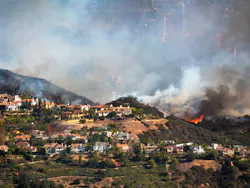
In January 2025, Southern California was devastated by a series of wildfires that merged and escalated into a destructive firestorm. In some places, Santa Ana winds reached 100 mph. The Palisades Fire and Eaton Fire caused the most damage, and at month’s end, when they were contained, 31 people had died.
In May 2025, California invested nearly $1.7 billion in highway safety and resilience improvements, including $86.5 million to repair roads and transportation infrastructure damaged during the disaster.
That figure highlights the growing impact of wildfire across all forms of critical infrastructure. For transportation systems specifically, wildfire now represents a direct and increasing threat to the availability, operability and safety of the corridors that support evacuation, emergency response and daily commerce.
Utilities, having adjusted their operations amid the rising wildfire threat, can offer transportation agencies useful perspective as they develop and deploy resilience strategies to protect critical mobility assets.
What's Changed in California
California's wildfire risk profile has fundamentally shifted. Fire seasons that once followed a predictable window from late summer through fall now extend year-round. The state's six investor-owned utilities all have authority under California Public Utilities Code to proactively de-energize power lines when conditions present an imminent and significant ignition risk. That authority has resulted in hundreds of public safety power shutoff (PSPS) events affecting millions of customers.
From a utility perspective, PSPS is a last-resort action taken under significant uncertainty. You do not know where a fire will start or when, and you do not know which part of your system could be the source. You only know that environmental conditions favor a fire that may not be contained.
From a transportation perspective, the consequences appear as secondary effects that are difficult to plan for, largely because there is no way to anticipate with certainty where or when impacts will occur. That uncertainty is the core challenge.
Traffic signals go dark, roadway lighting fails, electronic message signs lose power, railroad crossing revert to unpredictable states and communication systems used for emergency response can degrade or go offline.
Each of these failures introduces a direct safety risk: to drivers, to emergency responders, and to the communities relying on those corridors for evacuation. These communication systems are not just for emergencies; they underpin everyday operations and losing them is akin to losing sight or hearing.
When a utility de-energizes a line that passes through a fire threat district, every piece of electrically dependent transportation infrastructure in that corridor is affected.
Utilities also serve water infrastructure. The longer the outage, the greater the risk to communities that depend on wells and pumped storage for clean drinking water, and the immediate ability to fight fire is reduced.
The fires themselves have grown more destructive. The Palisades Fire burned more than 17,000 acres, displaced more than 175,000 people, and forced closures of major highways including Interstate-210 and Interstate-5.
These corridors carry freight, commuters and emergency responders throughout the Los Angeles basin. Closures during that event created chokepoints that slowed response, disrupted logistics and added pressure to an already complex situation.
A Shared Responsibility
Wildfire is often viewed as either a forestry issue or as an electric utility issue. While that is partially true, it does not account for the downstream effects on all critical infrastructure.
Roads serve as evacuation lifelines: When wildfire forces mass evacuation, the road network becomes the most critical piece of infrastructure in the system. Events across California illustrate how quickly evacuation demand exceeds road capacity, turning congestion into a direct safety risk, with gridlocked traffic, stalled evacuations and, in worst cases, loss of life on the roadway itself.
Because agencies own and operate this infrastructure, each with varying levels of capacity, resources and jurisdictional authority. The condition, design and management of the network directly influence whether evacuation efforts succeed or fail under pressure.
Corridors support fire response: Fire suppression depends on moving heavy equipment, including engines, water tenders, dozers and other equipment, to the fire's edge. In mountainous terrain, a single bridge closure or road washout adds significantly to response times when every minute counts.
When access is limited to narrow or unpaved roads, response time can determine whether a fire is contained or escalates into a major event affecting communities.
Resilience extends beyond the fire itself: Post-wildfire rainfall on already compromised soils can trigger debris flows and landslides that threaten hillside transportation infrastructure long after the fire is contained.
A single fire event can degrade transportation reliability for months or years. Efforts such as California’s Fire Safe Roadways Working Group demonstrate continued leadership in addressing these longer-term risks.
Lessons Learned
Utilities respond to events differently based on geography, climate and the communities they serve. However, three operational realities may offer insight for transportation leaders working under similar conditions.
Decisions are made under uncertainty: In utility control rooms, every outage begins as an unstructured problem to solve. Outages in general are unknown until the cause is found and then the response is known, studied and trained.
During a PSPS event, that sequence breaks down. There is no outage to start from, only a region of elevated risk defined by weather that shifts continuously. A forecast that justifies de-energizing customers at midnight may look entirely different by the next morning.
Yet the decision to de-energize, or not, must be made on a timeline that is at odds with two principles: Keep the lights on, and at the same time nothing can fail in such a way that the resulting arc may cause a fire.
Transportation agencies face the same dilemma. Close an evacuation route too early and you cut off evacuation routes; close it too late and civilians on the road are exposed while suppression crews fight through evacuation traffic.
The answer is not better forecasts, but decision frameworks that define triggers for action, acceptable levels of uncertainty and clear authority to act.
Risk trade-offs happen quickly: Every PSPS event involves trade-offs between ignition risk and the consequences of leaving communities without power. Utilities evaluate this through structured benefit-risk models that weigh safety, reliability and financial consequence in the context of fire risk.
Transportation agencies can consider equivalent frameworks. Restricting access to a bridge threatened by fire exposure trades direct safety risk against evacuation capacity.
Diverting traffic onto secondary roads trades congestion against direct fire proximity. Similar to electric utilities, the decisions that need to be made should be pre-planned, scenario-tested and coordinated with the utilities and emergency management organizations that will be making parallel decisions on overlapping timelines.
Cross-agency coordination often lags reality: This may be the hardest truth to face. Utilities, fire agencies, law enforcement and transportation departments are each solving unstructured problems in real time during active fire events.
Utilities notify the California Independent System Operator (CAISO), local governments and critical facilities of pending PSPS events, but notification is not coordination.
When do transportation agencies actually become aware? Who tells them? Is it through formal channels, or from social media or a 911 call?
Notification is only the starting point. A utility’s charge is to keep the line energized until it is no longer practical to do so, and that timeline can shift from weeks to hours or even minutes.
The resulting coordination gaps are not malicious, they are structural. Each infrastructure group is responding as best it can, but coordination is rarely integrated unless the utility is municipally owned.
What Agencies Can Consider
If wildfire risk is a transportation reliability issue, transportation agencies should consider similar questions to those of the electric utilities:
How does wildfire risk influence criticality? Not all roads are equally important during a fire event. Critical routes may not align with highest traffic volumes. Factors such as terrain, exposure, proximity to ignition sources and access to suppression resources (such as pumps or wells) all influence performance during a wildfire.
Agencies should also evaluate the placement of community shelters and incident command centers and identify contingency plans if those sites are threatened.
How does power availability shape operations? Signals, sensors, cameras and communication systems depend on electricity. Backup power may not last through extended outages.
Corridors located in high fire-threat districts are at risk of de-energization during fire weather. Understanding these dependencies help inform more resilient system design and operations.
How do interdependencies affect decision-making? No plan performs perfectly during a wildfire. Utilities plan for fire weather. Transportation agencies plan for traffic. Emergency managers plan for evacuation.
However, the thresholds that trigger action do not always align across those systems. A utility may decide when to de-energize based on fire weather and grid conditions, while a transportation agency may be focused on roadway capacity, access and evacuation flow.
Those decisions are connected, but they are not always made on the same timeline or with the same operating picture.
This type of challenge has been addressed in other disasters. During major hurricanes, unified command structures bring agencies together around shared situational awareness, clearly defined roles and faster coordination. Similar approaches offer a useful model to help wildfire-prone regions improve coordination across utilities, transportation and emergency response as conditions change rapidly.
Transportation Resilience
Wildfires in California are no longer a peripheral environmental risk for transportation. It is a core reliability and resilience challenge that demands the same rigorous planning applied to seismic risk, flooding, extreme weather and asset management.
Transportation agencies across the state are already managing these complexities. As conditions continue to evolve, there is an opportunity to build on existing practices by further integrating wildfire risk into planning, operations and cross-agency coordination. These practices are grounded in a shared understanding of the decision points and thresholds that drive action for each responding group.
Utilities have adapted through experience and regulatory pressure. Transportation agencies are well positioned to continue advancing proactive, system-wide approaches that support safe, reliable movement in an increasingly dynamic risk environment.
Josh Tweedy is vice president of Utility Operations Advisory Services, WSP in the U.S., specializing in grid resilience, wildfire risk and operational decision support for critical infrastructure.