Commercial Street Bridge Shows What Infrastructure Can Be
In May, I bumped into an acquaintance while walking my dog in Highland Park, the Pittsburgh neighborhood where I live. We know each other from the dog park, and as our dogs greeted each other, he asked if I knew about the Commercial Street Bridge project.
“Is this the first of its kind?” he asked.
He was shocked that the Pennsylvania Department of Transportation (PennDOT) planned to shut down a portion of Interstate 376, locally known as Parkway East, for a month to demolish and replace Commercial Street Bridge.
Throughout this year, I have had numerous conversations like this. People who work outside of the infrastructure construction industry have no idea what accelerated bridge construction (ABC) is and how effective it can be.
I have enjoyed seeing my life in Pittsburgh and my work covering infrastructure intersect in meaningful ways.
My favorite part: predicting to friends and family that PennDOT’s ambitious schedule would be achieved. This week, PennDOT made me look like Nostradamus to these people, when it opened the Commercial Street Bridge a week early.
This achievement deserves recognition beyond Pittsburgh’s three rivers, and not because completing an ABC project early is unusual, but because of what it represents.
The Parkway East is one of western Pennsylvania's most critical transportation corridors. It connects downtown Pittsburgh with the Pennsylvania Turnpike, as well as eastern suburbs, especially Monroeville and its business district. It carries commuters, freight, emergency vehicles and visitors every day. Closing it for nearly a month was never going to be convenient.
Yet, through an impressive outreach program, most Pittsburghers seemed to understand why it had to happen.
The Commercial Street Bridge had reached the point where replacement was the responsible choice. The question wasn't whether to replace it. The question was how to replace it while minimizing disruption to the public.
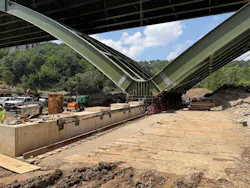
PennDOT chose an ambitious path: Instead of stretching construction over months with shifting lane closures and years of traffic headaches, the agency opted for a full closure combined with accelerated bridge construction techniques. It built the replacement bridge in advance, demolished the old structure, slid the new bridge into place, reconnected the highway and reopened traffic as quickly as possible.
It's a strategy we've written about many times in Roads & Bridges. But it's one thing to understand the concept intellectually and another to experience it as a resident.
I’m blown away by the result, and most people I know feel the same way. There is something remarkable about watching an aging bridge disappear and a new one take its place in just a matter of weeks.
Despite how impressive the project was, I would be remiss if I did not point out that the closure was challenging.
Traffic patterns changed overnight. Neighborhood streets absorbed detoured vehicles. Businesses adjusted deliveries. Families left home earlier. Employers encouraged remote work. Transit agencies modified service. Navigation apps recalculated millions of trips.
It became a regional exercise in patience.
However, there seemed to be less frustration compared with what many expected. PennDOT deserves credit for that. The agency made the schedule clear. It explained why the closure was necessary. It showed the public how the work would unfold. Most importantly, it gave residents confidence that every day of inconvenience was buying something meaningful.
Then the construction teams delivered.
Reopening the Parkway East more than a week ahead of the announced deadline wasn't simply good public relations. It was evidence that the planning, engineering and execution all worked together.
Projects like this require years of preparation before the first excavator arrives. Designers, contractors, inspectors, utility companies and public agencies spend countless hours coordinating logistics most motorists will never see. Every bridge component, every lane closure, every concrete pour and every crane lift must happen in sequence. When one activity slips, everything behind it can slip as well.
Finishing early is rarely the result of luck.
It is usually the result of disciplined planning.
The project also demonstrated something larger about the direction of our industry.
Accelerated bridge construction is no longer an experimental delivery method reserved for a handful of showcase projects. It has become one of the most effective tools transportation agencies have for replacing aging infrastructure while minimizing impacts on the traveling public.
That matters because America's transportation network is aging.
Thousands of bridges across the country will require rehabilitation or replacement in the coming decades. Communities are increasingly unwilling to accept years of construction delays if better approaches exist. They expect projects to move faster, communicate more clearly and reopen sooner.
The Commercial Street Bridge showed that those expectations can be met.
As someone who covers infrastructure for a living, I appreciated the engineering.
As someone who lives in Pittsburgh, I appreciated getting the Parkway back.
Those are two different perspectives, but they lead to the same conclusion.
This wasn't simply a successful bridge replacement.
It was a successful demonstration of what modern infrastructure delivery can look like when owners, engineers and contractors share a common goal: complete the work safely, complete it well and give the road back to the public as quickly as possible.
Transportation projects rarely become civic celebrations. Most are remembered for delays, detours or cost overruns.
The Commercial Street Bridge earned the goodwill of a region through precision, planning and communication, and the rest of the industry should take note.
About the Author
 Gavin Jenkins, Head of Content
Gavin Jenkins, Head of Content
Head of Content
Gavin Jenkins is an award-winning journalist based in Pittsburgh. His work has appeared in The New York Times, The Washington Post, The Atlantic, VICE, Narrative.ly, Prevention, the Pittsburgh Tribune-Review and Beijing Review.
In 2020, two stories he wrote for Pitt Med Magazine earned three Golden Quill Awards from the Press Club of Western Pennsylvania. “Surviving Survival” won Excellence in Corporate, Marketing and Promotional Communications – Written, Medical/Health, while “Oct. 27, 2018: Pittsburgh’s Darkest Day, and the Mass Casualty Response” won Excellence in Written Journalism, Magazines – Medical/Health, as well as the Ray Sprigle Memorial Award: Magazines, a Best in Show award.
After graduating from the University of Pittsburgh at Johnstown in 2003, he covered sports for the Bedford Gazette, in Bedford, Pa., and the Martinsville Bulletin, in Martinsville, Va. In 2006, he returned to Pittsburgh to write for Trib Total Media. Based out of the Kittanning Leader Times, he worked for the Trib for two years, and then he moved to Shenzhen, China, to teach English and freelance. After two years in China, he earned an MFA in nonfiction from the University of Pittsburgh.
When he's not at work, he's usually playing with his border-collie mix, Bob.