How DOTs Are Using Snow Sensors, RWIS and MDSS to Improve Winter Operations
Key Takeaways
- DOTs are seeking more accurate winter weather data after heavy snowfall and budget overruns highlighted the need for more efficient snow and ice operations.
- LIDAR-based snow sensors are gaining attention because they can provide more reliable measurements during active snowfall and operate effectively in remote locations.
- Many agencies are weighing standalone sensor upgrades against full RWIS and MDSS platforms, which combine weather observations, pavement conditions and forecasting tools to support operational decisions.
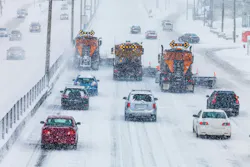
Snow remains a major topic for state transportation departments long after it melts, as the summer months are when agencies develop their maintenance plans for the upcoming winter. After the unprecedented snowfall of winter 2026, when many northeastern DOTs overspent their snow removal budgets, there is surmounting pressure to improve accuracy and efficiency in snow response efforts.
These considerations are leading transportation departments to reevaluate whether traditional snow measurement tools are enough — or if more comprehensive, connected systems are needed.
To run data-informed operations, DOTs are electing to install snow-depth sensors incrementally — a more cost-effective approach — or invest in full Road Weather Information Systems (RWIS) and Maintenance Decision Support Systems (MDSS) platforms that provide a more complete picture of weather conditions.
Targeted Sensors
Ultrasonic sensors are widely used by many DOTs as they are cost-effective and compatible with RWIS systems but can become less reliable over time as they degrade during active snowfall and suffer from gradients in air temperature, blowing snow, humidity and acoustic interference.
Some DOTs are turning to LIDAR-based snow depth sensing for more accurate snow depth measurements, as this technology has proven to be more resilient during active storms, and provide continuous, real-time measurements.
R.M. Young’s re-engineered SNOdar sensor reflects this shift, using LIDAR to maintain accurate readings during snowfall, when agencies need to make decisions quickly.
Ultrasonic sensors rely on acoustic waves and operate on a wide cone angle — creating interference from airborne objects, such as snowflakes during heavy snowfall.
Meanwhile, LIDAR sensors utilize a narrower beam and can operate at a much lower noise floor.
“Based on that, it’s going to see fewer of the snowflakes because it’s covering less of the air volume,” Conor Byrne, engineering manager of RM Young, said. “Really, all of your signal that’s coming back to the sensor is coming from the snow surface, so it’s going to measure the true distance to the snow surface regardless of what’s in the air.”
Their low power draw of 0.5 watts also makes them ideal for remote locations as they can run effectively on solar and battery.
LIDAR sensors provide DOTs with real-time data, as well as offer data logging capabilities that are especially impactful during power outages or communication issues as it allows for post-storm data retrieval and snow analysis. These capabilities are typically lacking in ultrasonic sensors.
SNOdar sensors work together with several other sensors that measure road surface temperatures and wind, for example, as the all-in-one sensors on the market do not provide snow depth measurements.
“None of it happens alone, especially as it comes to roads and bridges,” Byrne said. “You need temperature and relative humidity to predict road icing conditions. You might need road surface temp. You’re going to want wind to predict drifting across the road. No one data point, no one sensor tells you everything.”
Integrated Decision-Support Systems
To keep up with the technology available, agencies are deciding whether to incrementally introduce new standalone sensors — effectively upgrading their RWIS piece by piece — or complete a full system overhaul and invest in a single fully integrated RWIS network and MDSS.
The piecemeal approach has a lower upfront cost and is easier to deploy, but it can leave agencies working with siloed data and more limited decision-making support.
Meanwhile, a fully comprehensive approach that includes RWIS and MDSS is able to create a full picture of actual weather conditions in addition to snow depth, including pavement temperatures and weather forecasts.
The Minnesota Department of Transportation (MinnDOT) operates 160 weather stations statewide.
For MinnDOT, the largest factor for their snow operations hinges on pavement temperatures. Snow depth isn’t as crucial, as that number is calculated after they have already deployed their snow crews.
“We are out there as snow begins to fall,” said Jed Falgren, MinnDOT’s state maintenance engineer. “We are trying to be out there and begin making sure that we don’t get snow accumulations, or if we get them we can at least manage them a little bit better.”
The RWIS sensors support their team in making systemic decisions such as whether to apply chemicals, whether plowing is needed and how to best manage the resources at their disposal.
“We want to understand what is happening out there, and then what should our response be,” Falgren said, in order to keep the roads open throughout the storm.
Their system also helps crews use resources more efficiently. In blowing snow conditions, Falgren said, wind may clear snow from the roadway on its own, reducing or even eliminating the need for plowing.
Whether agencies invest in individual sensors or fully integrated RWIS and MDSS platforms, the goal is the same: giving crews better data to make smarter decisions. For smaller DOTs, targeted snow-depth sensing may be enough. For larger statewide agencies, broader systems can offer the coordination needed to manage resources more effectively.
About the Author
 Jessica Parks, Staff Writer
Jessica Parks, Staff Writer
Staff Writer
Jessica Parks is a staff writer at Roads & Bridges with newsroom experience in Brooklyn, Long Island and the U.S. Virgin Islands, and several years spent living in Puerto Rico. She is currently based in Tulsa, Oklahoma.