Road No. 10: Bottleneck Solutions are Bigger in Texas
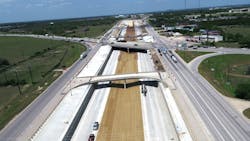
Williamson County is one of the fastest-growing areas in Texas. For years, U.S. 183A struggled to accommodate the region’s growth. The corridor’s tolled facility ended at Hero Way, creating a bottleneck for northbound travelers, while frontage roads regularly exceeded capacity. Congestion and safety concerns threatened mobility, freight movement and access to neighborhoods and businesses.
The 183A Phase III project addressed these challenges by extending the toll road 6.6 miles north, adding lanes, enhancing safety and integrating multimodal options. For these reasons, the project placed 10th on our list of Top 10 Roads of 2025.
The project added two tolled lanes in each direction within the existing median, expanded frontage road capacity and introduced a 10-foot-wide shared-use path for pedestrians and cyclists. Five elevated overpasses improved traffic flow, alleviated traffic volumes at signalized intersections and reduced conflict points, creating a safer, more reliable travel experience.
Continuous reinforced concrete pavement (CRCP) mainlanes were incorporated to ensure long-term durability, capable of handling heavy commuter and freight traffic. The corridor improvements provide critical infrastructure to support continued population growth, economic development and regional mobility, ensuring that residents, businesses and emergency services have dependable access.
The design phase demonstrated foresight and adaptability. By maximizing the existing median, the project avoided extensive new right-of-way acquisition, minimizing environmental impacts while delivering substantial capacity improvements.
Safety-focused design adjustments, such as metal beam guard fencing and cable barriers, protected structures within the clear zone and resolved potential conflicts between overhead signs and new structures. Multimodal integration, including the shared-use path connecting to existing trails and community amenities, sets this project apart from typical highway expansions in car-centric corridors.
The corridor’s topography and geology added complexity. The project traversed Karst Zones 3 and 4 of the Edwards Aquifer, requiring detailed void mitigation procedures to maintain construction progress while ensuring environmental compliance. Crossing multiple existing utility corridors, the team implemented proactive subsurface utility engineering (SUE) reviews to prevent delays, protect infrastructure and maintain continuity of service.
The construction phase demanded exceptional coordination, adaptability and technical solutions. Approximately 30 utility relocations, combined with undocumented waterlines, were managed through detailed SUE review and direct utility coordination by an on-site CEI utility coordinator, delivering seamless sequencing of trenching and boring activities.
Drones were deployed early to detect a critical water main leak and create 3D stockpile maps, enabling rapid mitigation and improved material management. Advanced scheduling tools tracked over 3,800 activities and 8,800 relationships, providing real-time forensic schedule analysis, risk identification and proactive mitigation of potential delays.
“Safe-to-open” evaluations were conducted before each phased opening, verifying operational readiness and protecting motorists and construction personnel. CRCP mainlanes underwent rigorous pre-paving inspections and diamond grinding where necessary.
The project’s alignment traversed densely developing suburban areas, requiring careful management of neighborhood access. Safety measures extended to live traffic operations around five elevated overpasses.
Environmental stewardship was critical, especially given the Karst geology and proximity to the Edwards Aquifer. Detailed void mitigation protocols allowed the team to address subsurface anomalies without disrupting the schedule, demonstrating the importance of geotechnical foresight in infrastructure design and construction.
The project brought together the Central Texas Regional Mobility Authority (CTRMA), RS&H as the lead CEI consultant, the Lane Construction Corporation, specialized engineering firms, and multiple utility providers. Collaboration extended across design, construction, inspection, scheduling and environmental compliance. Behind the scenes, individuals like RS&H Project Engineer Aquiles Navarro played critical roles as on-site utility coordinators, preventing costly conflicts and maintaining project momentum.
The 183A Phase III project stands out for combining technical sophistication, safety, multimodal access and environmental stewardship within a constrained corridor. Its strategic design and construction solutions relieve a major bottleneck, support regional growth, and deliver a corridor built for decades of future demand. By seamlessly integrating tolled lanes, frontage roads, elevated overpasses, and pedestrian infrastructure, the project demonstrates how careful planning, technology, and teamwork can create transformative roadway solutions.
Project: 183A Phase III
Location: Leander and Liberty Hill, Texas
Owner: Central Texas Regional Mobility Authority
Designer: Rodriguez Transportation Group
Contractor: The Lane Construction Corporation
Cost: $259 million
Length: 6.6 miles