Road No. 8: Closing the Loop on the Triangle’s Future
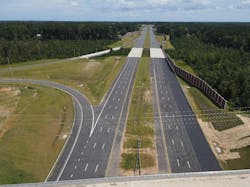
For decades, North Carolina’s vision for a complete outer loop encircling the Raleigh-Durham metro area seemed more aspiration than reality. The idea of a toll-financed expressway designed to ease congestion, improve safety and unlock regional mobility had circulated among local leaders since the 1960s. However, when the North Carolina Turnpike Authority (NCTA) launched the Complete 540 project, the long-awaited vision began to materialize.
The recent completion of Complete 540 Phase 1 (Contracts R-2721B and R-2828) represents a defining milestone: 13.5 miles of new six-lane expressway connecting communities south of Raleigh to the region’s interstate network. The $2.3 billion endeavor extends the Triangle Expressway by an additional 28 miles, ultimately linking the N.C. Highway 55 Bypass in Apex to Interstate-87 in Knightdale and will complete the long-envisioned loop around greater Raleigh.
The project’s timely, on-budget delivery, its innovative design-build execution and its far-reaching benefits to safety, mobility and sustainability earned eighth place on our list of Top 10 Roads of 2025.
Before Complete 540 Phase 1 opened last fall, commuters traveling east or west past Raleigh had little choice but to funnel through the chronically congested I-40 and I-440 corridors. Today, drivers can bypass those chokepoints. The new tollway’s smooth, grass median-separated lanes and state-of-the-art traffic management systems deliver safer, faster and more predictable mobility.
Two of the design-build contracts that make up Phase 1—R-2721B (4.9 miles) and R-2828 (8.6 miles)—delivered a technically complex segment of the corridor. Together, they include four full interchanges, one partial interchange, 43 bridges, 22 culverts and nearly one million square feet of brick noise walls.
Beyond its scale, the engineering achievement lies in its precision and integration. The NCTA adopted a multi-contract delivery approach with overlapping design-build schedules, allowing all 18 miles of Phase 1 to open simultaneously. That decision prevented traffic disruptions that would have occurred had segments opened piecemeal and kept quality consistent across contractors.
To maintain seamless coordination, NCTA established a centralized program management structure, weekly cross-contract meetings and standardized quality protocols. These measures ensured visual and structural consistency right down to the signature dogwood-flower emblem featured on bridges and sign columns, uniting the corridor’s identity.
The project’s most striking engineering feature may be the five-leg turbine interchange at I-40, a first for the Raleigh-Durham region. Originally designed as a three-level stack interchange, the concept was reimagined through an alternative technical proposal that simplified the geometry into a two-level, rotary-style interchange. The result reduced construction and maintenance costs while improving long-term safety and operational efficiency.
Technology was vital to the project. Automated machine guidance ensured grading precision, minimizing rework and material waste. Drone monitoring improved site safety, tracked erosion control and provided real-time progress verification. Cloud-based collaboration tools replaced traditional submittal processes, accelerating approvals and maintaining productivity even through COVID-19 disruptions.
Equally impressive was the coordination with the toll system integrator, a critical but often unseen factor in all-electronic toll facilities. Each contractor had to establish infrastructure to exacting standards before the integrator installed and tested tolling systems—an effort requiring near-flawless sequencing and communication across all partners.
Complete 540 Phase 1 also set a new standard for industry inclusion. A dedicated Disadvantaged Business Enterprise (DBE) forum connected prime contractors and minority-owned firms early in procurement, leading to $75 million in DBE contracts and exceeding participation goals. The collaboration fostered lasting partnerships and diversified the state’s contracting landscape.
The project also unearthed a literal connection to the region’s past: archaeological discoveries dating back 10,000 years. Instead of disrupting progress, NCTA built a data recovery program into its contract schedule, preserving artifacts for the North Carolina Office of State Archaeology—a reflection of the agency’s respect for heritage and progress.
More than a highway, Complete 540 is a catalyst—expanding access to education, healthcare and industry while shaping the Raleigh-Durham region’s future. It embodies what modern infrastructure should achieve: mobility without compromise, efficiency without neglect and growth balanced by stewardship.
Project: Complete 540 Phase 1 (Contracts R-2721B and R-2828)
Location: Raleigh, N.C.
Owner: North Carolina Turnpike Authority
Designer: HDR Engineering Inc. of the Carolinas for Contract R-2721B; WSP USA Inc. for Contract R-2828
Contractor: Flatiron Constructors Inc. – Branch Civil Inc., joint venture contractor for Contract R-2721B; The Lane Construction Corporation – Blythe Construction Inc., joint venture contractor for Contract R-2828
Cost: $563.2 million
Length: Contract R-2721B: 4.9 miles; Contract R-2828: 8.6 miles; Total: 13.5 miles