Road No. 6: Pioneering Mobility Through Arizona’s Rugged Core
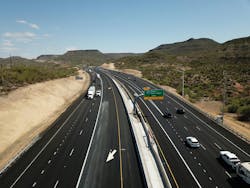
Cutting through the rugged desert mountains between Phoenix and Flagstaff, Interstate 17 is more than a highway — it’s Arizona’s backbone. The 23-mile stretch between Anthem Way and Sunset Point carries more than a million vehicles each year, connecting the state’s economic heart to its northern gateways and the Grand Canyon beyond.
For years, travelers along this corridor endured chronic congestion, weekend backups and unpredictable delays with no viable alternate routes.
That daily struggle led to one of the state’s most ambitious undertakings: the I-17 Improvement Project, a 23-mile reconstruction that added capacity, improved safety and introduced Arizona’s first-ever reversible “flex lanes.”
Combining innovation, collaboration and resilience across unforgiving terrain, this project redefined how Arizona moves — and for these reasons, the project placed sixth on our list of Top 10 Roads of 2025.
The Arizona Department of Transportation (ADOT) identified I-17 as a Key Commerce Corridor — a critical link between Interstates 10 and 40, and one of the most heavily traveled freight routes in the state. Yet the mountainous topography north of Phoenix made widening the highway a formidable challenge.
The I-17 Flex Lanes Project tackled that challenge head-on: expanding 15 miles of interstate from four to six lanes, adding eight miles of flex lanes, replacing or widening 13 bridges, and introducing a three-year operations and maintenance period for the new flex lanes.
The result is a transformative upgrade to one of Arizona’s most vital corridors — a highway designed not just for today’s traffic, but for the state’s next generation of growth.
The crown jewel of the project is Arizona’s first reversible flex lane system. Built adjacent to the southbound lanes and separated by a concrete median barrier, these two lanes can switch direction based on demand — northbound from Monday through Saturday, and southbound on Sundays, when traffic floods back toward Phoenix. During holidays or special events, ADOT can “flex” the lanes to whichever direction sees the heaviest flow, ensuring smooth travel for commuters, tourists and freight alike.
The system’s high-tech backbone includes dynamic message signs, 58 swing gates, four 30-foot steel barrier gates for emergency access and two vehicle arresting barriers designed to safely stop any vehicle that enters the wrong way.
Cameras throughout the corridor feed real-time data to ADOT’s Traffic Operations Center, where engineers monitor and control the system remotely.
Delivering such an intricate project required a uniquely collaborative approach. ADOT used a single Design-Build-Operate-Maintain (DBOM) Public-Private Partnership (P3) to combine design, construction and early operation and maintenance in one contract.
The Kiewit-Fann Joint Venture (KFJV) led the development team, with HDR serving as ADOT’s general engineering consultant (GEC). Together, they formed a co-located team in a field office in Black Canyon City, where they navigated the project’s complex demands — from blasting through steep rock formations to maintaining traffic flow.
Crews conducted 70 controlled blasts — far fewer than the original 120 projected — thanks to strategic use of “ripping,” a less disruptive method that uses heavy equipment to excavate softer rock.
Each blast required closing the highway entirely for one hour on weeknights after 10 p.m. Within that tight window, crews had to halt traffic, execute the blast, clear debris and reopen the road — all while maintaining safety and minimizing disruption to travelers.
In a nod to sustainability and efficiency, more than 185,000 cubic yards of excavated rock were reincorporated into the project, crushed for use as aggregate base, embankment, and rock mulch. This recycling effort reduced costs and environmental impact while enhancing the durability of the new roadway.
Keeping I-17 open during construction was a logistical feat in itself. With 50,000 vehicles using the corridor daily — and weekend traffic peaking with tourists and commuters — lane closures were limited strictly to weeknights.
To keep the public informed, ADOT’s outreach team provided weekly travel updates via social media, email alerts and the project website — a proactive communication model that minimized surprises and built trust among drivers.
When the I-17 Improvement Project opened, it marked a milestone for Arizona’s transportation history — a blueprint for blending smart technology, environmental stewardship and human-centered design. The new flex lanes now give drivers what they’ve long needed: reliability, safety and flexibility on one of the state’s most essential routes.
For its technical precision and exemplary collaboration, the I-17 Improvement Project stands as a model for modern highway engineering.
Project: I-17 Improvement Project “Flex Lanes”
Location: Maricopa and Yavapai Counties, Ariz.
Owner: Arizona Department of Transportation
Designer: Kiewit-Fann Joint Venture, General Engineering Consultant: HDR
Contractor: Kiewit-Fann Joint Venture
Cost: $544 million
Length: 23 miles