Ohio DOT Pilot Uses Real-Time Vehicle Data to Detect Roadway Deficiencies
Key Takeaways
- ODOT’s two-year pilot demonstrated that vehicle-generated data can accurately detect roadway deficiencies in real-world conditions.
- The system achieved accuracy rates as high as 99% for damaged signs and is projected to save more than $4.5 million annually.
- Automated detection reduces reliance on manual inspections, improving safety for maintenance crews and enabling more proactive asset management.
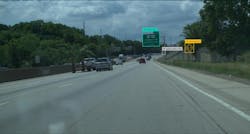
A first-of-its-kind pilot project using real-time, vehicle-generated data to detect roadway deficiencies produced highly accurate results that could translate into millions of dollars in cost savings for departments of transportation.
The Ohio Department of Transportation (ODOT) funded the two-year project, led by Honda and conducted in partnership with i-Probe Inc., Parsons and the University of Cincinnati, to evaluate the feasibility of an automated roadway detection and reporting system for state DOTs, according to a Honda press release.
To test Honda’s Proactive Roadway Maintenance System — which has been in development since 2021 — ODOT employees piloted Honda test vehicles equipped with advanced vision and LiDAR sensors across 3,000 miles of roadway in central and southeastern Ohio. The vehicles operated in real-world conditions, including rural and urban settings, varying weather and both daytime and nighttime hours, the release states.
The vehicle-based detection system identifies worn or obstructed road signs, damaged guardrails, potholes, shoulder drop-offs, insufficient roadway striping for automated vehicle systems and rough pavement conditions.
Detected roadway issues were logged in real-time to a web-based dashboard reviewed by ODOT staff and cross-referenced with traditional visual inspections.
According to the release, vehicle-collected data is processed through Edge AI models before being transmitted to Honda’s cloud platform, where it is analyzed and integrated into Parsons’ iNET Asset Guardian system.
The system automatically prioritizes roadway deficiencies and generates work orders for ODOT maintenance crews. Parsons’ technology groups work orders based on severity and proximity to optimize repair efficiency.
Results from the pilot showed a 99% accuracy rate for damaged or obstructed signs, 93% accuracy for damaged guardrails and an average accuracy rate of 89% for pothole detection.
ODOT staff supported continuous system improvement by flagging misdetections throughout the pilot.
Beyond damage detection, the system also supported broader maintenance planning. Analysis of the 3,000-mile test network identified a limited number of roadways with insufficient lane markings, allowing ODOT to adjust restriping schedules accordingly, the press release states.
Reducing the need for manual inspections provides safety benefits for maintenance crews by limiting their exposure to traffic.
Honda reported that decreased manual inspections, combined with optimized maintenance schedules and proactive repairs, could generate more than $4.5 million in annual cost savings for ODOT.
The next phase of the project will focus on scaling the prototype for real-world deployment, with Honda aiming to enable drivers to contribute to safer roadways by sharing anonymized vehicle data.
i-Probe supported the pilot by validating data and analyzing road roughness and lane marking conditions, while the University of Cincinnati assisted with sensor integration, development of damage detection features and system maintenance throughout the program.
The Hawaii Department of Transportation recently distributed 1,000 dashboard cameras to drivers across the Hawaiian Islands to detect roadway damage such as guardrail impacts and obstructions. The program uses Blyncsy, an AI-powered roadway intelligence platform operated by Bentley Systems.
Sources: Honda