85% Turned Around, Now What?
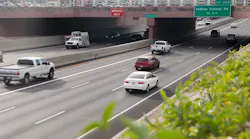
As days get shorter and holiday travel picks up, TAPCO has released new data on when wrong-way alerts happen and what drivers do after they’re warned. The report, “The Crash That Never Happened,” examines 3,370 wrong-way alert records from TAPCO systems in 23 states between October 2025 and September 2026. Of the 2,883 alerts with a recorded outcome, 85% were classified as the driver turning around. Alerts were most frequent from October through March, and about 61% came between 6 p.m. and 6 a.m.
Roads & Bridges spoke with Lindsay Harvey in a written exchange via email about what the numbers can and can’t show. Harvey has spent 11 years with TAPCO, where she serves as the senior ITS business development manager. She works with state departments of transportation, toll authorities and agency leaders.
According to TAPCO, the 85% figure is a baseline, not an effectiveness rate. The review had no comparison group. Harvey acknowledges that the data doesn’t track what happened to the 428 drivers who kept going. She also discusses possible reasons for the October peak and the spike the day after Christmas. She describes how the Connecticut Department of Transportation has used event data to target holiday enforcement and find ramps that need better lighting and markings, and she says where agencies should start when upgrading a problem ramp.
R&B: In 428 alerts, the driver kept going the wrong way. What happened in those cases: ow quickly did the traffic management center or police get notified, and do you know whether any ended in a crash?
LH: When a driver doesn’t turn around, the system automatically sends a real-time alert with live video and images to the traffic management center, DOT or police within seconds, depending on how each agency has it set up.
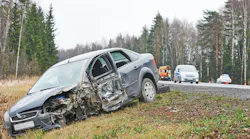
We don’t know whether any of the 428 ended in a crash. The system records what happens at the ramp, not after the driver leaves the camera’s view, and crash outcomes sit in agency and police records we don’t have. That’s why the report doesn’t claim crashes are prevented.
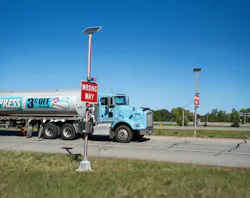
R&B: October had more alerts than December, and the October-to-March stretch made up 58% of the year. Did TAPCO adjust for sites added or offline during the year? What do you think explains the October peak and the jump on Dec. 26?
LH: The report presents raw alert counts and does not include adjustments for sites added, offline periods, traffic volumes or operating ramp-days.
We can’t say what caused the October peak, but a few factors likely play a role. Darkness comes earlier in October, and drivers are adjusting to more time on the road in low light. Holiday travel also puts more people on the road later at night, and NHTSA reports that December is one of the deadliest months for alcohol-impaired driving. AAA research found that six in 10 fatal wrong-way crashes involved an alcohol-impaired driver.
The day after Christmas is one of the busiest return-travel days of the holiday season, which may explain that spike, but our data doesn’t show why.
R&B: The report says agencies should rank locations by alerts, not crashes alone. Can you give a specific case where a DOT used alert data to move a unit, change signs or ramp design, or win HSIP or SS4A funding?
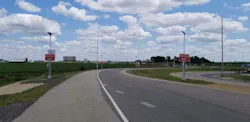
LH: The Connecticut Department of Transportation expanded from upgraded signage and public awareness campaigns to detection systems that also collect event data, giving it more detail on where and when wrong-way driving occurs. CTDOT uses that verified event data to target holiday and weekend operations, including pre-positioned police patrols and coordinated impaired-driving enforcement. Its analysis of those events also found that better lighting at ramps improved driver self-correction and that ramps with faded or missing pavement markings saw more wrong-way events.
R&B: The report tells agencies to improve how visible warnings are at night, with LED signs, dusk-to-dawn operation and changes to ramp geometry. Does your data show that some setups get more drivers to turn around than others? If an agency could make only one upgrade at a problem ramp, what should it be?
LH: We have learned that each ramp is unique and TAPCO works with agencies to evaluate the data and contributing factors to explore countermeasures that are the right-fit - one ramp countermeasure may be different from another ramp based on the ramp review. A good first step is changing traditional signs to LED-enhanced signs that are proven to encourage self-correction. We offer a white paper on our website that features Proven Approaches.
About the Author
 Gavin Jenkins, Head of Content
Head of Content
Gavin Jenkins is an award-winning journalist based in Pittsburgh. His work has appeared in The New York Times, The Washington Post, The Atlantic, VICE, Narrative.ly, Prevention, the Pittsburgh Tribune-Review and Beijing Review.
In 2020, two stories he wrote for Pitt Med Magazine earned three Golden Quill Awards from the Press Club of Western Pennsylvania. “Surviving Survival” won Excellence in Corporate, Marketing and Promotional Communications – Written, Medical/Health, while “Oct. 27, 2018: Pittsburgh’s Darkest Day, and the Mass Casualty Response” won Excellence in Written Journalism, Magazines – Medical/Health, as well as the Ray Sprigle Memorial Award: Magazines, a Best in Show award.
After graduating from the University of Pittsburgh at Johnstown in 2003, he covered sports for the Bedford Gazette, in Bedford, Pa., and the Martinsville Bulletin, in Martinsville, Va. In 2006, he returned to Pittsburgh to write for Trib Total Media. Based out of the Kittanning Leader Times, he worked for the Trib for two years, and then he moved to Shenzhen, China, to teach English and freelance. After two years in China, he earned an MFA in nonfiction from the University of Pittsburgh.
When he's not at work, he's usually playing with his border-collie mix, Bob.