Gaining Traction: Closing the Slip-Resistance Gap on Bridges

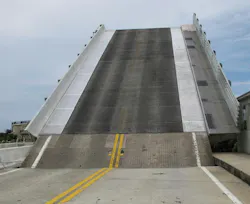
Bridge decks, pedestrian crossings and bike paths are exposed to rain, ice, wet leaves and deicing chemicals, plus years of foot, bike and vehicle traffic. Yet the standards that govern walking surfaces don’t say how much traction is enough. The Americans with Disabilities Act requires surfaces to be “slip resistant” but sets no friction value. That leaves bridge owners and designers to decide for themselves what is safe, and to defend those decisions when a fall turns into an injury claim.
In a written exchange over email, Roads & Bridges asked Scott Sargent, vice president of sales and marketing at SLIPNOT, how owners can measure slip resistance in a meaningful way, where pedestrian and bike bridges tend to fail first, and how metal safety flooring compares with coatings and epoxies over a structure’s service life.
R&B: The ADA calls for walking surfaces to be ‘slip resistant’ but doesn’t set a specific friction value. How should bridge owners and designers decide what’s slippery enough, and how well do the common test methods reflect real conditions like ice, wet leaves or worn surfaces?
SS: The National Floor Safety Institute (NFSI) is the new standard, as OSHA and other regulatory bodies have declined to offer specific friction guidance. To measure slip resistance across hard surfaces, independent NFSI certification evaluates materials in two phases: laboratory testing and field testing. During testing, digital devices measure a surface’s static grip and dynamic friction, assigning it to one of three safety categories:
- High Traction (above 0.60 wet SCOF): The highest safety rating, offering maximum stability in high-risk areas exposed to rain, ice, wet leaves or oils. This is also the requirement for heavy use infrastructure applications like roads and bridges.
- Moderate Traction (0.41–0.59 wet SCOF): Standard walkways that still require caution.
- Low Traction (under 0.40 wet SCOF): Hazardous surfaces that require immediate repair.
Bridge decks face harsher conditions than controlled indoor test floors. Standardizing certified High-Traction surfaces allows bridge owners and designers to:
- Evaluate safety surfaces using third-party lab and field data rather than general claims.
- Maintain certified grip across high-risk slip spots, like ramps or metal transition plates, before injuries, claims or regulatory citations occur.
- Secure executive budget approvals with proven test scores while lowering maintenance costs by replacing temporary tapes, paints and epoxies.
High-performance floor safety isn't only measured on day one; it's proven after years of heavy foot, bike and vehicle traffic as well as exposure to the elements. To prevent traction loss, owners and designers should prioritize slip-resistant metal flooring engineered with superior bond strength and a high surface hardness rated on the Rockwell C scale that won't peel, flake or wear down under high-wear conditions such as roads and bridges.
R&B: On pedestrian and bike bridges, where do slip-and-fall or trip problems tend to show up first, and what design or maintenance decisions usually cause them?
SS: On pedestrian and bike bridges, slip, trip and fall hazards appear first on open metal grating. Narrow bicycle tires slip between the bars, stroller and wheelchair wheels catch in the gaps, and the grates are slick for pedestrians.
These hazards usually stem from two mistakes. In the initial design, engineers often prioritize drainage and structural weight over user safety, treating traction as an afterthought. Then maintenance crews rely on short-term fixes like tapes, paint or coatings that quickly peel or wear away under traffic, exposing the slick metal underneath.
R&B: What are the honest trade-offs between installing metal safety flooring products (available in steel, stainless steel or aluminum) versus applying coatings or epoxies over a bridge’s service life, and when would you tell an owner one of them isn’t the right choice?
SS: The choice between metal safety flooring products and applied coatings or epoxies comes down to upfront price versus long-term cost.
Coatings and epoxies offer lower initial material and installation costs, but they rapidly wear down under continuous traffic and harsh weather. Once a coating wears smooth or delaminates, it loses its grip, raising the risk of slips, falls and injury claims. Reapplying coatings also means more bridge closures for cleaning and curing, which increases recurring maintenance expenses while delivering inferior performance over time.
In contrast, metal safety flooring products provide lasting durability that holds up over time. Since bridges are already built to carry heavy loads, product weight is rarely a problem. The material choice depends on the location:
- Aluminum is rustproof and lightweight, making it ideal for drawbridges and walking paths.
- Stainless steel holds up best against winter weather, deicers and ocean saltwater.
- Standard steel provides strength needed to support heavy loads and hard impacts without bending or cracking in sheltered or drier areas.
Whether specified during initial design or prefabricated to retrofit an existing deck, metal safety products provide lasting traction, reduce short-term maintenance and keep project budgets intact.
About the Author
 Gavin Jenkins, Head of Content
Head of Content
Gavin Jenkins is an award-winning journalist based in Pittsburgh. His work has appeared in The New York Times, The Washington Post, The Atlantic, VICE, Narrative.ly, Prevention, the Pittsburgh Tribune-Review and Beijing Review.
In 2020, two stories he wrote for Pitt Med Magazine earned three Golden Quill Awards from the Press Club of Western Pennsylvania. “Surviving Survival” won Excellence in Corporate, Marketing and Promotional Communications – Written, Medical/Health, while “Oct. 27, 2018: Pittsburgh’s Darkest Day, and the Mass Casualty Response” won Excellence in Written Journalism, Magazines – Medical/Health, as well as the Ray Sprigle Memorial Award: Magazines, a Best in Show award.
After graduating from the University of Pittsburgh at Johnstown in 2003, he covered sports for the Bedford Gazette, in Bedford, Pa., and the Martinsville Bulletin, in Martinsville, Va. In 2006, he returned to Pittsburgh to write for Trib Total Media. Based out of the Kittanning Leader Times, he worked for the Trib for two years, and then he moved to Shenzhen, China, to teach English and freelance. After two years in China, he earned an MFA in nonfiction from the University of Pittsburgh.
When he's not at work, he's usually playing with his border-collie mix, Bob.