Accident Reduction
By Nick Davis, Contributing Author
Nearly 800,000 wet-weather auto accidents occur annually, resulting in more than 250,000 injuries and 3,200 fatalities, according to a Federal Highway Administration study. These accidents cost U.S. drivers billions of dollars each year.
Imagine if we could reduce the risk of hydroplaning and vehicle highway departures.
Safe and sure vehicle handling relies heavily on how well the tires grip the road—or, in engineering terms, the coefficient of friction between the tire and the pavement. The presence of water on the pavement in the form of rain, snow, slush or ice causes friction loss, upsetting the balance of friction that is so necessary to safety. Over time, pavements also become worn and polished, further increasing accident risks. Additional factors such as tire wear, salt application and freeze-thaw cycles exacerbate the problem, compromising surface texture and traction.
Diamond grooving offers a reliable and economical method to enhance road safety. By cutting precise grooves into pavement surfaces, this technique improves traction, reduces hydroplaning and minimizes splash and spray, all while providing a superior braking surface. The grooves channel water away from the vehicle tires and increase directional stability to improve friction and significantly reduce accidents during inclement weather.
Grooving for Safety
Diamond grooving restores surface texture and friction where it is most needed, particularly under wet or slippery conditions. The interaction between tire treads and the patterned grooves ensures enhanced stability and improves braking control. Suitable for portland cement concrete and asphalt surfaces, safety grooving can be completed with minimal traffic disruption.
However, pavements must be structurally sound to qualify for grooving applications.
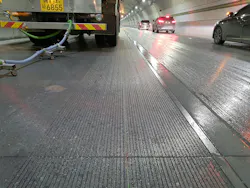
The process involves using grooving machines equipped with diamond-tipped saw blades to cut precise grooves into the pavement. The grooving machine’s blades are mounted and spaced on a horizontal shaft and are cooled constantly by water pumped from a tanker.
The grooves, typically specified at 1/8- to 3/16-inch wide and between 1/8- and ¼-inch deep for pavements, are designed to channel water and improve traction. While some states have adopted their own spacing configurations, the standard spacing recommended by the International Grooving and Grinding Association (IGGA) is 3/4-inch center-to-center.
The same grooving pattern used for concrete pavement can be applied to asphalt to create the same improvements to macrotexture and hydroplaning risk. The National Center for Asphalt Technology (NCAT) has a test section in place, which is being monitored for texture durability.
The existing asphalt was exposed to nearly 10 million equivalent single axle loads (ESALs) before safety grooving was applied. Since grooving, the test section has been exposed to over 5.2 million additional ESALs so far with negligible damage to the surface texture reported. This indicates that safety grooving is a great tool for engineers to use when texture remediation is required.
Regardless of pavement type, these discrete channels can be constructed transversely or longitudinally, depending on the need. However, research shows that longitudinal grooves, in particular, help resist lateral motion to provide additional stability. A California Department of Transportation (Caltrans) study found that longitudinal grooving reduced accident rates by an average of 20% overall, and a whopping 70% in wet conditions.
Bridge Deck Applications
Bridge decks are often more hazardous than the roadways they connect due to faster freezing of standing water. Motorist safety is paramount, and quick drainage of bridge deck surfaces can save lives.
Safety grooving on bridge decks improves drainage and traction, reducing the risk of hydroplaning. Grooves are typically cut perpendicular or parallel to the centerline, and it is recommended that they extend across the spans to within 2 feet of the gutter lines. This technique increases macrotexture by two to five times, creating thousands of mini-drainage channels that quickly dissipate water.
Additionally, surface-grooved bridges have reduced splash-and-spray visibility hazards. Water contained within the grooves lies below the pavement surface, minimizing the adverse effects of tire-pavement interaction during rainstorms.
A Proven Track Record
Studies consistently demonstrate the positive outcomes of safety grooving for accident reduction and improved vehicle braking and control during adverse weather. In addition, municipalities and transportation authorities have reported cost savings from decreased accident frequency and lower road maintenance requirements.
Research initiated by NASA decades ago confirmed significant improvements in aircraft landing performance on wet, grooved runways. The study results from NASA’s Langley Research Center spurred global adoption of the method on highways, runways, tunnels and bridge decks. The technique was inducted into the NASA Hall of Fame in 1990.
California also has provided compelling evidence of safety grooving’s impact. On various highway sections and specifically Interstate 5 at Laguna Canyon Road, a surge in accidents due to worn surface texture prompted longitudinal grooving projects, using a specified 1/8 by 1/8 inch on 1/2-inch center pattern.
As a result, Caltrans observed a 20% overall reduction in accidents, a 50% decline in fatal accidents and a 70% drop in wet-weather accidents. In another study evaluated by the Transportation Research Board (TRB), wet-pavement accidents were virtually eliminated as a result of safety grooving. These figures demonstrate the considerable improvement in road safety directly attributable to targeted grooving interventions.
Outside the U.S., research from the National University of Singapore has quantified the influence of groove dimensions, which helped verify the safety grooving dimensions used today as the country’s national standard.
Advancements in the Field
Today’s equipment innovations have transformed safety grooving into an efficient, cost-effective and precise intervention. The latest diamond grinding and grooving machines feature sophisticated automation and precision technologies that reduce operator workload and deliver consistent, high-quality results.
Digital tools, such as the International Grooving & Grinding Association’s (IGGA) Fuel/Carbon Savings Calculator, also highlight the environmental benefits of smoother pavements improved from diamond grinding. These benefits include reduced fuel consumption and lower carbon dioxide (CO₂) emissions.
By allowing users to input project-specific traffic and surface data, the calculator shows 10- and 20-year reductions in fuel consumption and CO₂ emissions. The free, web-based tool supports maintenance planning by providing clear data to justify preservation projects and reinforce sustainability goals.
Next Generation Concrete Surface (NGCS)
Recent years have seen the implementation of NGCS applications, which combine diamond grinding and longitudinal grooving to create the quietest non-porous concrete surface available. Developed by Purdue University and industry partners Minnesota Department of Transportation, the IGGA, American Concrete Pavement Association and Portland Cement Association (now called the American Cement Association), NGCS offers a smoother, safer ride.
NGCS surfaces are designed to last longer, withstanding environmental and traffic-related wear and tear more effectively than other pavement types. Despite their flatter, smoother riding surface compared to traditional portland cement concrete pavement, NGCS roads maintain reliable friction when constructed with quality aggregates. The longitudinal grooves provide substantial macrotexture, which enhances skid resistance and increases resistance to hydroplaning.
The technique’s durability, low maintenance and noise-reduction capabilities have made it a popular choice in more than 16 states and numerous countries around the globe. Its application continues to grow as transportation departments seek cost-effective and sustainable pavement solutions.
Why Safety Grooving Matters
Safety grooving stands out as an established, cost-effective and high-impact road safety measure. Its proven ability to reduce accidents and enhance roadway performance, especially under challenging weather conditions, makes it an essential consideration for roadway and infrastructure projects.
As advancements in grooving technology continue to improve efficiency and precision, now is the time to prioritize safety grooving in roadway planning. By investing in this proven method, engineers, policymakers and communities can create safer, more resilient roads.
Friction Versus Hydroplaning
Although the terms “friction” and “hydroplaning” are sometimes used interchangeably, they are different events and describe distinct phenomena.
Friction refers to the resistance between a tire and the pavement surface, which is critical for vehicle control. In the U.S., friction is generally measured with an ASTM locked-wheel skid trailer, which administers 0.5 millimeter (about half the thickness of a dime) of water in front of a locked/skidding tire.
When using an ASTM E 501 ribbed test tire, this test simulates dry conditions and the pavement’s friction attributes. Safety grooving can indirectly improve friction as a result of improved directional stability as tires attempt to stop.
Hydroplaning, on the other hand, occurs when the water cannot escape from within the tire contact patch area fast enough. This results in the tire losing contact with the surface of the pavement, leading to a total loss of traction.
This phenomenon can be tested using the same locked wheel friction tire, but with an ASTM E524 smooth tire. In highway applications, hydroplaning most often occurs at high speeds and in locations with poor surface drainage.
Safety-grooved pavements regularly show much higher friction results than non-grooved pavements when tested in this fashion, indicating the reduced hydroplaning risk when safety grooving is performed.
Proper surface texture, such as grooved pavement, plays a vital role in mitigating both issues by improving drainage and maintaining traction.
Nick Davis is the director of technical services at the International Grooving and Grinding Association. Prior to joining the IGGA, Davis gained seven years of experience as an assistant engineer at the New York State Department of Transportation.