Is a DDI the Right Fit?
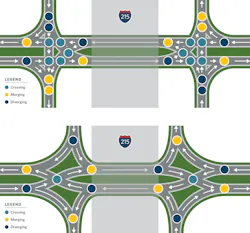
A diverging diamond interchange was a great fit for the Interstate 215 and University Parkway interchange, which serves as the primary freeway gateway to California State University, San Bernardino. But it’s not a solution for every congested intersection. Before considering the more complex design and extra effort of a DDI, infrastructure owners should ask a few questions.
Are turning movements the dominant problem, not through traffic?
DDIs perform best where heavy left-turn and ramp movements are competing against each other, especially during peak periods. At University Parkway, high inbound campus traffic and outbound neighborhood traffic occurred at the same time, creating congestion that conventional signal phasing couldn’t resolve.
The DDI allows those competing movements to operate simultaneously, reducing the delay that had been caused by long, multi-phase signal cycles. If the primary issue is heavy through traffic, a DDI may actually constrain operations rather than improve them.
Is there enough right of way to make the geometry work safely?
A DDI doesn’t require unlimited right of way, but it does require enough room to establish proper deflection angles, median islands and lane transitions. One of the first feasibility tests is simply whether the geometry for a DDI can physically fit while still meeting design standards. In constrained urban environments, limited widths and closely spaced intersections can rule out a DDI.
Related, DDIs operate on simplified, two-phase signals, which can be undermined by closely spaced downstream intersections or frequent driveway access. If traffic backs up from nearby signals, it can spill into the crossover area and reduce the effectiveness of the interchange. At University Parkway, adequate spacing and interconnected signal controllers help the DDI function as part of a corridor system rather than an isolated solution.
Are you prepared for public education and change management?
While DDIs are becoming more common, they are still unfamiliar to many drivers. Successful projects pair engineering with proactive outreach to explain how the interchange works and what drivers can expect. If an agency lacks the capacity or support to invest in education, temporary confusion could undermine public confidence, no matter how technically sound the design may be.
Does the project have clear cost or footprint advantages over traditional alternatives?
A DDI is often most compelling when it avoids major right-of-way acquisition or extensive property impacts. Leaders should ask whether a DDI meaningfully reduces cost, footprint or disruption compared with a conventional interchange rebuild. If a traditional solution is affordable and less disruptive, the added design and construction complexity of a DDI may not be justified.