Designed to Diverge
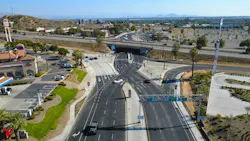
For decades, the Interstate 215 and University Parkway interchange served as the primary freeway gateway to California State University, San Bernardino (CSUSB), but it did so under growing strain.
Built in the mid-1960s, the compact diamond interchange struggled to handle rising traffic volumes tied to regional growth, commercial development and expanding university enrollment. Congestion was routine, with delays among the longest in Caltrans District 8, and safety concerns were mounting.
Today, that gateway has been redefined. The conversion of the interchange to a diverging diamond interchange (DDI) is delivering congestion relief, enhancing safety and adding meaningful pedestrian and bicycle connectivity, all within a tight urban footprint and without widening the existing freeway bridge.
The I-215 University Parkway Interchange project — completed in May 2026 — reflects years of collaboration among the San Bernardino County Transportation Authority (SBCTA), the city of San Bernardino, California’s Department of Transportation (Caltrans) and CSUSB.
It also reflects a willingness to rethink what is possible for the first constructed DDI in Caltrans District 8.
A Gateway Under Pressure
University Parkway is the main access route between I-215 and the CSUSB campus, as well as nearby neighborhoods and businesses. Peak traffic patterns are defined by overlapping movements: students and staff head into campus in the morning while nearby residents leave the area for work, followed by the reverse in the afternoon — with the addition of students’ arrival for night classes.
Those competing flows placed heavy demands on the former interchange’s signalized ramp terminals, which experienced increasing delays in all modes of travel.
Before the interchange reconfiguration, traffic signals were operating at up to 120 second cycle lengths, well beyond what is typically desired for saturated intersections. Congestion routinely backed up onto freeway ramps, and the interchange ranked among the most operationally challenged in the district.
Complicating matters, the surrounding area was developed and built out. The adjacent businesses, as well as closely spaced local intersections and limited right of way left little room for traditional expansion. Rebuilding or widening the freeway bridge would have significantly increased cost and community impacts. It was clear a fix was needed, but finding a solution required a creative approach.
An Unconventional Path
Early alternatives included a partial cloverleaf interchange and other configurations that would have required major right-of-way acquisitions and bridge reconstruction. Those options carried high costs and significant impacts to surrounding properties that threatened the viability of the project and did not fully address all the operational challenges in the interchange.
In 2017, HDR joined the project to consider whether a DDI made sense. Through careful analysis of the site’s constraints and traffic flow, it became clear that a DDI would be feasible. It was identified as the recommended alternative during the Project Approval and Environmental Document phase.
“A DDI could be more efficient in clearing surges of traffic, and it has a smaller footprint with less property acquisition needs,” said Tim Watkins, chief of legislative and public affairs at SBCTA. “The result was cost savings to taxpayers and local businesses.”
Earlier concepts carried estimated price tags of over $100 million once bridge reconstruction and property impacts were considered. By working within existing constraints, the final project was delivered for a fraction of that amount, with construction bids coming in under $20 million.
Funding was provided through a combination of local Measure I sales tax revenues and city contributions, with SBCTA serving as project sponsor and Caltrans providing oversight.
While still a new concept in California, the DDI offered a way to manage heavy turning movements more efficiently by allowing left turns to freeway ramps without crossing opposing traffic. It reduced the number of conflict points compared to a conventional diamond interchange. And at University Parkway, the DDI also passed a critical requirement: it could fit beneath the existing I-215 bridge.
Unlike other DDIs built as overcrossings with ample space, this one required threading new geometry through an approximately 82-foot-wide opening between bridge abutments, with no room for expansion.
This project became the first undercrossing DDI in California and only the third DDI in the state overall.
Designing Within the Constraints
Fitting a DDI into that narrow envelope required extensive design iterations. Lane widths, crossover angles, median islands and curvature were refined repeatedly to meet design standards while remaining within the existing right of way. The final configuration maintains two lanes in one direction and provides three in the other through the core of the interchange, while incorporating a barrier-protected, 8-foot-wide pedestrian pathway in the median.
One of the more challenging but critical parts of designing a DDI is creating or maintaining clear sight lines. This is particularly important at constrained locations like the I‑215 University Parkway undercrossing. Unlike a conventional diamond interchange, a DDI intentionally redirects drivers to the opposite side of the roadway, which makes visual guidance essential.
Designers had to carefully consider what drivers can and cannot see as they approach the crossover intersections.
Median islands were shaped to block direct lines of sight to opposing approaches and to separate vehicle paths. The lane alignment approaching the intersection points vehicles into a straight path of travel through the cross-over intersections, so drivers maintain their lane assignment.
This keeps drivers on their correct travel path. By narrowing the visual field and directing attention forward, these geometric features work in tandem with pavement markings and directional signal heads to reinforce proper movements and reduce hesitation or erratic maneuvers.
From an operational standpoint, HDR’s traffic team developed detailed simulation models to confirm that the DDI would perform as intended. The modeling demonstrated that the interchange could manage the heavy inbound and outbound movements simultaneously, a key reason the configuration works so well at this location.
Pedestrian and bicycle accommodations were a priority in the design. Sidewalks that once ran tight against bridge abutments were relocated to the center of the roadway, physically separating people from traffic and shortening street crossing distances.
The project also preserved important community elements, including campus murals on the bridge abutment walls that serve as a visual gateway to CSUSB. Protective barriers were carefully detailed to avoid obscuring those features.
Keeping Traffic Moving
Construction staging presented its own challenges. With its high traffic volumes, the interchange could not be closed for extended periods, yet building a DDI requires reversing traffic patterns and constructing median islands directly in the roadway.
As construction progressed, available lane capacity temporarily decreased, creating the risk of worsening congestion before relief could be delivered. To address that, the project team implemented a temporary DDI configuration during the later stages of construction, shifting traffic into its ultimate pattern earlier than originally planned. The approach reflected a clear priority of providing congestion relief as soon as possible, even during construction.
Deploying an interim DDI early reduced delays by cutting signal operations from multiple phases down to two, even before final median islands, paving and striping were complete. A final 55-hour weekend closure in April allowed crews to place the final lift of new pavement, remove temporary markings and deliver a clean, intuitive final configuration.
Safety and Public Understanding
A defining feature of the DDI is its safety performance. By eliminating left-turn conflicts and reducing the total number of vehicle conflict points, DDIs have been shown to significantly reduce injury crashes. At University Parkway, the conversion reduces conflict points from 26 to 14 and shortens pedestrian crossings so that people only interact with traffic coming from one direction at a time.
Still, unfamiliar designs require education across all modes of travel.
“For agencies venturing down this path for the first time, it’s important to get ahead of the public on the concept and education,” said Watkins. “Reminding them and assuring them that it’s not the first; it’s tested and engineered well, proven in other locations.”
SBCTA and other project stakeholders completed extensive outreach with local residents as well as the university community, where student turnover is constant. Public information campaigns, social media updates and coordination with city and county leadership helped prepare drivers, bicyclists and pedestrians for the change.
“We developed instructional videos, spoke to a lot of groups, worked with the university,” said Watkins. “Still, you can do all that [and] there will be people who encounter it for the first time when they drive it. What’s important then is the messaging at the location.”
Clear signage, pavement markings and signal displays using directional arrows reinforce correct movements and guide drivers through the crossover intersections. Beyond signage, designers focused on creating a clearly delineated path that helps drivers intuitively understand where they are going once inside the interchange. Visual cues such as well-defined islands and consistent deflection angles help the DDI operate as intended, even for first-time users.
A Gateway Reimagined
With the interchange now in full operation, the improvements are already visible. Traffic flows more smoothly through the corridor. Delays have been reduced. Pedestrians and cyclists move through the interchange with greater comfort and clarity.
For the project team, the result reflects years of persistence, technical rigor and collaboration. The I-215 University Parkway Interchange demonstrates how unconventional solutions, applied thoughtfully and with community input, can deliver meaningful improvements even in the most constrained environments.
Mark Hager, P.E., is a senior highway project manager in HDR’s Riverside, Calif. office and led the company’s work on the University Parkway I-215 interchange. Brian Smith, P.E., is a senior highway project manager, and Julian Hernandez, P.E., is a senior highway engineer. Both work for HDR in Southern California and played key roles in the design of the interchange.