Building Bridges Across Borders: Q&A with WSP’s Amanda Parolini Dutra
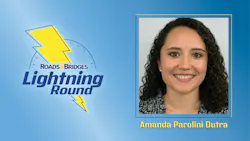
Born and raised in Belo Horizonte, Brazil, Amanda Parolini Dutra came to the United States on a soccer scholarship and earned her bachelor’s degree in civil engineering from Christian Brothers University in Memphis, Tenn. She later earned a master’s degree in structural engineering from the University of Arkansas before joining WSP in Miami, where she designs bridges.
That journey has given Dutra a unique perspective on transportation infrastructure. Having experienced life and infrastructure in Brazil and the United States, she has seen the advantages and shortcomings of transportation systems on both sides of the equator.
Now working in South Florida, she is particularly interested in how the region can accommodate rapid population growth while preparing for hurricanes, flooding and increasing demands on its transportation network.
Dutra also competed on the pilot episode of Roads & Bridges’ Lightning Round, where she put her infrastructure knowledge and quick thinking to the test. We caught up with her to discuss what she sees in Florida’s transportation system, the challenges facing South Florida and why better-connected public transportation could be critical to the region’s future.
R&B: You were born in Brazil and now live and work in South Florida. Having experienced infrastructure in different parts of the world, what stands out to you about Florida's transportation system? What needs to be improved?
APD: Having lived in Brazil and now in South Florida, I can say that the transportation infrastructure in the United States is generally more developed and extensive than what I experienced growing up in Brazil. What stands out to me most is the highway system, especially the large interchanges with multiple overpasses that allow drivers to move efficiently in different directions. I was always impressed by the scale and complexity of these structures. In addition, most highways I have driven on in the United States have multiple lanes, which helps traffic flow more efficiently and makes long-distance travel smoother. In Brazil, travel can often take longer and be more stressful due to a combination of geography, including hilly terrain and winding roads, as well as infrastructure limitations in certain areas.
That said, in South Florida specifically, I feel that having a car is almost a necessity. Public transportation options are limited in many areas, and not all roads are designed with adequate bicycle infrastructure, making driving the most practical form of transportation for many residents. For example, a commute that takes me about 15 minutes by car would take approximately 75 minutes by bus or 42 minutes by bicycle.
Because of this, I believe South Florida could benefit from a more efficient and better-connected public transportation system. Improving transit options would make them more attractive to residents, reduce dependence on personal vehicles, and help alleviate traffic congestion, which continues to be a challenge in the region.
R&B: South Florida faces hurricanes, flooding and rapid population growth. Which of those challenges do you think will have the biggest impact on infrastructure over the next 20 years? And how can the infrastructure construction industry help it?
APD: Among hurricanes, flooding, and rapid population growth, I believe rapid population growth will have the biggest impact on South Florida's infrastructure over the next 20 years. In many ways, population growth also amplifies the effects of hurricanes and flooding. As more people move to the region, a larger number of homes, businesses, and critical infrastructure assets become exposed to these natural hazards.
As the population continues to grow, demand on transportation networks, utilities, water systems, and public services will also increase. This growth will require the expansion and modernization of existing infrastructure to ensure it can continue serving the community efficiently. Without adequate planning, challenges such as traffic congestion, overcrowded public facilities, and increased strain on essential services may become more significant.
The infrastructure construction industry can help address these challenges through long-term planning and investment.
Projects should be designed not only to solve today's problems but also to accommodate future growth and future environmental challenges. Collaboration among engineers, contractors, planners, developers, and public agencies will be essential to building infrastructure that supports growth while maintaining residents' quality of life.
R&B: If you could champion one transportation improvement for Florida, what would it be and why?
APD: As I mentioned, one transportation improvement I would champion for Florida is a more efficient and better-connected public transportation system. Expanding regional transit connections between major employment centers, residential communities, airports, and other key destinations would provide a reliable alternative to driving and reduce dependence on personal vehicles. As Florida's population continues to grow, high-quality public transportation can improve mobility, reduce traffic congestion, shorten commute times, and support a more sustainable transportation network.
Because of South Florida's unique geology and high groundwater levels, constructing extensive underground metro systems can be more challenging and costly than in many other regions. However, buses, commuter rail, Brightline, Tri-Rail, and elevated transit systems such as Miami's Metrorail offer excellent opportunities to expand public transportation throughout the region. Investing in these transportation options would help create a more connected, accessible, and resilient transportation system for future generations.
Click here to compete in Roads & Bridges’ Lightning Round.
About the Author
 Gavin Jenkins, Head of Content
Gavin Jenkins, Head of Content
Head of Content
Gavin Jenkins is an award-winning journalist based in Pittsburgh. His work has appeared in The New York Times, The Washington Post, The Atlantic, VICE, Narrative.ly, Prevention, the Pittsburgh Tribune-Review and Beijing Review.
In 2020, two stories he wrote for Pitt Med Magazine earned three Golden Quill Awards from the Press Club of Western Pennsylvania. “Surviving Survival” won Excellence in Corporate, Marketing and Promotional Communications – Written, Medical/Health, while “Oct. 27, 2018: Pittsburgh’s Darkest Day, and the Mass Casualty Response” won Excellence in Written Journalism, Magazines – Medical/Health, as well as the Ray Sprigle Memorial Award: Magazines, a Best in Show award.
After graduating from the University of Pittsburgh at Johnstown in 2003, he covered sports for the Bedford Gazette, in Bedford, Pa., and the Martinsville Bulletin, in Martinsville, Va. In 2006, he returned to Pittsburgh to write for Trib Total Media. Based out of the Kittanning Leader Times, he worked for the Trib for two years, and then he moved to Shenzhen, China, to teach English and freelance. After two years in China, he earned an MFA in nonfiction from the University of Pittsburgh.
When he's not at work, he's usually playing with his border-collie mix, Bob.