T&I Committee Approves BUILD America 250 Act
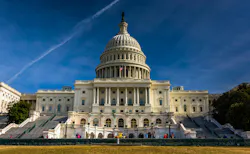
This morning, the House Transportation & Infrastructure Committee announced that it had approved the BUILD America 250 Act.
Following a 14-hour legislative markup, the T&I Committee approved H.R. 8870, the BUILD America 250 Act — a bipartisan, five-year surface transportation reauthorization bill aimed at investing in the nation’s roads, bridges, transit systems, passenger rail and highway safety programs.
The legislation would authorize major federal investments in surface transportation infrastructure while emphasizing freight mobility, project delivery reform, rail safety and innovation. Committee leaders say the legislation would deliver the largest federal bridge investment in U.S. history, expand passenger rail funding, shorten project delivery timelines and establish the nation’s first autonomous commercial motor vehicle framework. The bill also seeks to strengthen the Highway Trust Fund with its first new revenue stream in more than 30 years.
“The purpose of the BUILD America 250 Act is right there in its name. We are celebrating the 250th anniversary of our nation and the infrastructure that has helped form it, and this bill is about building the infrastructure we need for America’s future,” Transportation and Infrastructure Committee Chairman Sam Graves (R-Mo.) said in a statement. “This bill makes historic investments in our bridges and other critical infrastructure, reduces costs and delays in building, ensures states have the resources and flexibility they need, bolsters the Highway Trust Fund, fosters innovation, and provides a framework for safely integrating autonomous commercial motor vehicles onto our highways. I want to thank all the Committee Members on both sides of the aisle for the longs hours of debate they put in today on this vital legislation. I look forward to moving this bill on the House floor in the near future, and to working with the Senate to pass a final bill before the current law expires on September 30th.”
While committee approval is significant, the most politically difficult phase of the process still lies ahead in the House and the Senate. But for the moment, the roads and bridges construction industry can breathe a collective sigh of relief that there is a bipartisan framework in place.
The T&I Committee — specifically Graves and ranking member Rick Larsen (D-Wash.) — should be applauded for advancing the BUILD America 250 Act.
At a time when our leaders in Washington, D.C. often struggle to accomplish even basic governing tasks, advancing a bipartisan, five-year surface transportation reauthorization bill before the current authorization expires is a meaningful achievement.
For the infrastructure industry, certainty matters. Departments of transportation, transit agencies, contractors, engineering firms and manufacturers cannot operate efficiently when federal transportation policy hinges on a succession of short-term extensions. The committee’s action signals that Congress at least understands the importance of keeping the nation’s transportation programs stable and funded.
Despite the bipartisan approval within the T&I Committee, House members will push for amendments, funding revisions and policy changes. Representatives likely will have to reach across the political aisle and compromise to get this passed.
Then comes the Senate. Historically, Senate transportation bills rarely mirror House legislation. The Senate Environment and Public Works Committee, Commerce Committee and Banking Committee all hold jurisdiction over portions of surface transportation policy. Senators often bring different priorities to the table, including stronger transit funding, rail investment, resiliency measures and differing views on federal oversight.
That means two separate bills will likely emerge before congressional leaders attempt to reconcile them in conference negotiations. And looming over all of it is the White House.
No transportation authorization bill becomes law without executive branch influence, and President Donald Trump likely will weigh in before signing.
This means the BUILD America 250 Act is probably far from finished.
The bill approved by the House T&I Committee is best viewed as an opening framework rather than a final product, and many altered versions of the legislation are likely to emerge.
“You can’t have a big-league economy with little-league infrastructure,” Larsen said in a statement. “The BUILD America 250 Act will create good paying jobs while restoring aging bridges, repairing crumbling roads, and supporting safe, accessible rail, transit and bike infrastructure. My top priority this Congress was building on the momentum that the last bipartisan infrastructure law created for our transportation system and our economy and that’s exactly what the BUILD America 250 Act does. I want to thank Chairman Graves for his partnership and all my colleagues on the committee for their input and support. I look forward to swift passage by the full House.”
Still, the process itself matters because it highlights an issue many outside Washington, D.C. misunderstand: the relationship between the BUILD Act and the Infrastructure Investment and Jobs Act (IIJA).
The IIJA — also known as the Bipartisan Infrastructure Law — was not simply one giant infrastructure spending package. It was two things at once.
First, it served as the nation’s surface transportation authorization law, establishing federal highway, transit, rail and safety programs for a multi-year period. Those authorizations are what Congress must now replace before expiration.
Second, the IIJA included enormous supplemental infrastructure investments outside traditional transportation policy. Broadband deployment, electric vehicle charging infrastructure, water systems, grid modernization and resilience programs all received major funding injections through the law.
The BUILD America 250 Act primarily addresses the first category: surface transportation authorization.
That distinction is critical.
If enacted, BUILD America 250 would effectively replace the transportation authorization framework established under the IIJA, much like previous bills replaced earlier federal transportation laws such as the Fixing America's Surface Transportation Act and Moving Ahead for Progress in the 21st Century Act.
But it would not replace the entire IIJA. And Congress must be careful not to act as though everything outside highways and bridges no longer matters.
Some policymakers are already eager to move on from the Bipartisan Infrastructure Law politically. That would be a mistake. Many IIJA-funded programs are still in early deployment phases. Communities are only beginning to see results from broadband expansion, grid investments, port modernization, resilience initiatives and clean water upgrades.
Those programs in the IIJA have a positive impact on America’s roads and bridges. Ignoring them simply because the transportation authorization portion of the IIJA is expiring would create a dangerous policy blind spot.
America’s infrastructure challenges do not exist in silos. Roads depend on ports. Transit depends on reliable power systems. Freight movement depends on broadband-enabled logistics. Water systems, rail corridors, airports and highways all function as interconnected pieces of the same national economy.
The next surface transportation bill should absolutely focus on highways, bridges, transit and freight mobility. That is its purpose. But lawmakers must resist the temptation to narrow the national infrastructure conversation only to asphalt and concrete.
The IIJA represented one of the broadest federal infrastructure efforts in generations. Whether one supported every aspect of the law or not, the reality is that many of its programs are still unfolding and still needed.
The House T&I Committee has taken an important first step with BUILD America 250. Now comes the hard part: forging consensus between the House, Senate and White House while ensuring the nation does not lose sight of the broader infrastructure commitments already underway.
That negotiation will determine whether Congress simply passes another transportation bill — or delivers a truly coherent long-term infrastructure strategy.
Sources: House Committee on Transportation and Infrastructure press release
About the Author
 Gavin Jenkins, Head of Content
Gavin Jenkins, Head of Content
Head of Content
Gavin Jenkins is an award-winning journalist based in Pittsburgh. His work has appeared in The New York Times, The Washington Post, The Atlantic, VICE, Narrative.ly, Prevention, the Pittsburgh Tribune-Review and Beijing Review.
In 2020, two stories he wrote for Pitt Med Magazine earned three Golden Quill Awards from the Press Club of Western Pennsylvania. “Surviving Survival” won Excellence in Corporate, Marketing and Promotional Communications – Written, Medical/Health, while “Oct. 27, 2018: Pittsburgh’s Darkest Day, and the Mass Casualty Response” won Excellence in Written Journalism, Magazines – Medical/Health, as well as the Ray Sprigle Memorial Award: Magazines, a Best in Show award.
After graduating from the University of Pittsburgh at Johnstown in 2003, he covered sports for the Bedford Gazette, in Bedford, Pa., and the Martinsville Bulletin, in Martinsville, Va. In 2006, he returned to Pittsburgh to write for Trib Total Media. Based out of the Kittanning Leader Times, he worked for the Trib for two years, and then he moved to Shenzhen, China, to teach English and freelance. After two years in China, he earned an MFA in nonfiction from the University of Pittsburgh.
When he's not at work, he's usually playing with his border-collie mix, Bob.