A Reporter’s Road Trip: Exploring Infrastructure from Puerto Rico to Mass
As Roads & Bridges’ staff writer and co-host of the Infrastructure Technology Podcast, it’s my job to know the audience. But, since it’s the holidays, I want to share a little about myself.
My career began in Long Island, N.Y., a place molded by Robert Moses, the infamous urban planner, who created hundreds of miles of parkways. He also was the driving force behind the Long Island Expressway.
In Long Island, trucks are only allowed to travel on expressways, as parkways have bridges too low for trucks to pass.
After many years in Long Island and New York City, I moved to another island: Puerto Rico. Though I was physically in Puerto Rico, I worked for the Virgin Islands Daily News.
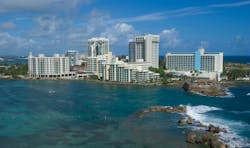
Island life has its benefits; infrastructure is not one of them. The crown jewel of Puerto Rico — Viejo San Juan — is home to tight, blue-brick-lined streets that do not make driving or walking easy.
Fun fact: The blue bricks seen on the roads of San Juan are often said to be ballast materials left behind by the Spanish when making room on their ships to carry away the gold stripped from the island.
Swimming holes are not just in the island’s center attraction. They also appear on the city streets, as massive potholes are a regular occurrence, often taking months if not years to be resolved.
Highway overpasses with no protective fencing were something that struck me when living on the island, as one wrong step (sometimes into a pothole) could leave you tumbling into the interstate.
Where road infrastructure was lacking, the island made up for with beautiful bridges over crystalline waters. My favorite was the Teodoro Moscoso Bridge that spans the San Jose Lagoon, connecting San Juan with Isla Verde, another popular tourist destination. The 1.4-mile bridge is lined with Puerto Rican and U.S. flags, symbolizing their connection.
Another bridge I loved was the Puente Dos Hermanos (Bridge Two Brothers in English) over the Condado Lagoon. On one side of the bridge is the gorgeous lagoon with sparkling waters filled with standup paddle boarders, and on the other, the Atlantic Ocean, flanked by historic ruins left over from the Spanish.
Over in the U.S. Virgin Islands, home to left-side drivers, infrastructure seems to be far from a priority, as money is not something readily at hand for the government, and traumatic weather events are plentiful. Rain floods roadways, cutting off access to entire communities.
Driving in the U.S. Virgin Islands is not for the faint of heart. American drivers have to wrap their head around driving on the opposite side of the road, and they also are confronted with vertical mountainside drops combined with tight, constricted roads.
I suppose when you are surrounded by breathtaking ocean views, you are less likely to take note of the crumbling infrastructure ahead.
From Puerto Rico, I headed back to my roots: the great state of Massachusetts, where there are two seasons: winter and construction season.
What I love about driving in Massachusetts is that it always seems like there are multiple ways to get everywhere, occasionally making for smooth travel. However, rush hour traffic seems to last all day the closer you get to Boston. It is often ranked as one of the most congested states in the country.
In Boston, one-way roads are aplenty, taking you for multiple loops as your destination seems to always be just out of reach. This is the result of using roads made for horse and buggy in the modern day. One wrong turn can cost you an additional hour in travel time on a good day.
Another regular occurrence within Boston’s city limit is a phenomenon coined “Storrowing.” Storrow Drive, one of Boston’s main entry points, has critically low overpasses that are regularly rammed by trucks who make a wrong turn that cannot be fixed before the worst happens.
Boston’s infrastructure might look good compared to Puerto Rico, but unfortunately that is not saying much, and there aren’t the scenic ocean views to ease the burn.
Each of these places shaped the way I see roads, bridges and the people who depend on them. From aging systems to innovative engineering, from breathtaking beauty to serious safety concerns, infrastructure tells the story of a community. I’m grateful that my path led me to Roads & Bridges, where I get to continue exploring those stories—and share them with readers who understand just how much the world runs on what’s built beneath our wheels.
About the Author

Jessica Parks, Staff Writer
Staff Writer
Jessica Parks is a staff writer at Roads & Bridges with newsroom experience in Brooklyn, Long Island and the U.S. Virgin Islands, and several years spent living in Puerto Rico. She is currently based in Massachusetts.