Invite the Next Gen to the Jobsite
By Rachel Bottles, Contributing Author
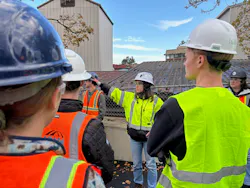
The first time a group of students stepped onto our State Route 520 Portage Bay Bridge jobsite in Seattle for Beavers Student Day, I was reminded of how powerful early exposure can be. For one day, textbooks turned into rebar, traffic plans turned into real world sequencing and civil engineering became something you could walk through, not just study.
Beavers Student Day is a professional outreach event hosted by The Beavers, an honorary organization founded in 1955 to support and promote the heavy civil construction industry. The goal is simple: bring civil engineering and construction management students onto active jobsites so they can see firsthand how large infrastructure projects are planned and built — and meet the people who make it happen.
I participated as a presenter and a tour guide on the SR 520 Portage Bay Bridge and Roanoke Lid Project, one of Washington’s largest and most complex transportation efforts. Led by the Washington State Department of Transportation (WSDOT), the project replaces the aging Portage Bay Bridge with two new, seismically resilient bridges while maintaining a critical corridor between Interstate 405 and Interstate 5. The work also reconnects neighborhoods through a landscaped highway lid and improves transit, pedestrian and bike access across Portage Bay.
I work on the roadway and maintenance of traffic scopes as a Field Engineer II. That means a lot of temporary access work, traffic shift planning and constant coordination to keep vehicles moving safely while construction advances.
One of the facts that I shared with students that stopped them in their tracks: the mainline of SR 520 will never be fully closed for more than a weekend at a time. To pull that off, we build a bridge to build a bridge to take down a bridge to build another bridge.
Sequencing isn’t just a planning exercise — it’s the backbone of the entire project.
Programs like Beavers Student Day matter because they demystify this work. When students walk an active site, they start to understand how many roles exist beyond what they may picture from a classroom or internship posting. They also see how collaboration actually works in the field — between engineers, superintendents, inspectors and crews—when conditions change daily and problems need real-time solutions.
Students asked thoughtful, honest questions throughout the day. One that comes up often is what I look for in interns or new hires. My answer is always the same: engagement. Show interest, ask questions and be willing to learn. No one expects you to know everything on day one. But if you’re curious and invested, people will want to teach you and keep you around.
Another question I love (and slightly dread) is what my day to day looks like. The truth is there’s no clean answer, and that’s what I love about this job. Every day is different. Some days I’m in the field solving immediate issues; other days I’m in the office planning weeks or months ahead. That variety is what keeps the work challenging and rewarding.
Now if I could go back and tell my younger self one thing, it would be this: your to do list will never be empty, and that’s okay. In college, clearing the list felt like success. In the field, success is prioritizing the right tasks at the right time and adapting when plans change. You learn quickly that progress isn’t about perfection — it’s about momentum.
My advice to students considering construction is simple: take the jobsite tours. Even if your friends aren’t going, get on the bus. Walking a site can tell you more in two hours than weeks of research online, and it might introduce you to a path you hadn’t considered.
As infrastructure across the country continues to age, the need for skilled engineers and construction professionals will only grow. By opening our jobsites and sharing our experiences, we’re not just educating students, we’re inviting them to help build the future. Programs like Beavers Student Day are an investment in that future, and one our industry can’t afford to overlook.
Rachel Bottles is a field engineer at Skanska.