Bytes and Bridges in Providence
By Mya E. DeAngelis, Contributing Author
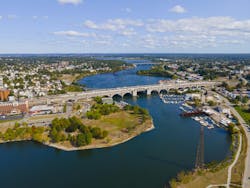
Rhode Island’s infrastructure seems to be at a breaking point. The Washington Bridge in Providence—one of the state’s busiest connectors, carrying approximately 90,000 vehicles daily—has become a symbol for what happens when decades of deferred maintenance collide with modern demands. Each lane closure ripples across the East Bay, snarling traffic on Interstate-195, impacting businesses, commerce, emergency services and commuters.
But the solution to Rhode Island’s infrastructure crisis doesn’t lie in pouring more concrete. It lies in connecting industries.
By pairing innovations from broadband technology with transportation systems, Rhode Island can build smarter, safer and more resilient infrastructure. Research from the Alliance for Innovation and Infrastructure (Aii) shows that fiber-optic broadband—long associated with high-speed internet—can also transform how we monitor and manage roads and bridges. Their 2025 report, Broadening Our View on Broadband, argues that fiber’s capabilities extend far beyond connectivity; it’s becoming the backbone of modern infrastructure.
The American Society of Civil Engineers (ASCE) gives Rhode Island’s transportation network a C-minus, reflecting chronic underinvestment. The state has 783 bridges, approximately, for motor vehicles, and roughly one in five is considered structurally deficient.
The Washington Bridge isn’t an isolated problem—it’s part of a system struggling to keep pace with use, weather and age. Congestion along Interstate-95, State Route 295 and State Route 146 wastes thousands of hours each year and costs millions in lost productivity and fuel. Traditional fixes like widening lanes or repaving are expensive and temporary. It’s time to think differently.
A technology called Distributed Fiber Optic Sensing (DFOS) can turn fiber cables into continuous sensors by measuring light scatter along the strands. Engineers can detect vibration, temperature changes or strain in real time.
Imagine fiber embedded in our bridges, instantly detecting stress before cracks form, or predicting rush-hour backups near the I-95/I-195 interchange to optimize signal timing. DFOS can even alert crews when construction threatens buried utilities, preventing costly damage and delays.
Fiber’s reliability is another advantage. Unlike wireless systems, it is immune to interference and outages, making it ideal for connected-vehicle ecosystems. With fiber-backed 5G, Rhode Island could pilot autonomous shuttles, upgrade our troubled RIPTA routes with live-data tracking, or deploy traffic lights that adjust automatically to real-time conditions. Since 94% of crashes stem from human error, connected systems could save lives while easing congestion.
The benefits would extend directly to Rhode Island’s economy. With fiber running alongside rebuilt transportation corridors, manufacturers could streamline logistics, local shops could expand digital services and tech-driven startups could find affordable, high-speed infrastructure just minutes from Providence.
Broadband access would make Rhode Island more competitive for investment while easing the daily disruptions caused by impaired roads and bridges.
The potential economic impact is enormous. A Brattle Group study cited by Aii estimates $3.24 trillion in national economic value from full fiber deployment—through job creation, housing growth and productivity. Integrating broadband expansion with road reconstruction could multiply these returns for Rhode Island, from the Port of Providence to Quonset Point—and for business corridors like the Washington Bridge, where logistics, manufacturing and digital commerce intersect.
Fiber technology could also tie into Rhode Island’s clean-energy transition. Aii’s Hydrogen Highway report outlines how alternative-powered vehicles could use smart, fiber-enabled infrastructure to monitor fuel pipelines and reduce emissions. DFOS-equipped pipelines could detect leaks instantly, linking energy, data and transportation systems to cut pollution along corridors like Route 146, I-95 and I-195.
Critics argue that digitizing infrastructure creates cyber risks, but fiber’s point-to-point design offers strong defense against intrusion. And as Aii notes, sustainability measures and carbon-offset programs can reduce the footprint of fiber construction, aligning perfectly with Rhode Island’s climate goals.
The Washington Bridge crisis should be a turning point—not just for how we fix what’s broken, but for how we build what’s next. Rhode Island’s policymakers should streamline permitting, incentivize fiber co-deployment on every major road project and pilot DFOS monitoring on key assets like the Washington Bridge.
Innovation thrives where industries meet. Rhode Island’s next great infrastructure project won’t just be built with steel and concrete—it will be wired with light. By connecting our roads and our data, we can build a safer, smarter and more resilient Ocean State.
Mya E. DeAngelis is a Construction & Project Management student at Wentworth Institute of Technology.