MaineDOT Releases Early Findings on Partial Bridge Collapse
Key Takeaways
- MaineDOT says an outer beam may have failed, triggering the partial collapse.
- FHWA experts and OSHA are assisting with the ongoing investigation.
- Testing, debris removal and computer modeling will help determine the collapse’s exact cause and impact on the project timeline.
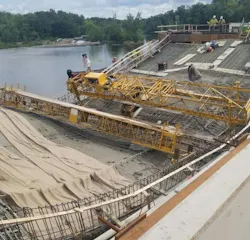
The Maine Department of Transportation has released early findings regarding a partial bridge collapse in Old Town last month.
Crews were pouring concrete on the new northbound Llewellyn Estes Bridge over the Stillwater River on Aug. 13 when it partially collapsed, causing one worker to break their ankle and two others treated for minor injuries, according to News Center Maine.
The bridge was under construction and was not open to the public.
According to evidence collected so far by MaineDOT, the agency suggests that an outer beam on one side of the bridge may have failed, causing nearby beams to quickly give way and leading to the collapse of part of the span.
These findings are preliminary, and more detailed testing and computer modeling will be conducted to determine the exact cause of the collapse, News Center Maine reported.
Since the collapse, MaineDOT has brought on experts from the Federal Highway Administration’s Turner Fairbank Highway Research Center to assist with gathering documents, reviewing data, documenting the scene and preparing materials for forensic testing.
WABI-TV reported that OSHA is also investigating the incident.
MaineDOT has launched a frequently asked questions page regarding the collapse, several of which involve new technology used on the project, according to WABI-TV.
The project used fiber-reinforced polymer composite tub girders developed by the University of Maine Structure and Composite Center and manufactured by Maine-based Basalt International. The technology is designed to increase the bridge’s service life and delay weather-related corrosion.
The material has been used on two other Maine bridges—the Grist Mill Bridge and Twin Bridges in Hampden—which are both inspected regularly.
According to WABI-TV, the FAQ page also reported that a different span was damaged by wind and repairs have been completed, though it is unclear when the damage occurred.
Meanwhile, a plan to remove debris is still being developed, and any information gathered during the removal could help investigators determine the cause of the failure.
Throughout the bridge’s construction, traffic has been rerouted to a temporary two-lane bridge, which was not damaged during the collapse and remains safe for use.
News Center Maine reported that MaineDOT remains unclear on how much the collapse will cost or how it will impact the project timeline. A revised schedule will not be developed until investigators determine the best path forward.
The project involves replacing the two bridges that carry Stillwater Avenue in Old Town.
Sources: News Center Maine, WABI-TV
About the Author
 Jessica Parks, Staff Writer
Jessica Parks, Staff Writer
Staff Writer
Jessica Parks is a staff writer at Roads & Bridges with newsroom experience in Brooklyn, Long Island and the U.S. Virgin Islands, and several years spent living in Puerto Rico. She is currently based in Tulsa, Oklahoma.