Modernizing Without Starting Over
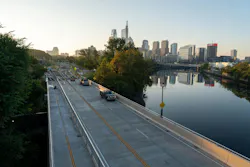
As America’s birthplace, Philadelphia boasts historic and cultural landmarks around every corner. With millions of visitors descending on the city each year, there is a constant need to provide safe, accessible and reliable transportation systems. But as infrastructure ages, these needs require ongoing upkeep, upgrades and, in some cases, complete renewal.
The Martin Luther King Jr. Drive Bridge (MLK Drive) is a critical connection that spans the Schuylkill River. Linking West Philadelphia and Center City, the bridge provides residents with access to parks, green space and other recreational areas. Its location near the Philadelphia Museum of Art places it at one of the city’s most visited areas, where it supports daily travel, major public events and seasonal celebrations. For thousands of pedestrians, cyclists and drivers, the bridge is part of the city’s heartbeat.
However, like many pieces of infrastructure that was built decades ago, the bridge deteriorated and required restoration. Spearheaded by the city of Philadelphia’s Department of Streets, the rehabilitation project was fully funded by the U.S. Department of Transportation’s (USDOT) Bridge Formula Program, a federal infrastructure program under the Bipartisan Infrastructure Law. The project included a $20 million rehabilitation to improve safety and extend the structure’s lifespan.
The rehabilitation of the MLK Drive Bridge was an exercise in extending the useful life of existing infrastructure while adapting it to the needs of a modern, multimodal city. With a deteriorated fracture-critical superstructure, limited access, an active river below and a heavily used trail alongside it, the project team had to balance structural demands with environmental, logistical and public-access considerations. The result was a strengthened and widened bridge that preserves a critical Philadelphia connection while providing improved accommodations for pedestrians and cyclists.
Project Overview
Built in 1965, the 700-foot, four-span bridge was comprised of a single simple span and a three-span continuous structure. It developed significant structural deficiencies over time, and these issues led to load restrictions that limited the weight crossing the bridge. This reduced stress on the bridge’s weakened structural elements but disrupted the flow of traffic.
The bridge deck showed widespread deterioration, including spalling, cracking and multiple holes across several areas. The fracture-critical steel superstructure, consisting of box girders, floorbeams and stringers, showed extensive rust and section loss.
A fracture-critical structure is as serious as it comes. If one section of the bridge were to fail, there is a high probability that the bridge would collapse completely. The existing bridge’s drainage details also led to long-term maintenance problems.
While the abutments and piers remained generally stable, they showed signs of aging, including cracking, shifted stonework and localized concrete spalling.
The bridge was restricted to a three-ton weight limit in 2018 due to damage to the deck and superstructure
Ongoing safety and maintenance concerns eventually led to a full closure to vehicular traffic in March of 2020.
During the final design phase of the rehabilitation, a routine biennial inspection identified deteriorated connections between the floorbeams and box girders, and it was decided to close the bridge to vehicular traffic but allow cyclists and pedestrians to continue to use the structure recreationally during the COVID-19 pandemic. The bridge was closed fully for the rehabilitation project from March 2023 to September 2025.
The bridge closure increased traffic on surrounding roadways. Pedestrians and cyclists who used the bridge to access the Schuylkill River Trail relied on alternate routes. These changes reinforced the bridge as an important connection and highlighted the need to maintain access where possible while limiting disruption during construction.
In response to the deteriorating conditions, the project focused on a thorough rehabilitation of the existing structure rather than a full replacement. The work included full deck removal and replacement, structural steel repairs and strengthening, installation of a new composite deck system and upgrades to drainage and expansion joints.
The rehabilitation also widened the bridge deck usage from 45-feet, 10-inches to 49-feet, 8-inches, maintaining accommodation for three vehicular lanes and incorporating a new, 10-foot, 6-inch protected shared-use path to better accommodate pedestrians and cyclists.
While a four-foot widening of the bridge may not sound significant, from an engineering standpoint, it was a feat to overcome.
Challenges
The rehabilitation involved a range of geometric and logistical constraints. Existing river piers on both sides, along with the Upper Spring Garden Street Bridge overhead, limited design and construction access. Working over an active river added another layer of complexity, requiring constant attention to safety, debris containment and coordination with ongoing river traffic. The contractor had to carefully plan and execute demolition and deck placement to comply with these restrictions.
Site access also was limited by the active Schuylkill River Trail and the river below. Maintaining required navigational clearances for the river and minimizing disruption to the heavily used trail along the east bank were important considerations. Coordination with the Philadelphia Parks and Recreation Department and the U.S. Coast Guard helped manage these impacts.
While some activities required temporary overnight trail closures for safety, most work was staged to allow continued access, with flagging personnel used where needed to keep interruptions to a minimum, which was a critical element for the public.
The bridge’s location near the Philadelphia Museum of Art also required careful planning during major public events, including July 4th and Thanksgiving celebrations, as well as the 2024 Philadelphia Eagles Super Bowl victory parade. Site security and coordination were important to maintain public safety during these high-traffic times.
The design also addressed geometric challenges. The original deck had relatively flat grades and no superelevation on curved sections. The new deck was designed to meet current standards, improving driver comfort and drainage.
Sawcutting was permitted as a means to remove the existing concrete bridge deck. During deck removal, the depth of the sawcutting operation was critical to avoid damaging the existing steel girder and stringer flanges beneath. This highlighted the challenges of maintaining precise depth control with sawcutting. Any minor flange repairs needed to be assimilated into the project and were addressed without impacting the cost or schedule.
Environmental Considerations
The project required careful attention to environmental and regulatory requirements. The MLK Drive Bridge spans a designated water trail by the Pennsylvania Fish & Boat Commission and an important waterway in the Schuylkill River. The design and construction teams coordinated closely with multiple agencies to ensure compliance throughout the project.
Because the bridge is located within the Philadelphia Parks System, the team worked in partnership with the Pennsylvania Department of Conservation and Natural Resources to secure the required permits and approvals. Ongoing coordination helped align construction activities with environmental protection standards while minimizing impacts to the surrounding parkland and public spaces.
Regulatory oversight also extended to the river itself. The team maintained continuous coordination with the U.S. Coast Guard and other environmental agencies, ensuring navigation, safety and environmental requirements were met. As part of the permitting process, an Aids to Navigation Plan was developed and submitted to the Pennsylvania Fish & Boat Commission to support safe passage along the river during construction.
Solutions
During construction, the bridge remained closed to the public for safety. However, protective shielding was installed over the Schuylkill River and the Schuylkill River Trail, allowing mariners, pedestrians and cyclists to continue using the river and trail throughout much of the project. Access was only temporarily restricted during specific high-risk activities, such as bridge demolition and concrete deck placement, when conditions required full closures. During these times communications with the public were of top priority.
To support multimodal access, the design included wider overhangs using custom overhang brackets. Additional bracing within the box girders was added to support these larger brackets and maintain structural stability. The contractor used overhang brackets spaced at 32 inches to support the wet concrete, formwork, screed and other construction loads.
Advanced staging and sequencing were used to work around the site’s limited access. The contractor made use of the Spring Garden Street Bridge, which passes over the MLK Drive Bridge, to help reach the middle spans during concrete deck pour operations. By using this bridge as an access point for concrete pours, crews were able to work from above instead of relying only on tight ground space or access from the river.
This provided a simple and effective solution that kept construction moving steadily despite the challenges of working in a constrained area over an active river corridor.
The existing finger joints at Pier A and the east abutment were replaced with modular expansion joints, which provide a watertight seal and protect the superstructure and bearings from corrosion. In addition, the original noncomposite deck was replaced with a composite deck system, requiring shear studs along the full length of the girders and stringers.
A 3D structural analysis of Span 1, which is curved and highly skewed, was performed to verify girder stability during deck removal and the replacement of a floorbeam. Steel deck beams embedded in the deck and connected to the girders were used in select locations to support the deck overhangs.
Collaboration
The success of the rehabilitation was driven by strong communication and a high level of collaboration among all parties involved. Throughout the design phases, the team worked closely with Philadelphia’s Streets Department, Parks and Recreation, and members of the public. Feedback from the Bicycle Coalition of Greater Philadelphia helped ensure cyclists’ and pedestrians’ needs were considered.
Public outreach meetings and a project website were used to inform stakeholders of detours, closures and work schedules. During construction, constant communication occurred among city departments, design teams and stakeholders, with social media and formal press releases used to provide updates on major activities.
Lessons Learned
This project highlights how important early coordination, teamwork and thoughtful planning are when working in a constrained and complex environment. Bringing together the design team, contractor and stakeholders early in the process helped everyone stay aligned on the goals and better understand how the work would come together in the field. That shared understanding made it easier to work through challenges as they came up and keep the project moving forward.
This project also shows that existing infrastructure can be adapted to better serve today’s needs. By adding a wider, protected shared-use path, the bridge now provides a safer and more comfortable experience for pedestrians and cyclists. This approach improved access and mobility without needing to fully replace the structure, showing how upgrades to existing assets can deliver for the community.
Civic Investment
With the nation’s 250th anniversary this summer, Philadelphia was on full display. Preparing for this kind of attention meant ensuring the city’s infrastructure was ready to handle crowds and provide a safe, welcoming experience. The Martin Luther King Jr. Drive Bridge Rehabilitation was part of that effort. The improvements align with the city’s push to make streets safer and more accessible.
The project also shows how existing infrastructure can be reimagined to meet today’s needs. The team saved time and resources while extending the life of a critical connection. It’s a practical approach that supports the city’s long-term goals.
As Philadelphia continues to grow and evolve, investments like this are important in maintaining safe, efficient and adaptable infrastructure.
By the Numbers:
- Approximately 717 feet in total length, with limits of work extending to about 1,450 feet across the Schuylkill River and surrounding approaches.
- Four-span structure, consisting of one simple span and a three-span continuous system.
- Bridge deck widened from 45-feet, 10-inches to 49-feet, 8-inches, accommodating three vehicular lanes and a 10-foot, 6-inch protected shared-use path.
- 1,680 cubic yards of structural concrete placed in the deck and parapets (approximately 2,353 tons).
- 353,469 lbs. (approximately 158 tons) of reinforcing steel installed.
- 91,698 lbs. (approximately 41 tons) of structural repair steel used to strengthen existing components.
MLK Jr. Drive Bridge Rehabilitation Team
- The City of Philadelphia Department of Streets
- The Federal Highway Administration
- The Pennsylvania Department of Transportation (PennDOT)
- The Bicycle Coalition of Greater Philadelphia
- Philadelphia Parks and Recreation
- Urban Engineers, Inc.
- Modjeski and Masters
- H&K Group, Inc.
Luigi Marraffino is vice president, construction department manager at Urban Engineers, Inc. William Gural, P.E., chief construction engineer and Tyler Barile, P.E., assistant chief construction engineer at the city of Philadelphia’s Streets Department.