Work Zone Crash Fears Rise as Crews Point to Distracted Driving, Weak Enforcement
Key Takeaways
- More than half of survey respondents said they feel at greater risk of a work zone crash than they did a year ago.
- Distracted driving and cellphone use were identified as the leading causes of work zone crashes and intrusions.
- Contractors overwhelmingly supported stronger police presence, stricter enforcement and expanded work zone safety technology.
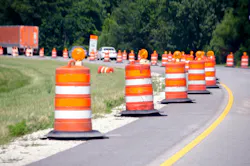
Highway work zone crashes are perceived to be a greater risk than one year ago, according to respondents of a survey released by the Associated General Contractors of America (AGC) and HCSS.
The 2026 Work Zone Awareness Survey polled 703 respondents on work zone safety, current enforcement measures and areas needing improvement.
“We want to understand how often crashes occur in work zones, what is causing them and what steps can be taken to better protect workers and motorists alike,” said Brian Turmail, spokesman for AGC of America, during a May 20 briefing.
More than half of the 540 respondents said they feel at greater risk of a highway work zone crash than they did a year ago, while 45% said their level of risk remained unchanged.
Crews identified distracted driving as the leading contributor to work zone crashes and intrusions, with 92% of 571 respondents citing it as a major factor. Cellphone use followed at 81%, speeding at 70% and reckless driving at 50%.
Enforcement was also viewed as lacking. Some 39% of respondents said current enforcement is insufficient, while 37% said that penalties in their states need to be more severe. Additionally, 40% said enforcement efforts are not deterring unsafe driving behaviors, compared to 29% who said enforcement has been effective.
Among 522 respondents, 79% said greater police presence would help reduce highway work zone crashes. Other frequently cites measures included stricter enforcement of existing laws at 72%, tougher distracted driving laws in work zones at 67% and automated speed enforcement at 58%.
Out of 591 respondents, 61% said they had experienced at least one work zone crash while on the job in the past year, with 33% reported experiencing five or more crashes.
The survey also found motorists involved in work zone crashes are more likely to be injured or killed than construction workers. Of respondents who experienced a crash, 73% said no construction workers were injured, while only 41% reported no injuries among drivers or passengers. Additionally, 24% said five or more motorists or passengers were injured in the crashes they witnessed.
Fatalities among construction workers were less common, with 93% of respondents reporting no worker deaths in crashes they experienced. By comparison, 78% reported no fatalities among drivers or passengers.
Crashes also continue to delay projects. More than half of respondents, 55%, said work zone crashes caused project delays. Some 27% reported delays lasting less than one day, while 10% experienced delays of five or more days.
The survey found 45% of respondents use Truck-Mounted Attenuators (TMAs) and view them as effective safety tools, while only 1% said they had abandoned their use.
Blue safety lights on construction vehicles remain less common, with 46% of respondents saying they have never used them and 14% describing them as helpful.
Nighttime work zone crashes were perceived as largely unchanged, with 63% reporting no significant shift compared to one year ago. However, 33% said nighttime crashes have become more frequent. Distracted driving again ranked as the top contributor to nighttime crashes at 84%, followed by speeding at 61% and impaired driving at 59%.
AGC of America is pushing for work zone safety measures to be included in the next federal highway and transit bill, including improved crash data and requirements for states to develop comprehensive work zone safety plans.
“Right now, states are required to put those kinds of plans together for improving pedestrian safety and road safety, but they are not required to do that for work zone safety,” Turmail said.
Steve McGough, president and CEO of HCSS, is pushing for reform in three primary areas:
- Expanding work zone safety education into ongoing driver education and license renewals.
- Using technology such as real-time notifications to alert drivers when workers are present.
- Increasing enforcement efforts, including automated speed cameras, with fines reinvested into worker safety programs.
Advocates said reducing work zone dangers will require making speeding and distracted driving in work zones as socially unacceptable as impaired driving.
Source: AGC of America/HCSS National Work Zone Awareness Survey
About the Author
 Jessica Parks, Staff Writer
Jessica Parks, Staff Writer
Staff Writer
Jessica Parks is a staff writer at Roads & Bridges with newsroom experience in Brooklyn, Long Island and the U.S. Virgin Islands, and several years spent living in Puerto Rico. She is currently based in Tulsa, Oklahoma.