How Truck-Mounted Attenuators Are Improving Safety in High-Speed Work Zones
Key Takeaways
- Truck-mounted attenuators (TMAs) provide critical last-line protection against vehicle intrusions in work zones.
- Automated TMAs are emerging as a solution to reduce worker exposure, especially in mobile and high-speed environments.
- Cost, deployment challenges and awareness continue to limit widespread adoption despite proven safety benefits.
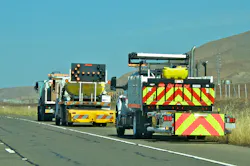
Crews working in high‑speed corridors and mobile work zones face an elevated risk of vehicle intrusions, where traditional safety equipment such as barrels and cones alone may not provide adequate protection.
This is where Truck-Mounted Attenuators (TMAs) come in.
These crash-absorbing safety devices attach to the rear end of a work truck and serve as the last line of defense against errant vehicles entering a work zone, helping prevent severe injuries and fatalities.
TMAs on the Jobsite
TMAs do not replace the use of cones and barrels in a work zone but instead complement more traditional safety equipment to create a more layered approach to work zone safety.
“When you think about what truck-mounted attenuators provide, it’s really active physical protection, and this is something that cones and signs simply can’t do,” Cole Hansen, Lindsay Corporation’s vice president and general manager, told Roads & Bridges.
The crash apparatus “should be prioritized wherever workers are exposed to live traffic,” Hansen said, especially on higher-speed corridors and “short-duration work zones.”
Unlike fixed barriers such as cones and signage, TMAs can move in coordination with mobile or short-duration work zones, maintaining a strong protective buffer as crews advance.
“In those types of environments, things change very quickly, and time doesn’t allow for extensive channelization with cones, barrels, etc., that don’t actually stop the vehicle,” Hansen said.
More recently, some manufacturers have taken that mobility a step further by introducing automated TMAs, which can follow work vehicles without a driver onboard, further reducing worker exposure to live traffic.
Automated TMAs are particularly effective in mobile work zones, where maintaining consistent spacing behind active work vehicles is critical. By preserving a standard following distance, these systems help ensure a reliable protective buffer remains in place as operations move, reducing risk in the event of a crash.
“With the automated system, you are actually able to keep that trailing distance a lot more closely in order to keep everybody safer,” said Taylor Wills, marketing manager for Royal Truck & Equipment, a forerunner in the automated TMA space.
Joe Hendrickson, Royal Truck & Equipment’s vice president of sales and marketing, highlighted street sweeping operations as a highly effective application of automated TMA systems.
“Where we got our start was actually in tandem with street sweepers that are sweeping on highways, so you’ve got the street sweeper as the lead vehicle, you’ve got the TMA as a trailing vehicle,” Hendrickson told Roads & Bridges, adding that any high-speed highway environment is well-suited for autonomous TMAs.
Why TMAs Aren’t on Every Jobsite
TMAs are not seen on every jobsite, which manufacturers say comes down to several factors that include cost, practicality and deployment time, especially on short-term jobs.
According to Hansen, older TMA systems were not designed for the fast-moving, mobile operations seen today, but as TMAs advance and become “easier to deploy and they’re easier to move, they’re going to be easier to adopt into work zone management.”
Meanwhile, automated TMAs aren’t widely seen on roads yet and have mostly been deployed for government use. While the added cost of running an automated system has been a barrier, the added protection for workers is priceless.
“You can’t say that the autonomous is less money, but when you minimize the risk to the human being and the liability of a life, how do you put a price tag on that,” Hendrickson said.
Another misconception is that an automated TMA eliminates the need for an operator entirely; however, an operator is still required for job‑site setup and calibration to follow a lead vehicle.
“The ideal commute is you bring that autonomous vehicle to the work zone with a human being; you then set it up to follow the lead vehicle, and then you remove that person from the vehicle while it’s in work mode,” Hendrickson said.
Recent Developments in the TMA Space
The evolution of work zones has influenced how manufacturers are rethinking TMA design and deployment to better protect workers.
Lindsay Corporation recently introduced the Road Runner, a TMA engineered for rapid deployment without occupying truck bed space, unlike many conventional systems.
After speaking with crews, Hansen said, “the consistent feedback that we got back was really around needing a product that didn’t slow them down.”
Quicker deployment also means less time where workers are at risk of live traffic.
Crews also expressed a need for a TMA designed to hold up against routine minor impacts that occur in active work zones, Hansen said.
“They needed a product rugged enough to minimize nuisance hits; usually that’s when they’re just backing up at slow speeds; they’re in small areas, but anytime they’re suffering nuisance hits that aren’t on a rugged TMA, its downtime for them to fix,” he said.
That same focus on reducing worker exposure has also driven interest in automated TMAs, which aim to remove operators from the shadow vehicle altogether while maintaining consistent protection.
“There is just this element of fear that the operator lives with in a TMA truck, they are waiting to be impacted, so you remove that,” Hendrickson said, noting the automated system also has the added benefit of helping crews operate more consistently.
As TMAs continue to evolve to meet the demands of modern job sites, manufacturers and agencies alike are emphasizing solutions that reduce worker exposure and adapt to faster‑moving, more complex work zones. Whether through improved design, easier deployment or automation, TMAs remain a critical layer of protection for crews working just feet from live traffic.
About the Author
 Jessica Parks, Staff Writer
Jessica Parks, Staff Writer
Staff Writer
Jessica Parks is a staff writer at Roads & Bridges with newsroom experience in Brooklyn, Long Island and the U.S. Virgin Islands, and several years spent living in Puerto Rico. She is currently based in Tulsa, Oklahoma.