The Zipper Merge Grows in Popularity on Jobsites
Key Takeaways
- Zipper merges encourage drivers to use both lanes and merge at a designated point, improving traffic flow and reducing crashes.
- Early merging can lead to aggressive driving, speed fluctuations and confusion in work zones.
- DOTs are expanding zipper merge use in high-traffic areas but face challenges with driver compliance and public understanding.
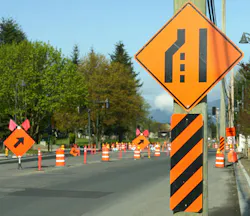
Each year, roadside workers are injured or killed in highway work zones because speeding, distracted driving, congestion, lane jockeying and sudden braking create unpredictable and dangerous traffic conditions.
As work zone crashes remain a persistent safety concern heading into peak construction season, transportation agencies are increasingly turning to the zipper merge as a tool to reduce congestion and calm driver behavior for work zones situated in high traffic areas.
With today being the midway point of National Work Zone Awareness Week, let’s take a look at the zipper merge and examine what makes it effective.
Problems with Early Merging
While many drivers traditionally attempt to merge as early as possible, this can often lead to aggressive driving and confusion among drivers as late mergers are perceived as cutting the line, a study from the Federal Highway Administration (FHWA) reported. However, many studies have shown that late merging at a specific point can improve safety in work zones.
Early merging maneuvers often lead to high fluctuation in driver speeds and uncertainty as drivers decide where and when to merge — resulting in increased risk of work zone crashes, according to research released by Iowa State University’s Institute for Transportation.
Another risk comes from drivers slowing down too quickly once they see the “lane closed ahead” sign, causing unexpected or dangerous lane switching, serious crashes and road rage, according to the Minnesota Department of Transportation’s (MnDOT) website.
A study from the North Carolina Department of Transportation (NCDOT) cited a report that identified driving maneuvers that were the most detrimental to work zone safety. These behaviors included forced and late merges, lane straddling and queue jumping — defined as moving from the open to closed lane and back again.
What is a Zipper Merge?
A zipper merge differs from the traditional early merge as it encourages late merging at a specified merge point to prolong the use of both lanes and keep traffic flowing smoothly. When the lanes merge into a single lane, drivers alternate turns entering the work zone “in a zipper fashion” into the open lane, according to New York State’s website.
Zipper merges are not sporadic, late or forced merges, but instead a controlled merge at a designated point, instead of drivers cutting in to the appropriate lane.
Static zipper merges are when the designated merge point stays in the same location. While in dynamic zipper merges, the designated merge point is adjusted in real time based on traffic conditions and driving speeds.
Benefits of the Zipper Merge
Drivers were found to travel as more uniform speeds and use the soon-to-be-closed lane more effectively when zipper merges were in place, according to a road user survey cited in Iowa State University’s research. The zipper merge promotes fairness by alternating vehicles into the open lane.
The use of the zipper merge has shown a wide-range of benefits when used in high-traffic areas, including decreased travel times, delays and rear-end crashes. MnDOT also found a reduction in congestion, queue length and the overall backup length by 40%.
Zipper merges are better suited for work zones located in moderate to high traffic volumes, as they allow for more steady speeds due to the utilization of a designated merge point. In lower traffic volume situations, drivers were found to merge earlier without creating any adverse impacts on traffic or road operations.
Though NCDOT does not allow for daytime lane closures on most of its highways, the agency found that dynamic zipper merges can improve traffic management, allowing work zones to remain in place for longer periods, potentially reducing overall construction timelines.
Problems with the Zipper Merge
The proper use of zipper merges relies heavily on the compliance and cooperation of drivers, and the use of signage to guide the driver to the merge point. Typically, drivers are directed to stay in their current lanes through a series of road signs leading up to the designated merge point
Zipper merges were shown to be more impactful as drivers became more familiar with them, though older motorists exhibited less compliance with zipper merges. This demonstrates a need for education to alter driver behaviors around merging, Iowa State University’s research stated.
Agencies are working to overcome skepticism about zipper merges through public awareness campaigns and improved signage designed to better guide drivers to the merge point.
New York State’s Use of the Zipper Merge
The New York State Department of Transportation (NYSDOT) is utilizing a zipper merge for its Interstate 490 bridge replacement project as the highway sees high traffic volumes and has closely spaced exits. The website states that if drivers need to use I-490, the zipper merge method will enhance safety and minimize delays.
Not only is the zipper merge reducing traffic on the interstate, but it is also expected to alleviate traffic on the highway’s entrance ramps and surrounding local streets, according to NYSDOT’s website.
The state transportation department urges drivers to avoid road rage by understanding that drivers merging just before the lane ends are properly adhering to the zipper merge.
All in all, zipper merges are not expected to replace the early merge completely, and both will be utilized on a case-by-case basis considering traffic volumes and other factors. DOTs still have a long way to go in educating the public on the proper use of zipper merges to deter aggressive driving and confusion — and ultimately improve safety for workers and drivers alike.
About the Author

Jessica Parks, Staff Writer
Staff Writer
Jessica Parks is a staff writer at Roads & Bridges with newsroom experience in Brooklyn, Long Island and the U.S. Virgin Islands, and several years spent living in Puerto Rico. She is currently based in Massachusetts.