Closing the Gap: How Smart Work Zones Reduce Risk
By Ryan Dobbins and David Feise, Contributing Authors
Each year, National Work Zone Awareness Week occurs as construction season ramps up, lane closures multiply and traffic patterns start shifting day to day. It’s the time of year that we’re reminded that the stakes in the industry are still uncomfortably high: work zones continue to kill and injure far too many people.
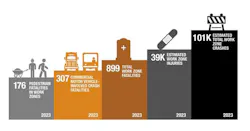
In 2023, work zone crashes killed nearly 900 people and injured over 39,000 based on publicly reported data. Those totals include drivers, passengers and workers, and the numbers point to a simple truth: the most dangerous variable in a work zone is moving traffic.
Technology cannot replace good planning, training and supervision, but it can compress the time between “something is changing” and “the field responded.” That same gap drives rear-end crashes at the back of a queue, struck by intrusions into the workspace and near misses that never make it into a report.
That’s why traffic control service providers are shrinking the gap by investing in connected work zones backed by connected operations.
Smart work zones are built by instrumenting the zone itself and turning those signals into action — how crews are scheduled, how equipment is deployed and how behaviors are coached across teams and support fleets. Proponents often describe it as next-generation because it links field devices and back-office decision-making into one system.
What is a Smart Work Zone?
A smart work zone is a living system that watches how traffic is behaving, recognizes when risk is building and helps the field respond before a problem turns into an incident.
The U.S. Department of Transportation (DoT) frames these as part of the larger push toward Intelligent Transportation System (ITS) deployments built to manage traffic impacts dynamically. In work zones, that translates into practical capabilities like connected automation, real-time traveler information and detour support.
The value starts with earlier, smoother reactions. When a smart work zone detects a queue beginning to form and pushes an alert upstream, for example, it gives drivers time to adjust gradually instead of slamming on the brakes at the last moment.
Smart Work Zone Tools
A smart work zone is defined by a toolchain that can do three things in sequence: sense what traffic is doing, translate that into a clear signal and support a response before conditions turn into a crash or a close call.
Sensing tools turn the approach into measurable conditions. In a traditional setup, crews often learn what is happening upstream after it has already become a problem. They find out during a periodic check, or during sudden braking when stop-and-go traffic reaches the zone. Connected devices change that by measuring conditions continuously. Smart channelization such as iCones, along with other portable traffic monitoring devices, can capture indicators like speed changes, stop-and-go patterns and the early formation of a queue. The value is catching instability early — traffic tightening up, the back of the line moving upstream or speeds dropping quickly.
Warning and information tools push that insight upstream. Once a queue begins forming, the risk often is concentrated at the back of the line. Queue warning systems take the detection signal (e.g., a sudden speed drop, growing congestion, a migrating queue) and trigger upstream warnings so drivers can slow down sooner. Traveler information updates and detour support tools add another layer of safety by steering some traffic away from the same choke point. For example:
- A portable message sign updates from “Road Work Ahead” to “Slow Traffic Ahead” or “Expect Delays,” then adds an alternate route notice.
- Work zone and traffic data flows into DOT traveler-information feeds and third-party aggregators, then into navigation apps and in-vehicle systems, prompting some drivers to reroute before they reach the queue.
Control tools automate the highest-exposure functions. Automated Flagger Assistance Devices (AFADs) are a good example of how technology is changing the way traffic is physically controlled. They do not run on their own, but they replace a person standing in or near the lane with an automated signal that a trained operator controls from a safer roadside position. The result is the same stop-and-go control but with less worker exposure to live traffic, while drivers see a highly visible, consistent signal.
What makes these tools matter is how they work together. Sensing tells you conditions have changed; warning buys time; automation reduces exposure at the control point. When those pieces are connected through a platform that can surface alerts and support faster field decisions, the work zone becomes a system that adapts as traffic does.
Ryan Dobbins is AWP Safety’s vice president of environmental, health and safety (EHS), and David Feise is president of Arrive Alive Traffic Control (AATC), an AWP Safety company.