Highways Could Soon Carry More Than Cars Under New ‘Great Corridors’ Plan
Key Highlights
- The AGCC program would allow utilities such as transmission lines, fiber optic cables and water pipelines to use existing rights-of-way.
- Revenue from utility leases could support upgrades to roads, bridges, tunnels and rail lines.
- USDOT plans to choose up to five priority corridors and provide technical support, permitting assistance and public-private partnership models.
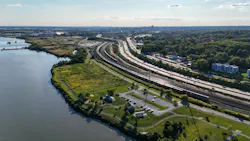
America’s highways and railroads could soon become more than routes for moving people and freight.
The U.S. Department of Transportation has launched a new initiative that would allow power, telecommunications and other utilities to be built along existing highways and rail corridors.
Called America’s Great Corridors of Commerce (AGCC), the voluntary program would give state transportation departments and railroads a way to lease portions of their rights-of-way for infrastructure such as transmission lines, fiber optic cables and water pipelines, according to the U.S. Department of Transportation.
The goal is to use land that already exists instead of acquiring new property for every project, potentially cutting costs and speeding up development.
Turning Transportation Corridors Into Multi-Use Routes
Under the AGCC model, states and railroads could partner with private companies known as “Corridor Managers.” Those companies would help oversee the design, construction, operation and maintenance of the added infrastructure, according to USDOT.
The department says the approach could also create a new source of revenue for transportation agencies. Money generated through utility leases could be used to help pay for repairs and upgrades to roads, bridges, tunnels and rail lines.
That could be particularly significant as transportation agencies face a massive backlog of infrastructure improvements.
The program is also designed to take advantage of existing environmental review exemptions where applicable, which USDOT says could help reduce lengthy permitting timelines.
Why Energy and Fiber Are Part of the Plan
The push comes as the U.S. faces growing demand for electricity and high-speed communications infrastructure.
New power generation is being added across the country, but getting that electricity where it is needed can be difficult because of limitations in the nation’s transmission network, according to USDOT.
The department points to China’s rapid expansion of high-voltage transmission as an example of the challenge facing the U.S. It says China has built more high-voltage transmission lines over the past 15 years than the United States has built throughout its history.
Fiber optic infrastructure is facing a similar challenge. Fiber is increasingly important for semiconductor manufacturing, data centers, smart transportation systems and other technology. Demand for fiber is expected to double by 2029, according to a study cited by USDOT.
The idea behind AGCC is to put some of that infrastructure in corridors where transportation rights-of-way already exist.
Up to Five Corridors Could Be Selected First
The Build America Bureau, which is part of USDOT, will select up to five initial priority corridors under the initiative. The agency plans to provide technical assistance, streamlined permitting support and public-private partnership models to help get the projects moving, according to USDOT.
Transportation Secretary Sean P. Duffy said the program is intended to lower infrastructure costs while making it easier to build the energy and telecommunications systems needed to support future industries.
“By working with the private sector to combine our existing transportation network with transmission lines, fiber optic cables, and other critical infrastructure,” Duffy said, “we can make energy more affordable and fuel American industry for generations to come.”
Build America Bureau Executive Director Morteza Farajian said the program is meant to give states and other infrastructure owners another option for delivering projects.
What Happens Next?
The AGCC is still in its early stages.
The Build America Bureau published a Request for Information (RFI) on August 18 seeking feedback on how the program should work. Comments are due Sept. 12, 2026, according to the Federal Register.
USDOT also plans to hold an informational webinar on Sept. 1 at 3:30 p.m. ET.
If the initiative moves forward as envisioned, a highway or railroad corridor could eventually serve several purposes at once: moving vehicles or trains while also carrying the power, communications and other utilities needed to support communities and businesses.
For transportation agencies, the bigger question may be whether those additional uses can help bring in enough private investment to improve aging infrastructure without placing more of the cost on taxpayers.
Source: USDOT
About the Author
 Karina Mazhukhina, Digital Content Specialist
Karina Mazhukhina, Digital Content Specialist
Digital Content Specialist
Karina Mazhukhina has extensive experience in journalism, content marketing, SEO, editorial strategy, and multimedia production. She was previously a real-time national reporter for McClatchy News and a digital journalist for KOMO News, and ABC-TV affiliate in Seattle.