Miami Ranks Among Nation’s Most Congested Cities as Commutes Stretch Longer
Key Takeaways
-
Greater Miami is now the second most traffic-congested metro area in the U.S., trailing only Los Angeles.
-
In 2025, Miami drivers spent nearly 50% more time on the road than in free-flowing traffic, with rush-hour speeds dropping below 19 mph.
-
The average commuter spends about 76 minutes driving each workday, or nearly two full weeks per year sitting in traffic.
-
Population growth, low-density zoning and highway expansion have fueled sprawl and longer commutes, while experts point to housing near transit, parking reform and safer walking and biking infrastructure as potential solutions.
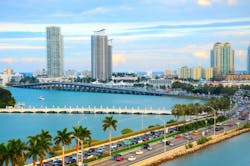
Every morning and evening, brake lights stretch across South Florida highways as traffic grinds to a crawl. Drivers inch forward, squeeze into tight gaps and lean on their horns, turning even short trips into long ordeals.
According to TomTom, Greater Miami is now the second most traffic-congested metro area in the United States, behind only Los Angeles. The ranking reflects a reality many residents already feel: longer commutes, heavier dependence on cars and rising transportation costs in a region already struggling with affordability.
Weeks Lost to Traffic
On a typical day in 2025, Miami drivers spent nearly 50% more time on the road than they would in free-flowing traffic, almost 20 percentage points worse than in 2019, TomTom reports. During rush hour, average speeds dipped below 19 miles per hour.
Morning congestion added about 74% to normal travel times, with cars averaging just over 20 miles per hour. Evening trips were even slower. Congestion climbed to 89%, and drivers crept along at roughly 18 miles per hour. On the worst day of the year, congestion hit 114%, meaning it took about 15 minutes to travel less than four miles.
That adds up quickly. Data from the United States Census Bureau show the average Miami commuter spent about 36 minutes driving to work last year, the Miami Herald reported.
Because evening trips tend to be slower, TomTom’s findings suggest many people spend around 40 minutes getting home. Together, that is roughly 76 minutes in the car each workday, or close to two full weeks a year spent sitting in traffic.
Heavy congestion can ripple through people’s lives, affecting punctuality, productivity and even career choices. Cathy Dos Santos, director of the nonprofit Transit Alliance, told the Miami Herald that commute times influence what jobs workers feel they can realistically take.
“It’s really hard to provide good public transportation options in those areas,” Dos Santos said. “Basically, we force everybody to drive.”
How Miami Grew into Gridlock
Miami’s traffic surge has tracked the region’s population boom since the pandemic. As housing costs climbed near the urban core, many workers moved farther south toward Homestead or north into Broward and Palm Beach counties, lengthening daily commutes.
Dos Santos said zoning patterns are a major factor. Much of Greater Miami is low-density and spread out, dominated by single-family neighborhoods. As the population grew, the region expanded outward instead of upward, pushing homes farther from jobs, schoolsand shopping.
At the same time, she said, a large share of transportation funding goes toward widening highways. That strategy can backfire because of what planners call induced demand: adding lanes often encourages more driving, which fills the roads again.
“For billions of dollars,” Dos Santos said, “we end up, in as little as a couple of years, with the exact same problem.”
Rethinking Solutions
Pete Costello, a senior account manager at TomTom, told the Miami Herald that Miami should look beyond simply expanding highways to address congestion. One option is changing land-use patterns by building more housing near transit, particularly affordable housing, an approach local governments have begun to explore.
Parking policy is another lever. Local rules often require 1.5 to two parking spaces per housing unit, yet Census data show only about 53% of Greater Miami’s 2.4 million households own more than one car. The Transit Alliance estimates those requirements create roughly half a million more parking spaces than Miami-Dade County actually needs, according to the news outlet.
“Parking is absolutely central to creating that sprawl,” Dos Santos said.
Easing those requirements could free land for modest increases in housing density, making transit more practical and reducing the need for constant driving. She emphasized that reform would not automatically eliminate parking.
“It doesn’t mean that, just automatically, less parking is going to exist,” Dos Santos said. “Let’s allow the private market to tell us how much parking they need.”
Costello added that improving options for walking and biking could also chip away at congestion. Short trips taken on foot or by bike instead of by car would reduce traffic and household transportation costs. But many neighborhoods still lack protected bike lanes, safe crossings and pedestrian-friendly streets.
Compared with massive transit projects, Dos Santos said those improvements can be faster and cheaper to build and maintain.
“We’re not talking about billions of dollars, we’re talking about millions,” she said. “It’s a step toward getting more people for those short trips, from point A to point B.”
Sources: TomTom, Miami Herald
About the Author
 Karina Mazhukhina, Digital Content Specialist
Karina Mazhukhina, Digital Content Specialist
Digital Content Specialist
Karina Mazhukhina has extensive experience in journalism, content marketing, SEO, editorial strategy, and multimedia production. She was previously a real-time national reporter for McClatchy News and a digital journalist for KOMO News, and ABC-TV affiliate in Seattle.