Top 10 Awards Submissions Open June 3
Each year, the Roads & Bridges editorial team judges the submissions for our annual Top 10 Roads and Top 10 Bridges awards.
It’s an honor to read the submissions and learn about the projects that have defined American infrastructure that year. It’s also incredibly challenging to choose which projects make the final cut.
It’s time to start that process again: Submissions for the 2026 Roads & Bridges Top 10 Roads and Top 10 Bridges awards open June 3.
Created in 2000, our annual awards recognize the year’s most outstanding road and bridge projects that were completed in North America.
As usual, nominations are submitted to the Roads & Bridges editorial staff. We determine the Top 10 lists based on the following criteria:
- Design
- Technology utilization
- Uniqueness
- Level of improvement over current infrastructure
- How the project team overcame obstacles
- Collaboration with stakeholders and community
Projects must have been completed or have reached the final construction phase within 14 months of the submission deadline, which is Sept. 4.
The early bird deadline for submissions is July 10.
Before we start pouring over the 2026 submissions, let’s take another look at the top five bridges from last year’s awards.
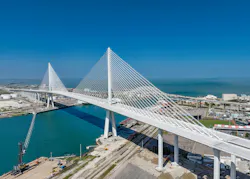
In 2025, the New Harbor Bridge earned first place on Roads & Bridges’ list of Top 10 bridges. The project gave Corpus Christi, Texas the longest cable-stayed main span in the United States and longest precast segmental span in the world.
Owned by the Texas Department of Transportation (TxDOT), the bridge replaced the aging steel-truss Harbor Bridge that had opened in 1959. The monumental undertaking to construct the tallest structure in South Texas was conducted by a consortium of public and private stakeholders, led by TxDOT, and including the project developer, Flatiron/Dragados, LLC (joint venture), and the CSB engineer of record, Arup-Carlos Fernandez Casado (joint venture).
The Buck O’Neil Bridge Design-Build Project took the No. 2 spot on our Top 10 bridges of 2025. The project replaced the aging Broadway Bridge in Kansas City, Mo. with a modern, multimodal crossing that provides better connections to downtown and surrounding transportation hubs.
The new bridge relieves congestion, improves airport access, supports freight and economic development and provides better connection to the Harlem neighborhood in Kansas City.
The SR 520 Montlake Lid and Bridges Project in Seattle claimed third place on our 2025 list of top bridges. The project replaced the West Approach Bridge South with a new 1.1-mile, 40-span elevated bridge complete with protections against seismic catastrophes and constructed a 3-acre landscaped lid over Washington State Route 520.
The $455 million project reconnected the Montlake neighborhood, which was split into two during the construction of SR 520 in the 1960s.
When judging last year’s submissions, the SR 520 Montlake Lid and Bridges Project’s use of green space, focus on environmental-sustainability, innovativeness and seismic resiliency caught the attention of our editorial team.
The US-50 Blue Mesa Bridge Emergency Repair took fourth place in 2025. This six-month long, $134-million project repaired a critical route over the Blue Mesa Reservoir and caused minimal traffic in the remote area of Western Colorado. The project successfully extended the bridge’s lifespan by 30 years.
Following a Federal Highway Administration mandate to conduct non-destructive testing of fracture critical members composed of AASHTO M244 Grade 100 Steel (T1 Steel), inspectors discovered a 2.5-inch crack and a weld defect indication on the Blue Mesa Middle Bridge, as well as internal flaws within the weld. The Colorado Department of Transportation, which owns the bridge, ordered a full and indefinite bridge closure.
The team, which included Michael Baker International as designer and Kiewit as contractor, used crack mitigation, remote location logistics and rapid delivery while also working under the scope of emergency response.
The $320 million historic rehabilitation of the iconic Brooklyn Bridge in New York City rounded out our top five bridges of 2025. This project caught our attention because it required precise coordination to balance modern engineering with historic preservation to upgrade the landmarked structure.
The major restoration included structural improvements to the bridge’s approach arches, the removal and replacement of the brick infill walls, rehabilitation of arch interiors, foundation strengthening and floor repairs. Additionally, the project included conservation of the bridge’s masonry — granite, limestone and brick — and the restoration of two towers, two anchorages and eight approach arch blocks.
These bridge projects earned a place on Roads & Bridges’ Top 10 list because they solved a major transportation challenge while also addressing broader community, economic and environmental goals. From the massive New Harbor Bridge in Corpus Christi to the careful rehabilitation of the Brooklyn Bridge, these projects combined engineering complexity with long-term public value. They improved mobility, strengthened freight and commuter networks, enhanced safety and created infrastructure designed to serve future generations rather than simply replace aging structures.
Another common thread among these projects is their ability to balance innovation with resilience. The Buck O’Neil Bridge and SR 520 Montlake Lid and Bridges Project reimagined how bridges can reconnect communities while improving multimodal transportation options. The Blue Mesa Bridge emergency repair project stood out because of the speed and ingenuity required to restore a critical mountain corridor under extraordinary circumstances. Meanwhile, the Brooklyn Bridge rehabilitation showed how historic preservation and modern engineering can coexist, extending the life of one of the nation’s most iconic transportation assets without compromising its historic character.
In every case, the winning projects required teams to overcome difficult site conditions, demanding schedules, extensive stakeholder coordination and highly technical construction challenges.
What ultimately makes these bridges noteworthy is their impact beyond the structures themselves. These projects became catalysts for economic development, regional connectivity and public confidence in infrastructure investment. They represent a shift in the bridge industry toward projects that prioritize durability, adaptability and user experience alongside structural performance.
Whether through monumental new construction, rapid emergency response or sensitive rehabilitation, the top-ranked bridges demonstrated excellence not only in engineering execution, but also in how infrastructure can improve the daily lives of the communities it serves.
Please keep the achievements of these bridge projects in mind as submissions open for the 2026 Top 10 Roads and Top 10 Bridges awards. The bar has been set high, but given the caliber of projects we have highlighted in previous issues this year, we know you’re up for the challenge.
About the Author
 Gavin Jenkins, Head of Content
Gavin Jenkins, Head of Content
Head of Content
Gavin Jenkins is an award-winning journalist based in Pittsburgh. His work has appeared in The New York Times, The Washington Post, The Atlantic, VICE, Narrative.ly, Prevention, the Pittsburgh Tribune-Review and Beijing Review.
In 2020, two stories he wrote for Pitt Med Magazine earned three Golden Quill Awards from the Press Club of Western Pennsylvania. “Surviving Survival” won Excellence in Corporate, Marketing and Promotional Communications – Written, Medical/Health, while “Oct. 27, 2018: Pittsburgh’s Darkest Day, and the Mass Casualty Response” won Excellence in Written Journalism, Magazines – Medical/Health, as well as the Ray Sprigle Memorial Award: Magazines, a Best in Show award.
After graduating from the University of Pittsburgh at Johnstown in 2003, he covered sports for the Bedford Gazette, in Bedford, Pa., and the Martinsville Bulletin, in Martinsville, Va. In 2006, he returned to Pittsburgh to write for Trib Total Media. Based out of the Kittanning Leader Times, he worked for the Trib for two years, and then he moved to Shenzhen, China, to teach English and freelance. After two years in China, he earned an MFA in nonfiction from the University of Pittsburgh.
When he's not at work, he's usually playing with his border-collie mix, Bob.