No. 10 Bridge: Precision and Power in Action
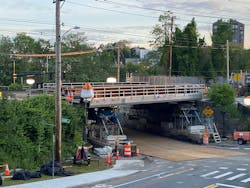
The MBTA West Route over South Elm Street Bridge project replaced a 120-year-old open deck rail crossing in Haverhill, Mass., using accelerated bridge construction (ABC) techniques, reinforced original abutments, and integrated upgrades to both rail and roadway infrastructure.
With a $14 million construction cost, the project delivered a modern, resilient rail bridge and improved local infrastructure while minimizing service disruptions and environmental impacts, placing the bridge as No.10 on Roads & Bridges 2025 Top 10 Bridge Awards.
The South Elm Street Bridge sees 36 passenger trains daily, including trains operated by the Massachusetts Bay Transportation Authority (MBTA) and Amtrak, as well as six to eight CSX freight trains. Under the bridge, there is significant two-way vehicular traffic.
The original bridge displayed signs of deterioration in its steel through-plate girders, floor beams and stringers, as well as miscellaneous steel components. Additionally, there were signs of collision damage in the knee braces, intermediate stiffeners, closure plates and the bottom flanges of the through-plate girders.
These findings led the MBTA to determine the bridge had reached the end of its useful life. It was not meeting current railroad operation requirements, therefore reducing speed limits on the bridge to 10 miles per hour.
The team opted for ABC techniques to reduce customer and traffic impacts to construct the new single-span steel through-plate girder bridge. They used prefabricated steel units for the superstructure and precast concrete units for the substructure and approach slabs. The steel components were partially assembled off-site, then transported to the construction site and finalized on temporary shoring supports next to their intended final location.
Using precast concrete components improved structural performance and minimized construction time, as well as environmental impact.
To move the pre-assembled steel superstructure from the staging area to its defined location, crews employed a Self-Propelled Modular Transporter (SPMT) for safe and efficient placement.
The structure’s original 1906 granite abutments were reused and reinforced instead of fully replacing them to preserve heritage while meeting modern load demands. The existing abutments were strengthened with the installation of a row of drilled micropiles through the granite and the installation of a row of tieback anchors.
Other bridge improvements include a new ballasted steel deck, increased horizontal clearance and spacing between tracks resulting in a smoother ride for train passengers and allowing for higher speeds.
The mandatory speed reduction was lifted with the bridge’s upgrade to a State of Good Repair, and the replacement resulted in an extension of the bridge’s lifespan by 75 years.
Not only did the project enhance the railroad bridge, but there were also a variety of streetscape improvements as well, including a complete pavement reconstruction of approximately 100 feet of roadway under the bridge with enhancements to improve surface water drainage and reduce pooling. The team additionally worked to install granite curb sidewalks, construct new concrete sidewalks, install new wheelchair ramps, place a precast concrete drainage structure, replace the existing catch basin frames and covers, as well as the application of new pavement markings.
The replacement serves as a model for accelerated rail bridge construction that balances operational continuity, structural innovation and community benefits.
Project Name: MBTA West Route over South Elm Street Bridge
Location: Haverhill, Mass.
Owner: MBTA
Designer: WSP USA
Contractor: MAS Building & Bridge, Inc.
Cost: $14 million
Length: 60 ft span; 827 ft track work
Completion Date: November 2025