No. 9 Bridge: A Safer, Smarter Gateway for Ohio’s Scenic Corridor
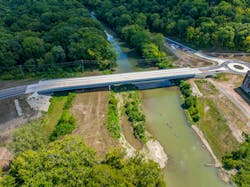
The replacement of the King Avenue/Grandin Road Bridge in South Lebanon, Ohio restores safe access to all vehicles, while improving regional connectivity, enhancing recreational opportunities and preserving the National Scenic River corridor.
The team’s dedication to environmental sensitivity, multimodal connectivity and structural innovation throughout the more than $22 million King Avenue/Grandin Road Bridge Replacement project gives it ninth place in our 2025 Roads & Bridges Top 10 Bridge Awards.
The original bridge was a six-span prestressed box-beam structure with sharp curves and steep grades along its approaches, including a 180-degree hairpin turn on King Avenue and a tight S-curve on Grandin Road. This made the road largely inaccessible to large vehicles, such as school buses and emergency vehicles.
The Warren County Engineer’s Office elected to relocate the bridge upstream on the Little Miami River to address it’s structural and geometric deficiencies while aligning with environmental priorities.
To eliminate hazardous curves and steep grades, the team needed to realign and raise the roadway which expanded access for larger vehicles, eliminated the at-grade trail crossing, and improved safety for all users.
The improved roadway has also supported economic growth in the area by providing a better connection to the redeveloped Peters Cartridge Factory, which now hosts apartments and a brewery. Additionally, tourism potential has expanded as the project now provides trailhead parking for the Little Miami Scenic Trail, increasing recreational access. A shared-use path was incorporated into the bridge’s structure, providing pedestrians and cyclists with a link to the neighboring trailway.
Some 2,500 vehicles travel along the roadway per day as it serves as a major connecter between Hamilton Township and the Interstate 71/State Route 741 interchange.
The bridge replacement was combined with utility upgrades, eliminating the need for separate projects and reducing long-term costs for the area. New water and sewer lines were incorporated directly into the bridge’s structure, minimizing the project’s environmental impact.
Environmental considerations were central to the project with the team electing to utilize a two-span steel girder design with drilled shafts and deep pile foundation to avoid placing piers in the water, reinforcing long-term stability in an area that is prone to floods. A precast arch structure was designed to separate the grade of the Little Miami Scenic Trail from road traffic to enhance safety for the trail’s users and maintain the natural character of the recreational space.
The 110-foot steel girders, each weighing 82,000 pounds, were fabricated off-site and delivered with specialized transport vehicles. The girders were placed over the Little Miami River using a 900-ton crane that was brought in from out of state. The crane’s capacity and reach were an integral part of placing the girders without causing disturbance to sensitive environmental features.
The team used a segmental casing method to drill 42-inch diameter concrete shafts for the bridge’s pier foundation. This method allows the team to maintain borehole stability in challenging soil conditions as they were able to install casing in segments as the drilling progressed.
The project needed to work around constantly evolving constraints such as the concurrent redevelopment of the Peters Cartridge Factory. As plans for the redevelopment changed, it required the reconfiguration of access points and rethinking the planned traffic circulation which led to the introduction of a roundabout that was not in the original plans.
The replacement of the King Avenue/Grandin Road Bridge serves as a model for integrated infrastructure to align with the goals and needs of the surrounding community — balancing mobility, environmental stewardship and community development.
Project Name: King Avenue/Grandin Road Bridge Replacement
Location: South Lebanon, Ohio
Owner: Warren County Engineer’s Office
Designer: Stantec Consulting Services Inc.
Contractor: Wood Environment & Infrastructure (FKA Amec Foster Wheeler; now WSP), Ohio Valley Archaeology, Inc., Eagle Bridge Co., and Prime AE Group
Cost: $22 million
Length: 2,400 feet
Completion Date: June 2024