No. 7 Bridge: Enhancing Structural Integrity of a 112-Year-Old Bridge
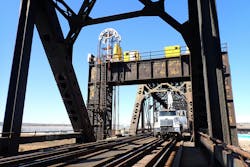
The $8.3 million KCT Railway Highline Lift Bridge Rehabilitation successfully modernized a 112-year-old railroad lift bridge in Kansas City, Kansas to complete necessary repairs and add flood resiliency measures while preserving its historic infrastructure.
The project restored full lifting capacity for all three spans of the bridge, ensuring compliance with updated flood standards to achieve uninterrupted freight movement across a critical rail corridor, putting it in seventh place for Roads & Bridges 2025 Top 10 Bridge Awards.
The vertical lift bridge required replacement of its outdated screw-jack system which had deteriorated to the point that only two of the bridge’s three spans could be lifted. The last full lift of the bridge is believed to not have occurred since 1991. The system was replaced with custom-engineered strand jacks that can lift each span independently or in unison.
Additionally, an assessment from the Army Corps of Engineers required the bridge to lift more than 17 feet — an increase of 10 feet from its original capacity — to meet flood protection standards. These measures protect the Kansas River levee system.
The team elected to adapt Enerpac strand jacks — typically used for temporary construction lifts — into a permanent solution to serve as a low-maintenance alternative to the original system which had long experienced mechanical failures. Each jack was custom fabricated in the Netherlands to withstand the project’s specific load and space constraints.
After careful analysis, the team found that the existing towers on the bridge were acceptable to support the new height and heavy-lift system with the removal of the original linking connections between the jacks and the span.
Modifications to the bridge’s existing towers were required to bear the heavy-duty lifting system. The towers were retrofitted using forged base plates and the team developed precision-machined connectors that could securely anchor the new system to the existing structures.
Completing this work with the existing structural constraints of a 112-year-old bridge proved to be a major engineering challenge that required detailed structural analysis, field verification and careful sequencing of construction activities.
Modifications needed to be completed without causing extended track closures on the route essential for freight in the Kansas City region. Ground cranes were used where possible to limit the number of on-track cranes that require more closures, disrupting train traffic.
A full test lift was completed within a single 24-hour track outage. GFT worked closely with the railroad to schedule modified signal system and the rerouting of train traffic. The bridge lift of 16.8 million pounds across three spans began at 8 a.m. and was lowered by 1:30 p.m. with traffic resuming by 8 p.m., far ahead of schedule.
The team’s reuse of forged base plates and commitment to retrofit the bridge’s existing towers contributed to a reduction of costs and the environmental impact of the project while extending the bridge’s functional life.
Rehabilitation of the 752-foot bridge was completed in five years, while significantly enhancing safety, regional mobility and structural integrity.
Project Name: KCT Railway Highline Lift Bridge Rehabilitation
Location: Kansas City, Kan.
Owner: Kansas City Terminal Railway Company
Designer: GFT
Contractor: L.G. Barcus and Sons, Inc.
Cost: $8.3 million
Length: 752 feet
Completion Date: March 2025