No. 6 Bridge: Pedestrian Overpass Connects Divided Neighborhoods
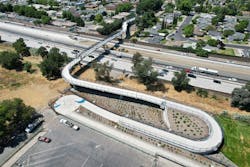
The $11.5 million Sycamore Trail Phase 2 – Pedestrian Overcrossing Bridge in West Sacramento, Calif., provides pedestrians and cyclists safe passage over US-50, connecting two historically divided neighborhoods.
The project’s commitment to ADA accessibility, multimodal connectivity and community-focused design give it sixth place in Roads & Bridges 2025 Top 10 Bridge Awards.
The bridge supports easier access in two disadvantaged neighborhoods that have been split for 70 years with the construction of US-50. The project eliminates dangerous crossings on auto-centric streets while bridging connections between Joey Lopes Park, Westmore Oaks Elementary School and West Sacramento High School. It serves as a critical link in the city’s Bicycle, Pedestrian & Trails Master Plan.
Completed in May 2025, the 1,950-foot-long bridge is outfitted with a compass plaza on its southern side, decorative fencing with custom metal silhouettes and landscaping reflecting the local identity of the area.
Sustainability was a major facet of the project. Native drought-tolerant vegetation — such as deer grass, flax and oleanders — was planted along the trail and within the overcrossing approaches. The plants were chosen for their resilience to air conditions, their value to the habitat and low-maintenance needs. Hydroseeding was conducted in several areas along the trail, using a seed mix specific to native plant life in West Sacramento. The plantings support reduced irrigation demand, improved water retention in the soil and enhances the area’s visual aesthetics.
LED pedestrian-scale lighting fixtures were selected for their low energy draw, reduced maintenance needs and increased lifespan, supporting the project’s commitment to energy efficiency.
Property constraints and utilities’ right of ways dictated the bridge’s size, forcing the design team to be creative with the overall look of the pedestrian bridge. On its southern side, it utilizes an S-shaped alignment to navigate around the utilities, and is outfitted with a Mechanically Stabilized Earth wall, a retaining wall mixing soil with layers of backfill to support slopes and soil retention. The northern section of the bridge is narrow to not conflict with the neighboring community gardens. The bridge hugs one side of the project limits and a bioretention and driveway occupy the other side. To create the S-shape, the bridge was constructed with three independent frames and two hinges.
Work was conducted simultaneously to the $300 million reconstruction of US-50, in which the bridge was fully situated in its project limits. This required coordination between multiple agencies to manage precise schedules. Construction was completed over eight lanes of active highway, where some 60,000 vehicles travel each day.
The team worked with the California Department of Transportation (Caltrans) to align closure windows, detour routes and public notification processes. Full nighttime closures of the highway were planned so workers could safely work on the bridge overhead.
The team innovatively used programs to assist in on-time completion such as Drone Deploy software and 360-degree site documentation to streamline communication and reduce project delays.
The Sycamore Trail Overcrossing is more than a bridge—it’s a lifeline that reconnects neighborhoods, promotes safe and equitable mobility, and reflects a commitment to sustainability and community identity. By overcoming complex design constraints and coordinating with a major highway reconstruction, the project delivers a lasting connection that will serve West Sacramento for generations.
Project Name: Sycamore Trail Phase 2 – Pedestrian Overcrossing Bridge
Location: West Sacramento, Calif.
Owner: City of West Sacramento
Designer: Dewberry Engineers
Contractor: Bridgeway Civil Contractors
Construction Manager: Consor
Cost: $11.5 million
Length: 1,950 feet
Completion Date: May 2025