No. 5 Bridge: Rehabilitating the Historic Brooklyn Bridge
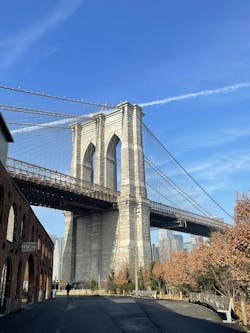
The $320 million historic rehabilitation of the iconic Brooklyn Bridge in New York City required precise coordination to balance modern engineering with historic preservation to upgrade the landmarked structure.
The project’s dedication to cultural integrity while improving the bridge’s structural safety and aesthetics for future generations put it as number five on our list for the 2025 Top 10 Bridge Awards.
The major restoration included structural improvements to the bridge’s approach arches, the removal and replacement of the brick infill walls, rehabilitation of arch interiors, foundation strengthening and floor repairs. Additionally, the project included conservation of the bridge’s masonry — granite, limestone and brick — and the restoration of two towers, two anchorages and eight approach arch blocks.
Rehabilitation included the cleaning of all masonry surfaces and new lighting at the main towers. Crews also installed public plazas at the Arch Blocks in Brooklyn and Manhattan, enhancing the bridge’s open space.
The Brooklyn Bridge sees 107,000 vehicles, 32,000 pedestrians and 4,000 cyclists each day traveling between Manhattan and Brooklyn, serving as a critical transportation link for commuters and visitors in New York City.
As a National Historic Landmark, Civil Engineering Landmark and listed on the UNESCO’s tentative World Heritage list, repairs needed to adhere to federal standards for historic properties. This required that original materials were salvaged and reused wherever possible and when new materials were necessary, they were sourced from original quarries and manufacturers to match 19th-century construction.
The team utilized jet grouting to stabilize the soil under the Manhattan approach arches to not disrupt the bridge’s operation during construction. To enhance seismic resilience while preserving the bridge’s iconic aesthetics, they installed reinforced concrete shear walls behind historic masonry facades.
The rehabilitation took six years and was completed in June 2025. During that time, crews sequenced work to limit lane closures over the highly trafficked bridge. A majority of lane closure were during nighttime travel periods.
The sheer size of the Brooklyn Bridge — with its main span totaling 1,600 feet and a full length of 6,000 feet when including the approaches — required considerable collaboration and planning for the multiple trades and scopes of work involved. The team operated swing stage scaffolding, boom and scissor lifts, pipe frame scaffolding and a barge in the East River at the Manhattan Tower. It's clearance from the waterway totals 135 feet and the masonry towers stand at 275 feet above the high-water line.
The design team remained involved following the design phase to address solutions that arose throughout construction.
The team worked hard to be considerate of the bridge’s many neighbors as some processes of the construction caused a significant amount of noise, residents and businesses were notified in advance of these disruptions as well as the specific work hours these activities were being conducted. Their hard work to prioritize transparency and keep the community in the loop eliminated the surprise factor that often leads to complaints and project delays.
The Brooklyn Bridge rehabilitation honors one of America’s most iconic landmarks while ensuring its strength and functionality for the next century. By blending modern engineering with meticulous historic preservation, the project safeguards a vital transportation link and cultural treasure—proving that innovation and heritage can coexist on the same span.
Project Name: Historic Rehabilitation of the Brooklyn Bridge
Location: New York City, N.Y.
Owner: NYC Department of Transportation
Designer: Parsons
Contractor(s): Parsons; Integrated Conservation Resources, Inc.; Jablonski Building Conservation Inc.; Atkinson-Noland & Associates; Greenman-Pedersen, Inc.; Joint Venture: Navillus-MLJ; Li Saltzman Architects PC; Pullman SST Inc.
Cost: $320 million
Length: 6,000 feet
Completion Date: June 2025