No. 4 Bridge: Rapid Repairs Restore a Lifeline in Colorado’s Rocky Mountains
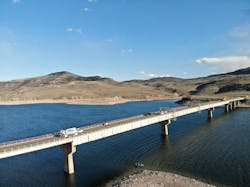
The US-50 Blue Mesa Bridge Emergency Repair was a six-month long, $134-million endeavor to repair a critical route over the Blue Mesa Reservoir while causing minimal disruption to local traffic in the remote area of Colorado, successfully extending the bridge’s lifespan by 30 years.
The team’s use of innovative crack mitigation, remote location logistics and rapid delivery while working under the scope of emergency response gives the Blue Mesa Middle Bridge fourth place in our 2025 Top 10 Bridge Awards.
The bridge’s remote location in the Rocky Mountains of western Colorado makes for relatively light vehicle traffic, recording only 2,800 vehicles per day in 2020 — 13 percent of which was truck traffic. However, the bridge’s closure would force drivers to take a 300-mile detour, therefore, the bridge is imperative for emergency services, tourism and regional mobility.
Following a Federal Highway Administration mandate to conduct non-destructive testing of fracture critical members composed of AASHTO M244 Grade 100 Steel (T1 Steel), inspectors discovered a 2.5-inch crack and a weld defect indication on the Blue Mesa Middle Bridge, as well as internal flaws within the weld. The findings led to a full and indefinite closure of the bridge.
Electing to repair the bridge to more quickly restore access, the team worked 24/7 for six months, designing and constructing the bridge concurrently to speed up the project. The nature of the project required close collaboration between all stakeholders to make decisions rapidly.
The 1,500-foot bridge utilizes a first-of-its kind “Plinko plate” crack arrest system using offset holes and overlay plates to prevent future weld failures. The strategy was modeled using advanced 3D simulation and finite element analysis to predict stress behavior and crack propagation.
The most complex facet of the project was the tie-in between the emergency repairs and the permanent plates. The team was unable to remove all the bolts at once as it would have made the bridge unstable, so they operated with a fastener swapping method. This required the team to temporarily position the new plates and replace each bolt one at a time to keep the bridge secure throughout the process.
As the repaired section was especially thick, they utilized high-strength threaded roads with a double-nut system to hold everything in place. Cheese plates — special spacer plates that match the thickness of a bolt head or a nut — were used to make the process easier, allowing the new plates to sit correctly while still giving crews access to remove and replace bolts individually.
The project’s initial fabrication and as-built conditions revealed a wide array of structural inconsistencies — including misaligned webs, skewed splice holes and wavy flanges, complicating fit-up and bolting. A mystery plate discovered during demolition required on-the-fly engineering analysis to gauge its purpose and impact.
Construction was challenging as it required work be performed directly over water, on which there were high winds and wildlife hazards. To ensure crew’s safety, the team employed ocean-rated rescue boats, staggered shift handoffs to avoid elk crossings and strict fatigue management.
Their efficient use of time and innovation allowed for the reopening of the Blue Mesa Middle Bridge on Nov. 28, 2024, six months following the launch of the project, setting a new standard for emergency bridge rehabilitation in remote, high-risk environments.
Project Name: US 50-Blue Mesa Bridge Emergency Repair
Location: Gunnison County, Colo.
Owner: Colorado Department of Transportation
Designer: Michael Baker International
Contractor: Kiewit
Cost: $121 million
Length: 1,500 feet
Completion Date: November 2024