No. 3 Bridge: A Green Gateway Over SR 520
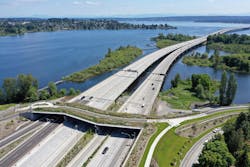
The SR 520 Montlake Lid and Bridges Project in Seattle, Washington replaced the West Approach Bridge South with a new 1.1-mile, 40-span elevated bridge complete with protections against seismic catastrophes and constructed a 3-acre landscaped lid over SR-520. The $455 million project reconnects the Montlake neighborhood, which was split into two during the construction of SR 520 in the 1960s.
As one of the final projects in the overall SR 520 HOV and Bridge Replacement Program, the Montlake project completes one of the most complicated sections of the 520 corridor,” said Ron Paananen, HDR’s Vice President and Senior Program Manager. “It has created new local connections in a community that was split by the original highway construction.”
The project’s use of green space, focus on environmental-sustainability, innovativeness and seismic resiliency give it third place in this year’s Roads & Bridges Top 10 Bridge Awards.
The new West Approach Bridge South provides motorists with a vital connection across Union Bay, linking Seattle to the floating bridge and Eastside communities.
As the bridge serves as an essential evacuation route during earthquake events, it was imperative for it to incorporate seismic resiliency measures and is outfitted with 93 seismic isolation bearings and 80 new solid columns. These measures allow the bridge to remain operational in the event of a 1,000-year earthquake. The new bridge’s base isolation and stronger foundation required a lesser number of piers placed in the water and utilize longer prestressed girders.
Crews were forced to adapt to a restrictive in water work schedule when constructing the bridge, which only allowed small windows of time for construction activities to occur in Lake Washington, a crucial habitat for a diverse range of animals and fish. During the time frames that in-water work was permitted, crews needed to complete the installation of temporary shoring, construction of the new bridge and the demolition of the old structure.
To work efficiently around these restrictions, the team manufactured precast components of the bridge off-site that were later transported to the site for assembly, significantly reducing the amount of necessary in-water work.
Not only does the new bridge accommodate the smoother flow of traffic with the addition of an HOV lane, but it also accommodates future light rail. The 3-acre lid, outfitted with pedestrian and bike paths, welcomes the return of bus access to the 520/Montlake Boulevard Interchange, which discontinued service in the area six years ago.
The lid covering SR 520 provides a full slate of benefits to the surrounding community, in addition to expanded green space. The accompanying land bridge for pedestrians and cyclists mirrors the Union Bay shoreline offering users scenic overlooks.
“There are now multiple crossings available to pedestrians and cyclists that enhance local safety and circulation. The transit center on the lid replaces the previous bus stop which as down on the highway in a very noisy environment,” Paananen said. “The project is truly a complete package of improvement for the region as well as the local community.”
Additionally, the lid reconnects the Arboretum and Lake Washington Boulevard, while reclaiming land for the Arboretum and integrating ethnobotanical plantings in coordination with Native American Tribes.
The project also led to the removal of the “ramps to nowhere” resulting from the canceled R.H. Thomson Expressway.
Construction of the bridge and lid occurred inside a heavily trafficked urban area, with 75,000 vehicles traveling on SR 520 during the weekdays, nearly 60,000 vehicles on Montlake Boulevard and over 10,000 on Lake Washington Boulevard.
Maintaining traffic flows throughout the construction phase was one of the project’s biggest challenges. A highway onramp was constructed directly from one of the local arterial streets, reducing the traffic burden on the main interchange and allowing users to completely circumvent the construction zone. Two lanes of traffic remained open in each direction on SR 520 throughout construction and Montlake Boulevard remained open with limited closures throughout the project.
The lid was constructed over an active highway and interchange and was built in three segments to maintain traffic flows over SR 520, 24th Avenue and Montlake Boulevard.
To be considerate of the tight-knit urban area, contractors utilized a sawcut and pick method to demolish the former bridge and the on-ramp to the Arboretum in order to eliminate vibration-generating activities associated with more traditional demolitions. The process required the installation of four nearly 70-foot-tall gantry cranes on temporary work bridges in Union Bay along the former bridge, which cut off large portions of the bridge that were loaded onto trucks and hauled away for processing and recycling off site.
The SR 520 Montlake Lid and Bridges projects set a new standard for urban highway design with its focus on multimodal mobility, beautification, sustainability and community restoration in concurrence with providing a crucial link to the area’s motorists.
Project Name: SR 520 Montlake Lid and Bridges
Location: Seattle, Wash.
Owner: Washington State Department of Transportation
Designer: TYLin International
Contractor: HDR (Program Manager), Graham Construction and Engineering
Cost: $455 million
Length: Bridge is 1.1 miles, Lid is 3 acres.
Completion Date: May 2025