No. 2 Bridge: Buck O’Neil’s Legacy Spans the Missouri
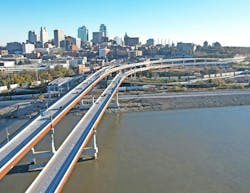
The Buck O’Neil Bridge Design-Build Project set out to replace the aging Broadway Bridge in Kansas City, Missouri with a modern, multimodal crossing that provides better connections to downtown Kansas City and surrounding transportation hubs.
The new bridge solves a variety of issues plaguing the area’s motorists, as it relieves congestion, improves airport access, supports freight and economic development and provides better connection to the Harlem neighborhood in Kansas City. Therefore, the Buck O’Neil Bridge takes home second place in Roads & Bridges 2025 Top 10 Bridge Awards.
“This recognition means a great deal to everyone who worked on the Buck O’Neil Bridge. It reflects the dedication of hundreds of people who believed in what this project could mean for Kansas City,” said Marc Whitmore, HNTB project manager. “MoDOT’s vision and collaboration with our partners resulted in a bridge that not only improves mobility and safety but also celebrates a community and a legacy.”
The $257 million project — launched on Feb. 4, 2021, and reopened for all directions of highway traffic on time and on budget on Dec. 1, 2024 — is one rooted in innovation, collaboration, community and technological advancements to construct a bridge that seamlessly integrated with the surrounding urban environment while enhancing mobility throughout the area.
Restrictions associated with the railroad and the nearby airport eliminated the use of bridge structures such as cable-stayed bridge and tied-arch bridge designs, therefore leading the team to elect for twin steel plate girder bridges — one heading southbound and the other heading northbound.
The former bridge, constructed in 1956, was a north-south, triple-arch steel truss structure that carried U.S. 169 — a pivotal connection over the Missouri River into downtown Kansas City.
In addition to improving traffic along U.S. 169, the new Buck O’Neil Bridge eliminates a major congestion point in downtown Kansas City by providing connection to Interstate 35 with the addition of two flyover bridges that allow through traffic to bypass the downtown area.
To provide access to the new airport, the design team opted for a left-hand exit from the bridge to not conflict with the BNSF Railway.
The new bridge is outfitted with wider lanes, safer shoulders and an upgraded bike and pedestrian path that is ADA-compliant. Pedestrians and bicyclists can enjoy views of the Kansas City skyline from the path’s scenic overlooks.
To not impede travel for the bridge’s 50,000 daily commuters, the project was completed in four phases. In the first two phases, traffic continued on the old bridge as the new southbound span was constructed; and in phases three and four, northbound traffic was shifted onto the new southbound span, and southbound traffic was rerouted using existing routes.
“Communication was essential from day one. MoDOT, the City of Kansas City, HNTB and the Massman-Clarkson joint venture worked as one team to keep everyone aligned through every phase of design and construction,” Whitmore said. “That constant dialogue — built on trust and shared accountability — allowed us to deliver a complex river crossing safely, efficiently, and on schedule.”
Adapting to the fluctuating water levels in the Missouri River, which ranged from record-low levels to flooding, contractors employed four barge-mounted cranes, including a Manitowoc 7000 Ringer Crane — a rare, high-capacity lattice boom crane. The crane operates with a lifting capacity of up to 350 tons and its extended boom length and far reach, made it “instrumental in completing critical foundation and structural work along the riverbank where conventionally mounted equipment couldn’t reach.”
Boasting of a 100-year service life, the bridge was constructed with 7 million pounds of reinforcing steel, 21,000 cubic yards of concrete and 18 million pounds of structural steel with the materials and design selected to enhance the bridge’s durability, corrosion resistance, long-term performance and reduce the need for recurring maintenance.
Designers operated a community-oriented approach when designing the bridge which can be exhibited through its incorporation of public art. In collaboration with public artists, a 4,000 sq. ft. mural of baseball great John J. “Buck” O’ Neil is displayed on the bridge’s stabilized earth walls. Several pier surfaces and retaining walls were also designed to showcase public art.
The Buck O’Neil Bridge stands as a tribute to perseverance and vision—connecting Kansas City’s past to its future while ensuring safe, efficient travel for generations to come.
“The Buck O’Neil Bridge will stand as a game-changing investment in Kansas City’s infrastructure. MoDOT’s leadership delivered more than a new river crossing — it reconnected neighborhoods, opened access to economic opportunity and created a safe structure that people can take pride in,” Whitmore said. “From the shared-use path to the public art honoring Buck O’Neil, every element of this project reflects the character and spirit of Kansas City. Its legacy will be measured not just in how it moves traffic, but in how it brings people together and strengthens the heart of the city.”
Project Name: Buck O’Neil Bridge Design-Build Project
Location: Kansas City, Mo.
Owner: Missouri Department of Transportation and City of Kansas City, Missouri
Designer: HNTB
Contractor: Massman-Clarkson, A Joint Venture
Cost: $257 million
Length: 3 miles
Completion Date: December 2024