How Tampa Uses Data to Plan Traffic and Road Construction
Key Highlights
-
Tampa drivers spend about four and a half hours each day in traffic, adding up to roughly 40 days a year stuck in congestion.
-
Planners use traffic data from sensors, cameras, and rubber tubes to identify problem areas, forecast future needs, and prioritize projects like the $227 million I-4/I-275interchange redesign.
-
Fatal crashes in Tampa remain slightly above the U.S. average, which means more funding, planning, and community involvement are needed to keep roads safe.
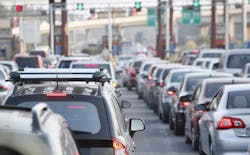
Most drivers don’t give much thought to how a road came to be. But behind every lane closure, traffic backup or construction zone is a long chain of decisions shared among local, county and state agencies.
Those decisions are driven largely by data that transportation planners use to understand where congestion is happening and to anticipate future problems, according to WUSF Rush Family Radio.
At the Hillsborough Transportation Planning Organization, planners’ study countywide traffic trends using a mix of technology and fieldwork. On their screens, color-coded maps illustrate how vehicles move through the region each day.
The goal, officials say, is to take massive amounts of raw information and narrow it down to specific problem areas that can realistically be addressed.
“Maybe there’s a perception that projects just get picked out of nowhere,” Elizabeth Watkins, executive planner with the Hillsborough Transportation Planning Organization, told WUSF Rush Family Radio. “But there is a lot of analysis and hard work that goes behind looking at the system-level data.”
That information is gathered in several ways. Traffic volumes are measured using roadway sensors, cameras and temporary devices placed directly on the pavement. Some methods are simple but effective. Rubber tubes stretched across the road record air pulses each time a vehicle passes, allowing planners to calculate traffic counts and patterns.
This data is crucial because Tampa drivers are spending more time in congestion each year.
A recent Consumer Affairs study ranked Tampa as the 13th-worst city in the U.S. for traffic, showing that congestion has gotten worse in recent years. Drivers now spend about four and a half hours each day stuck in traffic, nearly two hours more than last year.
Over the course of a year, that adds up to roughly 40 days spent sitting in gridlock. The study also found that fatal crashes in Tampa are still slightly higher than the national average, showing that while planners’ efforts are helping, traffic problems remain a challenge.
According to Watkins, the data collected through these methods helps planners move from “really conceptual, large-scale data” to identifying specific transportation problems.
Combined with other tools, the data helps forecast how population growth and land-use changes could affect the transportation network decades from now.
“We’re looking out to 2050,” Watkins told the radio station, adding that planners consider population trends, land use and public input when evaluating long-term transportation needs.
Those projections reveal a growing challenge: funding doesn’t always keep pace with demand. While long-term studies show tens of billions of dollars in transportation needs through mid-century, only a fraction of that amount is expected to be available.
“We did an analysis, and we found that between 2030 and 2050 there were about $47 billion worth of needs, but only $18 billion we expect to receive,” Watkins told the radio station.
As a result, agencies prioritize locations where improvements can have the greatest impact on safety and mobility.
One of those locations is the heavily traveled interchange where I-4 meets I-275 in downtown Tampa, a corridor long known for crashes and congestion.
The Florida Department of Transportation is investing $227 million to redesign the area, a process that requires careful coordination with local governments, nearby neighborhoods and businesses.
The project should wrap up by early 2027.
Source: WUSF