Seeing What the Operator Can’t
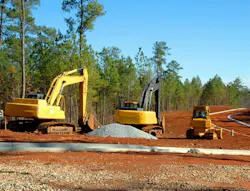
In an active construction work zone, the most dangerous space is often the one the operator can’t see. Cabs can have blind spots, and experience doesn’t always remove them. The consequences show up in the fatality data. Struck-by incidents remain one of the Occupational Safety and Health Administration’s (OSHA) “Focus Four” construction hazards, and heavy equipment is involved in most struck-by deaths.
The technology to close that gap has matured quickly. Camera-based machine vision can now recognize a worker crouched behind a loader or lying near a track. Many of these systems can also be bolted onto equipment that is decades old. The harder questions come after detection. Should the system issue a warning or stop the machine? Who is responsible for that decision? And how do contractors turn a stream of near-miss data into safer site layouts instead of another monthly report nobody reads?
Nathan McKenzie has spent more than 20 years working on those questions. He joined Speedshield Technologies as an engineer in 2003, later served as engineering manager and CTO, and helped develop one of the industry’s first forklift-specific telemetry platforms. He is now the company’s CEO. Roads & Bridges spoke with him through email about what machine vision can detect, how to retrofit mixed fleets, how close automatic intervention really is and which safety data contractors should be watching.
This interview has been edited for length and clarity.
R&B: Construction sites are constantly changing, with workers, trucks and heavy equipment sharing space. What can today's machine-vision and collision-avoidance systems actually detect that an equipment operator cannot—and how can that technology reduce struck-by incidents on active jobsites?
NM: OSHA estimates about 75% of struck-by fatalities in construction involve heavy equipment like trucks or cranes, and powered vehicles account for a large share of construction deaths overall. The problem isn't operator skill, however. A cab has fixed sightlines – counterweights, dump bodies, booms, and loads create blind spots that no amount of experience can eliminate.
Modular technologies such as AiVA can be retrofitted to fleet vehicles, supplementing single-vantage point vision with continuous monitoring to deliver all-round coverage. Four or more cameras build a 360-degree bird's-eye view, using 3D imaging to identify pedestrians at up to 12 meters/40 feet, including many postures that a human eye or basic sensor technologies miss, such as bodies that are crouched or prone. Solutions like [retrofit vision systems] are best used as an added layer of awareness, improving what the operator and the machine can see and react to, without replacing the machine's own safeguards. The alerting method reflects this with a graded response: yellow indicators at 5 meters/16 feet, escalating to red and audio inside 3 meters/about 10 feet.
R&B: Many contractors operate mixed fleets that include both new and decades-old equipment. What does it take to retrofit older loaders, excavators, forklifts and other machines with modern safety technology, and where do you see the biggest opportunities for contractors to improve safety without replacing their fleets?
NM: Asset owners I’ve encountered often assume collision-avoidance is a new-equipment feature, so they leave their older machines unprotected because they don’t have the budget to upgrade their entire fleets. But that’s not necessary. [The system can be] designed and built for the aftermarket, bolting cameras and an indicator onto the machine rather than requiring factory electronics integration. A retrofit vision system sits above the machine's existing engineering controls rather than inside them, and as such, it doesn't require redesigning or re-engineering the machine's original safety systems to add another layer of safety.
One mining customer described the system as easily adaptable to safety interlocks already on their machines, adding controls that protect operators regardless of who's in the cab. Leaders might be wondering whether they can afford to replace the oldest 20% of their fleet, but the real value is delivering a standardized detection layer across old and new machines alike at a fraction of the cost.
R&B: There is a growing push to use technology not just to warn operators but to automatically slow or stop equipment when a dangerous situation is detected. How close are we to making that kind of machine intervention commonplace on construction sites, and what are the biggest technical or operational challenges that still need to be solved?
NM: Closer than most assume, but with a real caveat, and it comes down to where responsibility sits. AiVA already supports automatic slowdown when a pedestrian is detected in a danger area, but the qualifier attached to nearly every installation, "subject to OEM integration and vehicle compatibility," is significant. AiVA is a detection and information system. It hands off a signal, and the physical act of intervention is executed by the machine's own safety-rated control system. That responsibility sits with the original machine's design, not with a bolt-on sensor layer.
Other technical challenges include environmental conditions such as glare, rain, fog, dust, and lens contamination, which can reduce detection accuracy, which matters more once detection feeds a slowdown. Fault detection at the sensor helps to mitigate this and provide intentional fail safes.
Warning/alerting is already mature and common. Automatic intervention is moving toward wider rollout, but it scales only as fast as OEMs open interfaces for third-party detection systems to integrate to. Continued collaboration to expand the sensor / machine actions possible will help close this gap.
R&B: Contractors increasingly have access to data from connected equipment, but collecting data is different from actually preventing accidents. What are the most valuable safety metrics or patterns contractors should be looking for, and how can they turn that information into changes in jobsite operations?
NM: Most companies already have telemetry. What they lack is the behavioral and operational change needed to make it useful. Data like near-miss frequency is valuable, but location and context matter just as much, because if repeated pedestrian detections occur in one particular loading zone or during a particular shift change, it can reveal deeper problems to do with traffic flow, scheduling, visibility, or the way a task has been organized.
Contractors should also look for recurring operator-level patterns, while being careful not to assume the operator is automatically at fault. Repeated events could point to fatigue or unfamiliarity with a machine, but they could just as easily reveal an unworkable operating environment. Video linked to each event provides that missing context. It turns a point on a dashboard into something supervisors and crews can review together and use for coaching, site redesign, or changes to working practices.
Of course, some of the most consequential moments happen immediately between operators and pedestrians. Everyone’s internal tape measure is different, but a detection system’s isn’t. When it consistently identifies that somebody has crossed a defined threshold, both people gain a clearer understanding of what “too close” actually means. The value of the data is therefore not the size of the monthly report, but in how quickly the contractor can identify a recurring risk, understand why it’s happening, and make an adjustment before a near miss becomes an accident.
About the Author
 Gavin Jenkins, Head of Content
Gavin Jenkins, Head of Content
Head of Content
Gavin Jenkins is an award-winning journalist based in Pittsburgh. His work has appeared in The New York Times, The Washington Post, The Atlantic, VICE, Narrative.ly, Prevention, the Pittsburgh Tribune-Review and Beijing Review.
In 2020, two stories he wrote for Pitt Med Magazine earned three Golden Quill Awards from the Press Club of Western Pennsylvania. “Surviving Survival” won Excellence in Corporate, Marketing and Promotional Communications – Written, Medical/Health, while “Oct. 27, 2018: Pittsburgh’s Darkest Day, and the Mass Casualty Response” won Excellence in Written Journalism, Magazines – Medical/Health, as well as the Ray Sprigle Memorial Award: Magazines, a Best in Show award.
After graduating from the University of Pittsburgh at Johnstown in 2003, he covered sports for the Bedford Gazette, in Bedford, Pa., and the Martinsville Bulletin, in Martinsville, Va. In 2006, he returned to Pittsburgh to write for Trib Total Media. Based out of the Kittanning Leader Times, he worked for the Trib for two years, and then he moved to Shenzhen, China, to teach English and freelance. After two years in China, he earned an MFA in nonfiction from the University of Pittsburgh.
When he's not at work, he's usually playing with his border-collie mix, Bob.